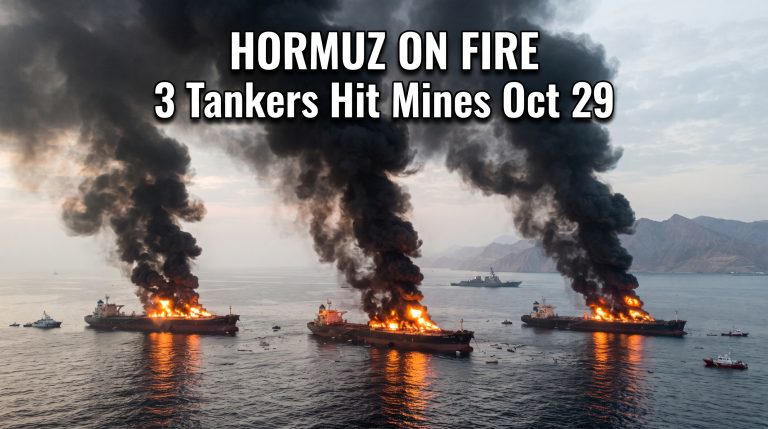
US strikes Iran Qeshm Island operations escalated late Thursday, October 29, 2026, as American forces struck two high-value Iranian military positions: an Islamic Revolutionary Guard Corps (IRGC) anti-ship missile launcher on Qeshm Island and the Iranian Navy’s Jask Naval Base in Bandar-e-Jask. According to defense and OSINT reporting compiled by WarBrief, the strikes hit between 8:37 PM and 9:08 PM ET just as United States Central Command (CENTCOM) commander Admiral Brad Cooper briefed the White House on potential post-midterm military options. Hours later, early Friday trading pushed Brent crude futures past $115.74 a barrel via ET Now, while the U.S. Treasury tightened its financial dragnet against maritime shippers paying transit fees to cross the Strait of Hormuz.
I use research tools daily to track military and economic dispatches like this one, then go back through the primary agency filings, maritime trackers, and wire reports myself before writing. When you sit with the hard numbers coming out of the Persian Gulf this morning, a clear picture emerges. We are not merely watching isolated tit-for-tat skirmishes on a radar screen. We are watching the simultaneous convergence of energy warfare, digital financial surveillance, and the exact Middle Eastern fault lines described in the Old and New Testaments. For full context on how these maritime flashpoints fit together, see our foundational analysis on the global oil crisis 2026 Strait of Hormuz Red Sea and our pillar study on the 2026 Iran war Ezekiel 38 Hormuz blockade.
Four Missiles at Bandar-e-Jask and the Qeshm Island Pincer
To understand why Thursday night’s US strikes Iran Qeshm Island and Bandar-e-Jask matter so much to military planners, we have to look at a map of southern Iran. Qeshm Island is the largest island in the Persian Gulf, sitting right inside the narrow throat of the Strait of Hormuz. If you want to threaten commercial tankers inside the bottleneck with coastal anti-ship batteries, Qeshm is where you park your launchers.
According to a CENTCOM official cited in the WarBrief October 29 operational assessment, the Qeshm Island site was an active IRGC launcher area that American reconnaissance had been watching closely over the past week, prepared to act defensively after repeated missile launches toward coalition vessels. Qeshm Governor Hossein Amir Teymouri told regional media that ten to eleven projectiles exclusively targeted military installations on the island, with no civilian casualties reported, continuing a pattern of maritime friction documented by Iran International and Anadolu Agency.
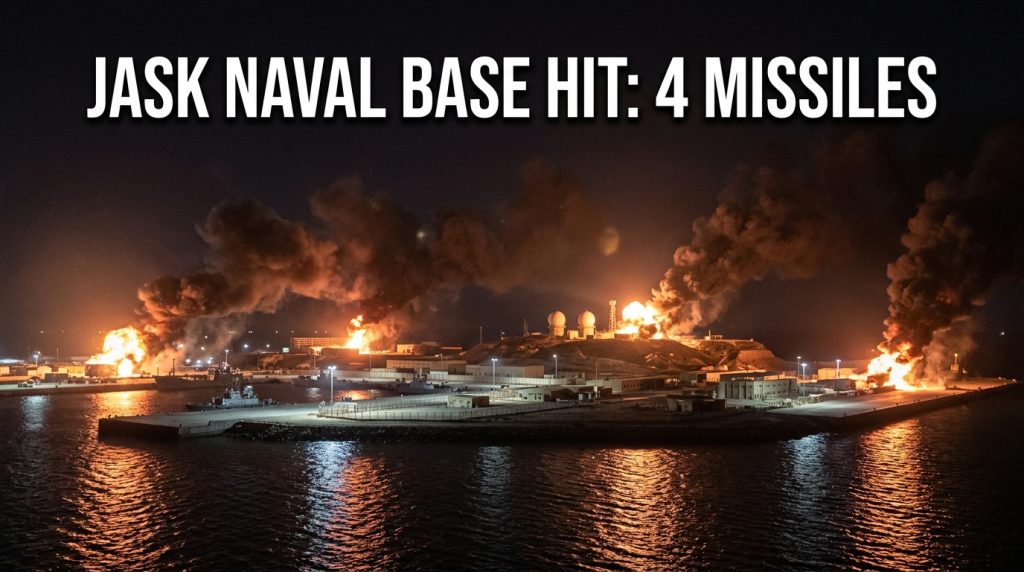
Then look east, outside the Strait of Hormuz, to Bandar-e-Jask on the Gulf of Oman. Preliminary regional reports indicate four missiles struck the Jask Naval Base, alongside reported blasts near the Sirik Naval Base and coastal air defense batteries near Bandar Abbas. Why hit Qeshm and Jask in the exact same thirty-minute window? Because Tehran spent years building the Jask naval facility and the Goreh-Jask crude export terminal specifically to bypass the Strait of Hormuz—so Iran could theoretically lock the front door at Qeshm while slipping its own naval assets and oil tankers out the back door at Jask.
By striking the Qeshm Island missile launcher and the Jask Naval Base simultaneously, U.S. forces hit Iran’s ability to close the strait and its ability to bypass the strait at the same time. At the same time, we want to keep our feet firmly on verified ground. While the IRGC claimed on Friday morning that three or four commercial tankers struck mines in the Strait of Hormuz, the Associated Press and Al Jazeera’s live maritime desk noted that those mine claims have not been independently verified. What is verified by UK Maritime Trade Operations (UKMTO) is that one commercial tanker near Khasab was struck by an unidentified projectile on October 29, fortunately with no crew injuries. Even without confirmed minefields, the shipping lane is functionally strangled—and Pentagon data obtained by Reuters now places the U.S. military cost of the 2026 Iran conflict at more than $47 billion.
Brent Crude Hits $115.74 After Ras Tanura and Abqaiq Barrages
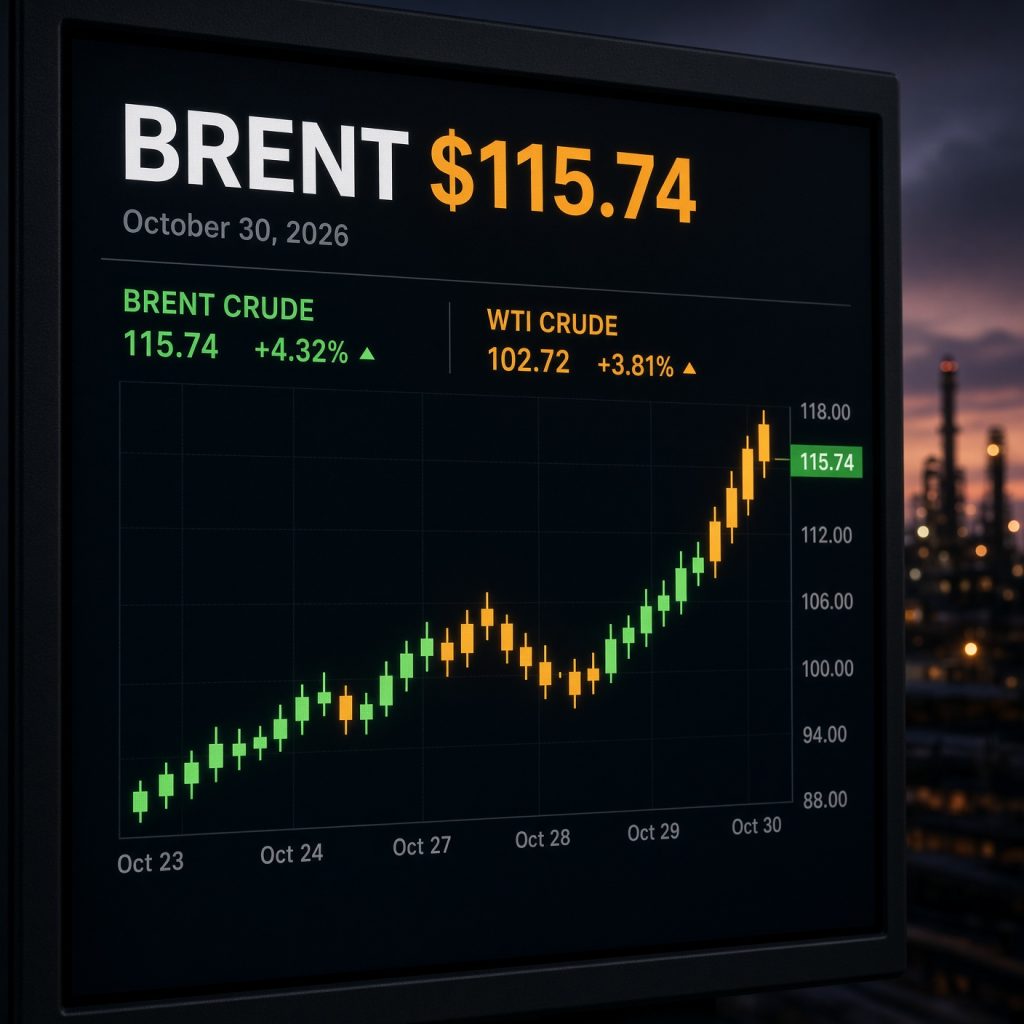
The kinetic strikes along the Qeshm-Jask corridor did not happen in a vacuum. Hours after the coastal explosions, global energy markets jolted upward. According to ET Now and the Qatar News Agency, Brent crude futures climbed 86 cents, or 0.75 percent, to trade at $115.74 a barrel as of 0122 GMT on Friday, October 30, briefly touching $116.10 in intraday action. U.S. West Texas Intermediate (WTI) crude futures rose 72 cents to $102.72 a barrel.
The numbers are worth sitting with for a moment. Both global benchmarks are now locked on track for a fourth consecutive monthly gain—the steepest sustained climb since July—after Yemen’s Iran-aligned Houthis intensified drone and ballistic missile attacks against Saudi Arabian energy infrastructure on Thursday, while Saudi coalition air defenses intercepted a Houthi drone over the Mecca region on Friday morning per Al Jazeera and market coverage in the Times of India. When missiles fly at Qeshm Island on the northern shore of the Gulf and Houthi drones target Saudi oil facilities on the southern shore, the world’s most important energy artery catches fire from both sides.
Hormuz Transit Tolls, BitBank Sanctions, and the Architecture of Revelation 13
Here is where the story shifts from conventional naval warfare into something that should make every serious student of Scripture sit up and pay attention. Alongside the military strikes, Washington is waging a high-tech economic war over who gets to buy, sell, and move cargo through international waters.
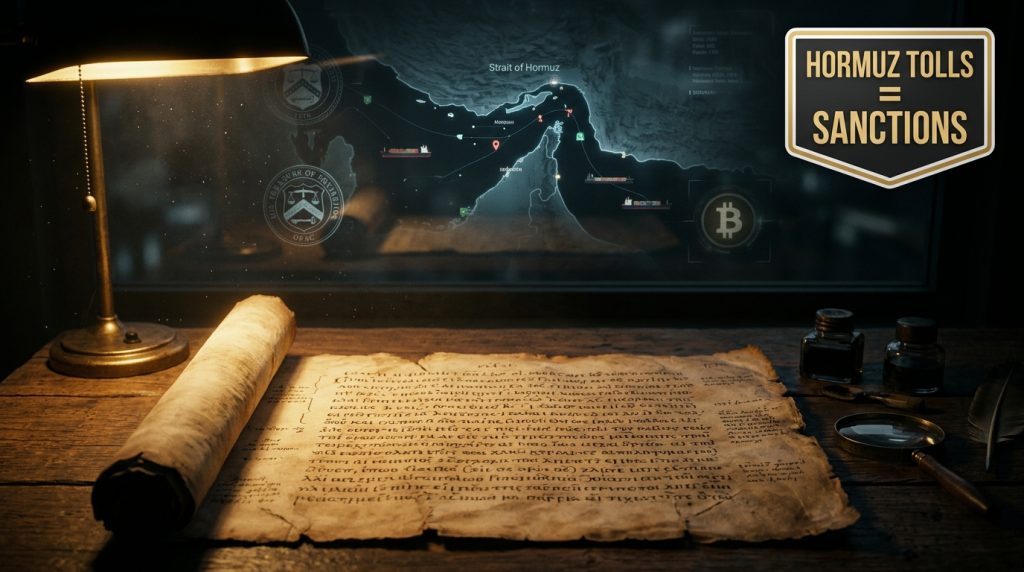
Since early May 2026, Tehran has operated an entity called the Persian Gulf Strait Authority (PGSA), demanding that commercial vessels submit crew manifests, cargo disclosures, and “navigational service fees” of up to $2 million per voyage—on top of war-risk insurance premiums reaching $10 million per transit—just to pass through the Strait of Hormuz without being seized, as documented in the Straits.live Hormuz Toll Analysis. Because diverting a supertanker around Africa’s Cape of Good Hope adds two weeks and millions in fuel costs, some desperate operators quietly paid the extortion fee.
To shut that revenue pipeline down, the U.S. Treasury’s Office of Foreign Assets Control (OFAC) sanctioned the Persian Gulf Strait Authority under counterterrorism authority (Executive Order 13224), detailed by the Baltic Exchange, and issued sweeping advisories warning international shipowners, maritime insurers, and banks that paying Hormuz tolls in any form risks severe secondary sanctions. When Tehran tried to bypass the traditional dollar banking system by collecting tanker tolls in Bitcoin, digital assets, informal swaps, and even disguised “charitable donations” to the Iranian Red Crescent, Treasury launched Operation Economic Outcast. As documented by FinCrime Central and KuCoin’s regulatory desk, OFAC sanctioned the Tehran-based cryptocurrency exchange BitBank, its software developer, and associates of financier Babak Zanjani after discovering BitBank had moved hundreds of millions of dollars in Bitcoin to the IRGC to settle tanker tolls collected through the Hormuz Safe Marine Services Authority, followed this week by sanctions against three additional Iranian currency exchange firms.
Pause and think about the mechanism we are watching unfold. For nearly two thousand years, skeptics read the Apostle John’s prophecy in Revelation 13 and scoffed at the logistics:
“And that no man might buy or sell, save he that had the mark, or the name of the beast, or the number of his name.” — Revelation 13:17 (KJV)
How could any regime on earth monitor and block every commercial transaction, currency swap, and cargo shipment across the globe in real time? In the first century—or even fifty years ago—it was technologically impossible. Today, we are watching the exact financial and maritime control architecture operate in real time. Between Iran’s gated digital permit regime in the Strait of Hormuz and the U.S. Treasury’s ability to trace cross-border Bitcoin wallets, software developers, maritime insurance syndicates, and currency houses instantaneously, the global plumbing required to turn commerce on or off at the flip of a switch is no longer science fiction. And when you pair that with John’s vision in Revelation 18:11 and 18:17 (KJV) of “the merchants of the earth” weeping and mourning over Babylon because “no man buyeth their merchandise any more” and “every shipmaster, and all the company in ships, and sailors, and as many as trade by sea, stood afar off,” the sight of supertankers sitting anchored outside a burning strait reads like tomorrow’s newspaper arriving early.
The November 3 Midterm Window, Backchannel Diplomacy, and Ezekiel 38’s Hooks
Why did the US strikes Iran Qeshm Island happen on the night of October 29? The timing points straight to the calendar. As WarBrief and the Wall Street Journal noted, CENTCOM’s latest briefing to the White House comes just five days before the November 3, 2026 U.S. midterm elections, amid extensive reporting that Washington has told Middle Eastern allies to prepare for a potential “short, intense military campaign” against Iran once the domestic voting window closes.
Yet here is the fascinating dual-track tension: even as U.S. missiles struck Qeshm Island and Jask, diplomacy was running feverishly in the background. Qatari mediators handed Tehran a seven-day draft framework on Sunday to pause hostilities and reopen the Strait of Hormuz, and U.S. Vice President JD Vance sent a direct communication to senior Iranian security official Mohsen Rezaei exploring peace talks—even as President Trump publicly distanced himself from the outreach on October 29 per NDTV and Tehran insisted on seven preconditions before negotiations can advance.
Notice that rhythm. Diplomatic letters promising de-escalation in one hand; precision missile strikes and post-election war plans in the other. The Apostle Paul warned the early believers in 1 Thessalonians 5:3 (KJV): “For when they shall say, Peace and safety; then sudden destruction cometh upon them, as travail upon a woman with child; and they shall not escape.” We do not set dates here—no man knows the day or the hour—but we pay very close attention when peace frameworks and war preparations march down the hallway together.
Ezekiel 38 and the Qeshm-Jask Corridor
When we step back and view the US strikes Iran Qeshm Island through the lens of Old Testament prophecy, the geography of Persia (modern-day Iran) takes center stage. In Ezekiel 38, the prophet describes a massive end-times coalition led by Gog of the land of Magog, with “Persia, Ethiopia, and Libya with them; all of them with shield and helmet” (Ezekiel 38:5, KJV). Look at how God describes the catalyst that drags this coalition into the final conflict in the verse just before it:
“And I will turn thee back, and put hooks into thy jaws, and I will bring thee forth, and all thine army, horses and horsemen, all of them clothed with all sorts of armour, even a great company with bucklers and shields, all of them handling swords:” — Ezekiel 38:4 (KJV)
For generations, Bible teachers wondered what kind of geopolitical pressure could act as literal “hooks in the jaws,” pulling nations into an unavoidable military collision in the Middle East. Look at the Qeshm-Jask corridor today. When 20 percent of the world’s petroleum supply is held hostage at the mouth of the Persian Gulf, when Russian, Chinese, and Western economic lifelines are entangled in sanction waivers and dark-fleet tankers, and when every missile strike on Qeshm Island sends shockwaves from Tokyo to Wall Street, those hooks are visible in broad daylight. You can trace how this coalition has been forming piece by piece in our ongoing coverage of the 2026 Iran war Ezekiel 38 Hormuz blockade and missile strikes and escalating rumors of war.
Birth Pangs: Oil, Earthquakes, and the Roaring Sea
What makes this week’s news so compelling isn’t just one strike on an island in the Persian Gulf—it is the simultaneous convergence of multiple prophetic categories happening in real time across the globe. Jesus told His disciples in Luke 21:25 (KJV):
“And there shall be signs in the sun, and in the moon, and in the stars; and upon the earth distress of nations, with perplexity; the sea and the waves roaring;” — Luke 21:25 (KJV)
That Greek word translated “perplexity” (aporia) literally means “having no way out—at a complete loss for how to proceed.” That is an exact clinical description of world leaders staring at a 242-day Strait of Hormuz crisis where every military option risks $150 oil and every diplomatic option leaves the IRGC collecting extortion tolls. And as Paul wrote in Romans 8:22 (KJV), “we know that the whole creation groaneth and travaileth in pain together until now.” On the exact same day that Brent crude surged past $115.74 and missiles hit Qeshm and Jask, seismic monitors tracked significant tectonic unrest, from the M6.0 earthquake swarm in Vanuatu to tremors shaking Latin America.
Now, let’s keep our promise of strict intellectual honesty here: as the USGS regularly points out, the long-term baseline average of major (Magnitude 7.0+) earthquakes has held relatively steady around 18 to 19 per year since 1900. The biblical argument is not a raw statistical trick—it is about convergence and real-time global visibility. Never before in human history has a single generation watched Persian Gulf naval warfare, digital transaction blockades, extreme atmospheric anomalies, and global seismic swarms simultaneously on the palms of their hands. You can explore those parallel tracks in our pillar on 2026 global weather events birth pangs and our study on discerning the signs of the times. And if you are new here and wondering why we trust an ancient text to interpret modern geopolitics, start with our foundational apologetics archive on the biblical track record of fulfilled prophecy.
Four Critical Flashpoints to Watch After the Qeshm Strikes
The November 3 Post-Midterm Campaign Window: With only five days between the October 29 US strikes Iran Qeshm Island and the November 3 U.S. elections, watch whether Qatari mediators secure a response from Tehran on the seven-day draft deal—or whether CENTCOM’s briefed post-midterm military campaign transitions from planning to execution per WarBrief.
The $120 Brent Crude Threshold: With Brent sitting at $115.74 and WTI at $102.72 via ET Now, another Houthi strike on Saudi Aramco infrastructure or a confirmed mine impact inside the Strait of Hormuz could rapidly push crude past the psychological $120 mark, reigniting global inflation.
Operation Economic Outcast & Crypto Enforcement: Watch for expanded OFAC secondary sanctions against non-U.S. shipping insurers, banks, and decentralized crypto bridges following the designation of BitBank and the three Iranian currency exchange firms per FinCrime Central.
Day 242 on the Hormuz Maritime Tracker: According to the Straits.live transit tracker, today marks Day 242 since the February 28 Strait of Hormuz crisis began, with commercial traffic running below one-tenth of pre-crisis volume and one of the world’s largest container carriers halting transit entirely over the last 60 days—proving that an economic blockade does not require a physical chain across the water.
An Unshakable Kingdom While Qeshm Burns
If the talk of missile strikes in the Persian Gulf, $115 oil, and global financial tracking gives you a knot in your stomach, take a deep breath—grab a sandwich, step away from the news feed for a minute, and remember who sits on the throne. This stuff doesn’t trouble me at all, because I know who my King is.
Consider what the prophet Daniel declared to a pagan king who thought his earthly empire would last forever:
“And in the days of these kings shall the God of heaven set up a kingdom, which shall never be destroyed: and the kingdom shall not be left to other people, but it shall break in pieces and consume all these kingdoms, and it shall stand for ever.” — Daniel 2:44 (KJV)
While an IRGC missile launcher burns on Qeshm Island, while four missiles strike Jask Naval Base, and while central banks and treasuries build systems to police every dollar and Bitcoin crossing the water, our hope is anchored in a Savior whose supply never runs dry. As we watch the shadow of the seven-year Tribulation fall across the global stage, we hold firmly to the pre-tribulation promise that Christ will catch away His bride before the hour of God’s wrath falls upon the earth (1 Thessalonians 4:16–17; 1 Thessalonians 5:9; Revelation 3:10, KJV). Now, this is the reading I hold and make the case for; other faithful, serious students of Scripture read these same texts differently, and you should study it out for yourself like the Bereans (Acts 17:11; 2 Timothy 2:15, KJV) rather than simply take my word for it.
But on the most important question in the universe, there is no debate at all: when Jesus saw these exact birth pangs approaching, He didn’t tell His followers to panic or hoard supplies. He said: “And when these things begin to come to pass, then look up, and lift up your heads; for your redemption draweth nigh” (Luke 21:28, KJV).
If today’s shaking in the Middle East stirs something in your heart, good. That is the exact right response. Don’t wait another day to settle your eternity—discover the peace, forgiveness, and hope found in Jesus Christ today, and explore our full breakdown of the biblical signs of the end times 2026.
[Sign Up for the Convergence Report]
#StraitOfHormuz #QeshmIsland #BrentCrude
Sources
WarBrief Live — “US Strikes on Iran’s Naval Targets: What October 29 Changed (Qeshm Island & Jask Analysis)” (October 30, 2026) Read the source
ET Now — “Oil price today: Brent crude tops 115.74) as escalating Houthi attacks on Saudi Arabia raises further supply concerns” (October 30, 2026) Read the source
Qatar News Agency (QNA) — “Oil Prices Rise in Early Trading: Brent Crude Climbs to USD 115.74, WTI at USD 102.72” (October 30, 2026) Read the source
Al Jazeera Live Blog — “Iran war live: Saudi coalition says it downed Houthi drone in Mecca; Strait of Hormuz tanker alerts” (October 30, 2026) Read the source
Straits.live — “Strait of Hormuz Transit Fee: Iran’s Hormuz Toll & Persian Gulf Strait Authority Explained” (October 28, 2026) Read the source
FinCrime Central — “US Sanctions BitBank and Developer Over Alleged IRGC Crypto Transfers Under Operation Economic Outcast” (September 20, 2026) Read the source
KuCoin Regulatory Blog — “US Sanctions Iranian Crypto Exchange BitBank Over IRGC Bitcoin Transfers and Hormuz Payments” (September 21, 2026) Read the source
Baltic Exchange — “U.S. OFAC Sanctions Persian Gulf Strait Authority Pursuant to Executive Order 13224” (May 27, 2026) Read the source
Iran International — “Explosion heard near Iran’s Qeshm Island as US pressure targets Iranian oil revenue” (October 4, 2026) Read the source
Times of India — “Market & Crude Oil Benchmark Coverage: Brent Crude Above USD 115 Amid Middle East Tensions” (October 26–30, 2026) Read the source
Editor’s note — KJV final read: Revelation 13:17, Revelation 18:11, Revelation 18:17, 1 Thessalonians 5:3, Ezekiel 38:4, Ezekiel 38:5, Luke 21:25, Romans 8:22, Daniel 2:44, 1 Thessalonians 4:16-17, 1 Thessalonians 5:9, Revelation 3:10, Acts 17:11, 2 Timothy 2:15, Luke 21:28.