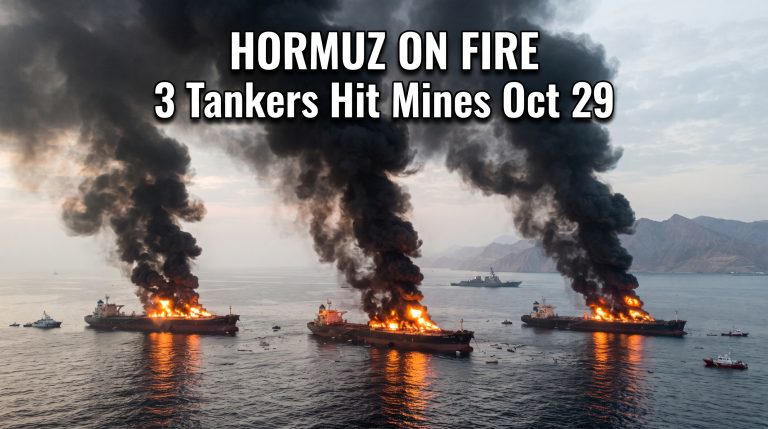
Strait of Hormuz attacks pushed past 30 commercial vessels in October 2026, setting the highest monthly total since the US-Iran war began on February 28, 2026, according to UK Maritime Trade Operations (UKMTO) data. The month closed on October 30 with a dramatic double flashpoint: the Royal Navy of Oman rescuing 25 sailors from the burning Panamanian-flagged crude oil tanker RITI just 1.6 nautical miles off the Musandam Peninsula, and unknown projectiles striking the Qatari-owned LNG carrier Al Mayeda 40 nautical miles south of Iran’s Lavan Island. While official logs now show 145 total maritime incidents since late February, shipping intelligence analysts estimate the true October count may be double the confirmed tally as commercial operators quietly absorb strikes to avoid catastrophic war-risk insurance spikes.
Oil futures are set to reopen Sunday evening at 6:00 p.m. Eastern after the expiring December Brent crude contract settled Friday at $117.64 a barrel, capping a 13.6% October surge and the highest settlement since late April. Even more telling than the headline price is the physical volume moving through the waterway. According to weekly tracking data cited by the Strait of Hormuz Tracker, vessel traffic remains roughly 70% below pre-war levels, logging just 277 total transits (155 inbound, 122 outbound) across the seven days ending October 28.
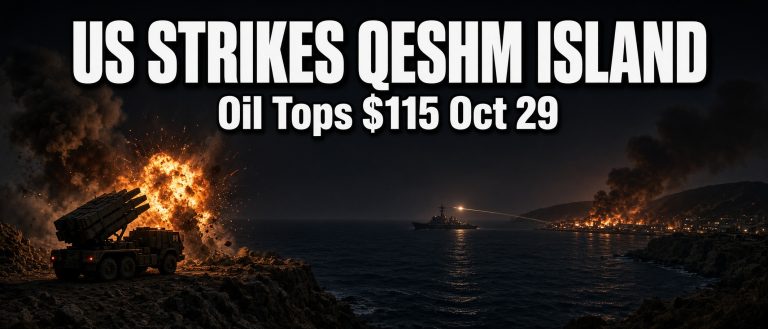
The numbers are worth sitting with for a moment. I use research tools daily to track dispatches like this one, then go back through the primary agency filings, maritime advisories, and wire reports myself before writing. When you line up the official British naval logs next to the corporate shipping disclosures out of Doha and Muscat, a clear pattern emerges. We are watching the world’s most critical energy corridor—a narrow maritime funnel that normally carries 20% of the planet’s petroleum and a massive share of its liquefied natural gas—get systematically squeezed by low-cost, asymmetric warfare right as global markets try to price in the next phase of the [global oil crisis in the Strait of Hormuz and Red Sea](https://samuelclark.com/global-oil-crisis-2026-strait-of-hormuz-red-sea/).
Oman Rescues 25 Sailors From Burning RITI While Qatari LNG Tanker Al Mayeda Takes Fire Off Lavan Island
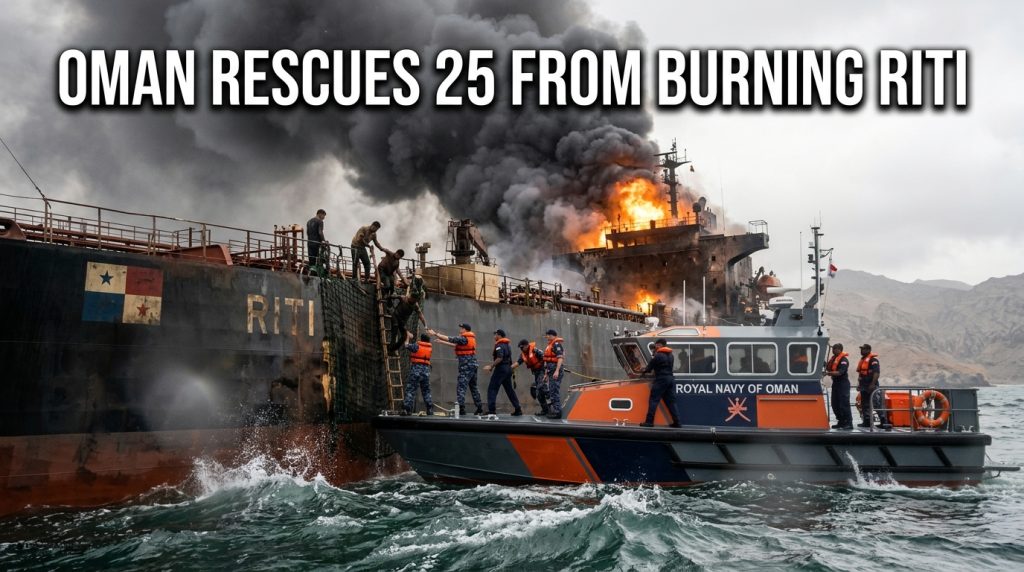
Two back-to-back maritime emergencies on Friday, October 30, 2026, illustrated just how quickly the threat envelope in the Gulf is widening. Up to this point in the conflict, commercial strikes had overwhelmingly targeted crude oil tankers and bulk carriers. Friday’s salvos proved that liquefied natural gas infrastructure and near-shore coastal waters off Oman are no longer insulated.
In the first major emergency, Oman’s Maritime Security Centre confirmed that the Royal Navy of Oman executed a high-stakes evacuation of all 25 crew members aboard the Panamanian-flagged merchant vessel RITI. The ship, identified by MarineTraffic tracking data as a crude oil tanker, was targeted and set ablaze just 1.6 nautical miles off the coast of Oman’s northern Musandam Governorate. Omani naval units pulled all 25 mariners from the burning tanker and transferred them ashore for medical care. The rescue unfolded on the very same day that US Central Command (CENTCOM) Commander Adm. Brad Cooper released a video statement asserting that US naval forces had cleared the strait’s primary international transit lanes of Iranian sea mines—a stark contrast to simultaneous Islamic Revolutionary Guard Corps (IRGC) claims that three oil tankers had been halted by explosions or mines in the corridor.
Hours later, the escalation reached the liquefied natural gas sector. Qatar Gas Transport Company, known globally as Nakilat—the world’s largest LNG shipping fleet operator—announced in an official corporate release that its Marshall Islands-flagged LNG carrier Al Mayeda (IMO 9397298) was struck by “unidentified objects” while transiting the Arabian Gulf on Friday evening. Parallel reporting from the Institute for the Study of War (Critical Threats) and UKMTO advisories placed an unknown projectile strike approximately 40 nautical miles south of Iran’s Lavan Island, sparking a localized deck fire aboard the vessel.
Wait and consider what could have happened had that projectile breached a primary cryogenic containment dome. Fortunately, India’s Union Minister for Ports, Shipping and Waterways, Sarbananda Sonowal, confirmed via The Economic Times that all 25 crew members aboard the Al Mayeda, including six Indian seafarers, were unharmed. Nakilat verified that there was no environmental release and that the LNG carrier remained afloat and operational while damage assessments continued.
Why October’s 30+ Confirmed Vessel Strikes Double September’s Pace and Mask Hidden Attacks
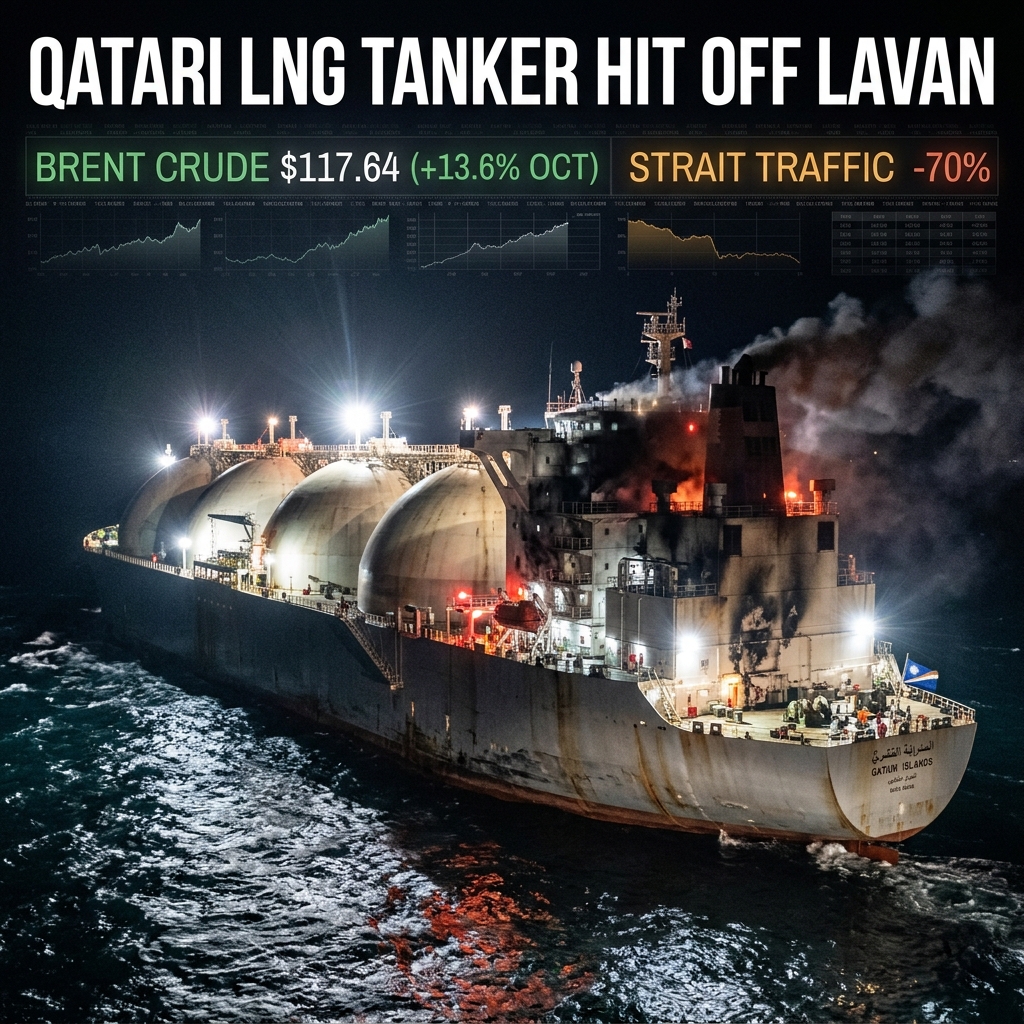
When UKMTO reported more than 30 commercial vessel incidents across the Strait of Hormuz, the Gulf of Oman, and the Arabian Gulf in October, it marked a decisive inflection point in the eight-month conflict. October’s tally more than doubled September’s incident rate and officially surpassed March 2026—the first full month of the war, which saw roughly 30 attacks—as the most violent month on the water since hostilities opened on February 28.
Different maritime monitoring desks track slightly different geographic boundaries and confirmation thresholds, which explains the spread across year-to-date tallies:
- UKMTO Official Logs: Over 30 confirmed commercial ship attacks in October, pushing cumulative conflict incidents since February 28 to 145 total reports across the wider Arabian Gulf and Gulf of Oman theater (with 88 logged directly inside the narrow Hormuz transit lanes).
- Washington Institute for Near East Policy: Tallied 28 confirmed kinetic strikes in the strait and immediate approaches during October, bringing their verified conflict database to 113 strikes since late February.
- Independent OSINT Trackers (GeoXAxis & PetroleumPrice): Logged up to 35 regional shipping strikes in October when including unflagged shadow-fleet vessels and near-miss drone detonations.
- The Underreporting Gap (ScanX Trade & Maritime Insurers): Industry trade analysts warn that the true October attack count likely sits between 60 and 100 incidents. Because war-risk insurance premiums for a single Gulf transit have skyrocketed into the hundreds of thousands of dollars, many independent shipowners and shadow-fleet operators are refusing to file formal UKMTO incident reports when projectiles cause minor shrapnel or superstructure damage that does not disable propulsion.
That reporting gap matters. When half of the hits in a combat zone go unlogged because vessel owners fear being priced out of the Lloyd’s of London insurance market, the public data represents a floor, not a ceiling. This is the exact economic pressure cooker we have been documenting inside our ongoing coverage of the [2026 Iran war and the Ezekiel 38 Hormuz blockade](https://samuelclark.com/2026-iran-war-ezekiel-38-hormuz-blockade/).
Limpet Mines on the Tanker Louise 1 Signal a Shift to Asymmetric Hull Sabotage
Beyond the sheer volume of October strikes, naval analysts are closely watching a tactical shift away from expensive ballistic missiles toward deniable, close-in hull sabotage. On October 29–30, roughly 25 nautical miles northeast of Khasab, Oman, a small fast-attack craft approached the Panamanian-flagged crude oil tanker Louise 1 and attached two limpet mines directly to its hull, according to maritime security reporting via Times Kuwait and IDN Financials.
The detonation caused an engine room fire and temporary propulsion failure aboard the Louise 1, which was carrying 27 Indian seafarers. Fortunately, the crew extinguished the blaze and safely restored enough power to clear the immediate danger zone without injuries or an oil spill. Crucially, UKMTO and regional security officials noted that this strike marked the first known successful use of limpet mines against a commercial tanker in the Strait of Hormuz since the US-Iran war began in February.
Interestingly, maritime records show the Louise 1 had previously been targeted by naval drones in the Black Sea due to its suspected role in Russia’s sanction-evading “shadow fleet.” Whether the Khasab limpet mine operation was executed by IRGC naval commandos enforcing Tehran’s transit toll regime or by a regional proxy unit, the operational takeaway is unmistakable. Just as we recently examined in our breakdown of [modern missile technology and wars and rumors of wars](https://samuelclark.com/russia-ukraine-war-kyiv-missile-strike/), cheap asymmetric weapons—magnetic hull mines, one-way surface drones, and unguided short-range projectiles—allow a combatant to paralyze global trade lanes at a fraction of the cost of conventional naval warfare.
Ezekiel 38, Persia’s Maritime Chokepoint, and the Roaring Seas of Luke 21
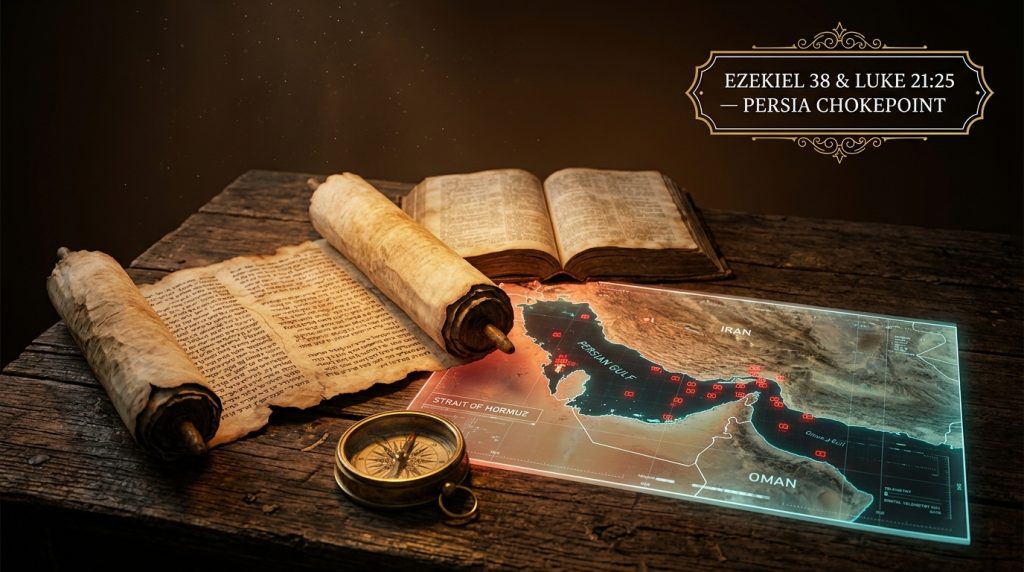
For those of us who watch world events through the lens of Scripture, the relentless battering of the Strait of Hormuz is not random geopolitical static. It is the staging ground of ancient prophecy playing out on modern satellite feeds.
Twenty-six hundred years ago, the prophet Ezekiel recorded a specific geopolitical alignment that would take center stage in the “latter years” and “latter days.” In Ezekiel 38, the sovereign Lord addresses a northern coalition led by Gog of the land of Magog, and the very first military partner named in that alliance is Persia—modern-day Iran:
“And I will turn thee back, and put hooks into thy jaws, and I will bring thee forth, and all thine army, horses and horsemen, all of them clothed with all sorts of armour, even a great company with bucklers and shields, all of them handling swords: Persia, Ethiopia, and Libya with them; all of them with shield and helmet:” (Ezekiel 38:4–5, KJV)
Notice the imagery God uses in verse 4: “put hooks into thy jaws, and I will bring thee forth.” In the ancient world, a hook in the jaw was used to compel a powerful beast to move in a direction that ultimately served a higher design. Today, Iran’s military grip over the Strait of Hormuz—and its deepening military-industrial partnership with Moscow, even as shadow-fleet tankers like the Louise 1 get caught in the crossfire—draws the world’s superpowers directly into the Middle Eastern vortex.
At the same time, look at what Jesus told His disciples in the Olivet Discourse when they asked for the signs preceding His return. In Luke 21, He connected physical commotion on the waters directly to the psychological paralysis of international leaders:
“And there shall be signs in the sun, and in the moon, and in the stars; and upon the earth distress of nations, with perplexity; the sea and the waves roaring; Men’s hearts failing them for fear, and for looking after those things which are coming on the earth: for the powers of heaven shall be shaken.” (Luke 21:25–26, KJV)
That English word “perplexity” in the King James text translates the Greek noun aporia, which literally means “having no way out” or standing at a dead-end crossroads with zero workable solutions. Pause and think about the mechanism we are watching unfold. If Western navies escalate strikes against Iranian coastal launch sites on Lavan Island or Qeshm, Tehran threatens to close the strait entirely and send Brent crude past $150. If Western forces hold back and merely escort convoys, small boats with limpet mines and short-range projectiles bleed commercial shipping at a rate of 30 to 60 hits a month, keeping transit volumes 70% below normal. The diplomats, central bankers, and admirals are staring at textbook aporia—distress of nations with no clean exit ramp.
And the biblical picture goes even deeper into the mechanics of global commerce. In Revelation 18, the Apostle John records a future lament over the sudden collapse of the end-times commercial system, and the focal point of that grief is maritime shipping:
“And every shipmaster, and all the company in ships, and sailors, and as many as trade by sea, stood afar off, And cried when they saw the smoke of her burning, saying, What city is like unto this great city!” (Revelation 18:17–18, KJV)
When you read reports of shipmasters holding their vessels outside the Gulf of Oman, watching columns of black smoke rise off Musandam and Lavan Island while maritime insurance underwriters ration coverage, you are seeing a real-time preview of how fragile global sea trade truly is. Every modern supply chain, energy grid, and digital financial ledger—the very architecture that Revelation 13:16–17 warns will eventually consolidate control over buying and selling—depends on uninterrupted maritime chokepoints. This convergence of energy fragility, military escalation, and economic bottlenecking is central to the biblical signs of the end times in 2026 that we track every week.
Now, as part of our commitment to honest biblical discernment, we always apply a sober reality check here. Historians will rightly point out that the Persian Gulf lived through the brutal “Tanker War” of 1984–1988 during the Iran-Iraq conflict, when hundreds of merchant vessels were attacked by both sides without triggering the immediate end of the age. In the same way that global earthquake data (where the USGS baseline averages 18 to 19 Magnitude 7.0+ quakes a year) requires us to distinguish routine historical cycles from true anomalies, a spike in tanker attacks is not a date-setting stopwatch. What makes October 2026 prophetically distinct is not maritime conflict in isolation—it is the simultaneous global convergence. In the 1980s, Persia was not locked into a strategic drone-and-missile alliance with a nuclear Russia in Ukraine, Israel was not fighting a multi-front existential war against Tehran’s direct axis, and global debt markets were not wired together by instantaneous algorithmic triggers. It is the convergence of all these scriptural birth pangs at once—just as Romans 8:22 describes the whole creation groaning and travailing in pain together—that commands our attention.
Four Market and Security Flashpoints to Watch as Oil Futures Reopen
As energy traders and maritime security directors digest October’s record-breaking UKMTO ledger, four immediate fault lines stand out for the weeks ahead:
- The Maritime Insurance and Underreporting Crisis: With intelligence desks estimating that 60 to 100 vessels may have suffered kinetic encounters in October compared to the 30+ formally logged with UKMTO, war-risk premiums are severely mispriced. If a single unreported hull strike results in a catastrophic sinking or environmental spill in the strait, maritime insurers could suspend coverage across the Persian Gulf overnight.
- Sunday’s Oil Futures Reopen and the $120 Brent Threshold: Following Friday’s expiration of the December Brent contract at $117.64 per barrel (up 2.4% on the day and 13.6% for October, with active January Brent at $113.43 and WTI at $104.12), Sunday evening’s 6:00 p.m. ET reopen will test whether traders price in a permanent conflict premium above $120 heading into winter heating demand.
- Contagion into the Global LNG Supply Chain: The projectile strike on Nakilat’s Al Mayeda crosses a major threshold. Qatar supplies roughly a fifth of the world’s liquefied natural gas, and every single drop of Qatari LNG must transit the Strait of Hormuz. If LNG carriers become routine targets alongside crude supertankers, European and Asian utility markets will face an immediate winter supply shock.
- Oman’s Growing Burden as the Gulf’s Rescue Lifeline: From evacuating 24 seafarers in June 2026 to pulling 25 crew members off the burning RITI just 1.6 nautical miles off Musandam on October 30, the Sultanate of Oman is bearing the frontline humanitarian cost of a war happening right on its territorial doorstep, even while diplomat channels whisper “peace and safety” (1 Thessalonians 5:3) behind closed doors.
An Unshakable Kingdom While the Strait of Hormuz Attacks Continue
If the talk of burning supertankers, magnetic hull mines, and $117 oil gives you a knot in your stomach, take a deep breath, grab a sandwich, and remember who sits on the throne. This stuff doesn’t trouble me at all, because I know who my King is.
When God gave the prophet Daniel a panoramic vision of the rise and fall of world empires—including the Medo-Persian empire and the final, fractured kingdoms of human history—He did not leave His people wondering how the story ends. Look at the promise anchored in Daniel 2:44:
“And in the days of these kings shall the God of heaven set up a kingdom, which shall never be destroyed: and the kingdom shall not be left to other people, but it shall break in pieces and consume all these kingdoms, and it shall stand for ever.” (Daniel 2:44, KJV)
Notice that phrase: “which shall never be destroyed.” Human empires fight over narrow strips of saltwater, ration insurance policies, and hurl projectiles at cargo ships in the dark. God’s kingdom cannot be blockaded, mined, or inflated away. And for those who belong to Jesus Christ, the convergence of these end-times signs is not a signal to panic—it is a reminder to look up. Jesus promised right after describing the roaring seas and the perplexity of nations:
“And when these things begin to come to pass, then look up, and lift up your heads; for your redemption draweth nigh.” (Luke 21:28, KJV)
In my own study of Scripture, I hold to the blessed hope of the pre-tribulation Rapture—that the Lord Himself will descend from heaven with a shout to catch away His bride (1 Thessalonians 4:16–17) before the final hour of global trial falls upon the earth, because “God hath not appointed us to wrath, but to obtain salvation by our Lord Jesus Christ” (1 Thessalonians 5:9; see also Revelation 3:10). At the same time, I recognize that other faithful, Bible-believing students of Scripture read the timing of these passages differently. Don’t take my word for it—open your Bible, test every teaching against the text like the noble Bereans in Acts 17:11, and study to show yourself approved unto God (2 Timothy 2:15). You can explore our full archive of fulfilled biblical prophecy and discernment resources to trace how every single word God has spoken in the past has come to pass with 100% precision.
If you are still weighing whether the Bible can be trusted in an age of geopolitical chaos, take ten minutes today to read through the hard historical and archaeological evidence that the Bible is true and examine every messianic prophecy Jesus fulfilled at His first coming. And if you have never anchored your life, your soul, and your eternity to the Savior who conquered death and holds the future in His hands, don’t wait for the next headline out of the Middle East. Find out how you can know for certain that you have peace with God through the saving gospel of Jesus Christ today.
#StraitOfHormuz #OmanRescue #LNGTanker #straitofhormuzattacks
Sources
- The National — “Attacks on ships transiting Hormuz in October highest since start of war” (October 31, 2026) Read the source
- Institute for the Study of War / Critical Threats — “Iran Update: October 31, 2026 (UKMTO Lavan Island & Hormuz Strike Data)” (October 31, 2026) Read the source
- Middle East Eye — “Oman evacuates crew of tanker RITI set ablaze near Hormuz” (October 30, 2026) Read the source
- Iran International — “Oman evacuates 25 crew from Panama-flagged vessel RITI after fire off Musandam” (October 30, 2026) Read the source
- Fana News / Qatar News Agency (QNA) — “Qatar Gas Transport Company (Nakilat) Announces One of its Vessels Attacked in Arabian Gulf” (November 1, 2026) Read the source
- The Economic Times — “Marshall Islands-flagged LNG carrier M/T AL MAYEDA with six Indians targeted in Persian Gulf attack; all crew safe” (October 31, 2026) Read the source
- Times Kuwait — “Indian crew safe after oil tanker Louise 1 attacked with limpet mines in Strait of Hormuz” (October 31, 2026) Read the source
- The Nation / Reuters — “Brent ends October up 13.6% at $117.64 as Iran war risks unsettle markets” (October 30, 2026) Read the source
- Alupetra Maritime — “Strait of Hormuz Tracker — Shipping, Attacks, Oil Flows and 277 Weekly Transits” (October 31, 2026) Read the source