Every Messianic Prophecy Jesus Fulfilled — and the Odds Against It
Five hundred years early, a prophet wrote down how the King would arrive: on a donkey. He did. That’s one of hundreds. Here’s the tour, and the arithmetic. We can not include every messianic prophecy Jesus fulfilled on this page as it would be the longest page on the internet! 🙂
I’ll start with the one that still gives me chills, because it’s my favorite in all of Scripture. Five centuries before it happened, the prophet Zechariah didn’t just say the King would come — he said how He’d travel.
“Rejoice greatly, O daughter of Zion; shout, O daughter of Jerusalem: behold, thy King cometh unto thee: he is just, and having salvation; lowly, and riding upon an ass, and upon a colt the foal of an ass” — Zechariah 9:9
A king — not on a war-horse, but on a borrowed donkey. It’s almost a contradiction: royalty arriving in the humblest way a man could travel. And on the day we call Palm Sunday, that is exactly how Jesus entered Jerusalem, recorded in Matthew 21 and John 12. He could have staged any entrance. He staged that one, down to the animal.
A Jewish carpenter from Nazareth matches a set of predictions written centuries before He was born — place, lineage, timing, betrayal, and death. The odds are staggering. So are the honest objections. We’ll face both.
Here’s a claim that ought to make any honest person sit up straight: the messianic prophecies Jesus fulfilled form a detailed, multi-layered fingerprint written centuries before He was born. Not a vague “someone special will come someday,” but birthplace, family line, forerunner, manner of arrival, price of betrayal, method of execution, unbroken bones, burial with the rich, and a tight chronological window that lands in the first century. And then one man shows up and matches every single line.
That’s not a small claim. Extraordinary claims get extraordinary scrutiny, and they should. So let’s do the work. We’ll look at what the Old Testament actually says in the KJV, check it against the historical record of Jesus of Nazareth, put real numbers on the probability, and then — because hiding the hard questions is the mark of a salesman, not a watchman — we’ll name the strongest objections and answer them on the merits.
This is not a list of three hundred obscure allusions. This is the clear, load-bearing messianic prophecies that even the most careful scholars on both sides have to wrestle with. And at the end of it, the only question left standing is the one that actually matters: what will you do with the Man who fits the fingerprint?
Judas 30 Pieces of Silver

The donkey doesn’t stand alone. Consider a few, each written centuries in advance:
- Bethlehem — Micah named the town while it was still “little among the thousands of Judah” (Micah 5:2). Jesus was born there.
- Pierced, and gambled over — the Psalmist wrote “they pierced my hands and my feet” and “they part my garments among them, and cast lots” (Psalm 22:16,18) — centuries before crucifixion was a Roman practice.
- Thirty pieces of silver — Zechariah set the betrayal price and its destination, “cast… to the potter” (Zechariah 11:12–13).
- Silent before His accusers — Isaiah: “he opened not his mouth” (Isaiah 53:7).
How many such prophecies are there? Scholars count differently — estimates run from about 300 up past 450, per reference works like J. Barton Payne’s Encyclopedia of Biblical Prophecy and others. I’ll use the conservative floor: over 300.
The Scope of the Claim — How Many Messianic Prophecy Jesus Fulfilled?
Scholars who have catalogued the data land in the same neighborhood. Alfred Edersheim identified 456 Old Testament verses referring to the Messiah or His times. J. Barton Payne found 574. Conservatively, most careful treatments settle on at least three hundred distinct prophecies and types that Jesus fulfilled in His first coming — direct predictions plus the patterns the New Testament itself treats as fulfilled.
We don’t need three hundred. Even a handful of the most precise ones already push the probability into the absurd. First, the actual texts.

Mathematician Peter Stoner famously estimated that the odds of one man fulfilling just eight of these by chance came to about 1 in 10¹⁷ — a one with seventeen zeroes. I’ll tell you plainly what that is and isn’t: it’s a striking illustration, not a laboratory proof, and honest people have questioned its assumptions. So don’t take it as a QED. Take it as a way to feel the size of the thing, then weigh the individual fulfillments yourself.
The Ones That Cannot Be Staged
Start with the birth. The prophet Micah, writing around 700 BC, names a tiny, almost forgotten village:
“But thou, Bethlehem Ephratah, though thou be little among the thousands of Judah, yet out of thee shall he come forth unto me that is to be ruler in Israel; whose goings forth have been from of old, from everlasting.” (Micah 5:2)
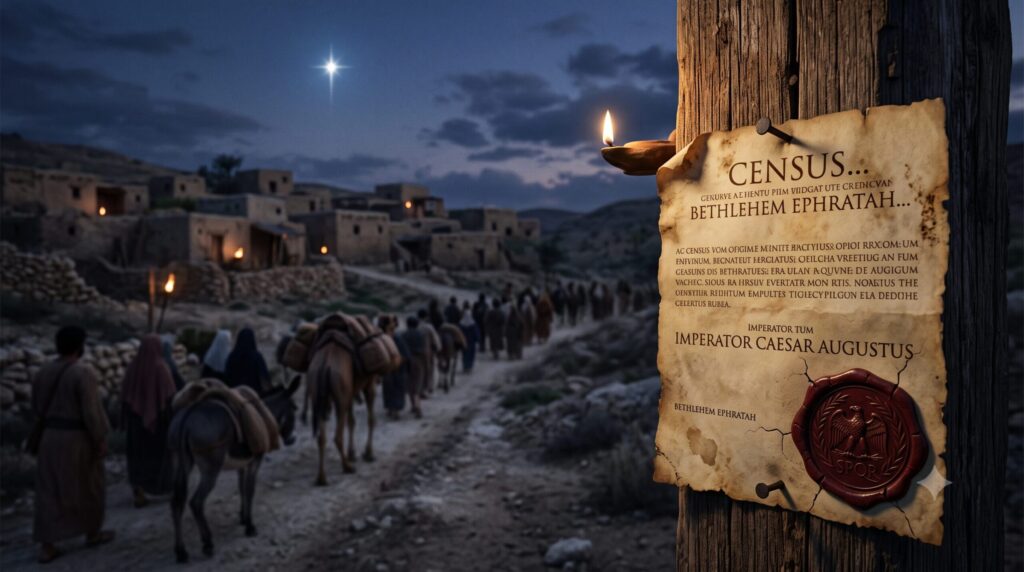
Not Jerusalem. Not a royal city. Bethlehem. The New Testament records that Jesus was born there because of a Roman census that forced Joseph and Mary to travel from Nazareth (Luke 2:1-7; Matthew 2:1-6). Herod’s own scholars confirmed the prophecy when the Magi arrived. A first-century Jew could not choose his birthplace. That detail was settled before He drew breath.
Then the manner of the birth. Isaiah, roughly the same era:
“Therefore the Lord himself shall give you a sign; Behold, a virgin shall conceive, and bear a son, and shall call his name Immanuel.” (Isaiah 7:14)
Matthew quotes it directly (Matthew 1:22-23). The Hebrew almah and the Greek Septuagint’s parthenos both carry the force of a young woman of marriageable age who has not known a man. The early church, the apostles, and the Jewish community that first heard the claim all understood the force of the sign. A virgin birth is not something a man can arrange for himself.
Lineage matters too. The Messiah had to come from the tribe of Judah (Genesis 49:10), the house of David (2 Samuel 7:12-16; Isaiah 11:1; Jeremiah 23:5). Both Matthew and Luke carefully preserve the genealogies. After the destruction of the Temple in AD 70, the official genealogical records were lost. No one after that generation could ever again prove Davidic descent. The window closed.
Then the public ministry. Isaiah 40:3 and Malachi 3:1 speak of a forerunner crying in the wilderness — John the Baptist. Isaiah 9:1-2 places the light of the Messiah’s early ministry in Galilee of the Gentiles. Zechariah 9:9 describes the King arriving not on a war horse but “lowly, and riding upon an ass, and upon a colt the foal of an ass.” Jesus did exactly that on Palm Sunday (Matthew 21:1-11).
The betrayal price is almost surgical. Zechariah 11:12-13: thirty pieces of silver, cast to the potter in the house of the Lord. Judas received thirty pieces of silver (Matthew 26:15). When he tried to return it, the priests used the money to buy the potter’s field (Matthew 27:3-10). The precision is uncomfortable for anyone who wants to call this coincidence.
And then the death. Psalm 22, written by David a thousand years before crucifixion was invented by the Persians and perfected by the Romans, describes the scene in first-person detail:
“My God, my God, why hast thou forsaken me? … All they that see me laugh me to scorn: they shoot out the lip, they shake the head, saying, He trusted on the LORD that he would deliver him… They pierced my hands and my feet… They part my garments among them, and cast lots upon my vesture.” (Psalm 22:1, 7-8, 16, 18)
Jesus quotes the opening line from the cross (Matthew 27:46). The soldiers gambled for His clothing (John 19:23-24). His hands and feet were pierced. Crucifixion had not even been invented when David wrote those words.

Isaiah 53 is the clearest portrait of all. The suffering servant is “despised and rejected of men,” “wounded for our transgressions,” “bruised for our iniquities,” “brought as a lamb to the slaughter,” “cut off out of the land of the living,” “made his grave with the wicked, and with the rich in his death,” and yet “he shall prolong his days” — language of resurrection. Louis Lapides, a Jewish seeker who set out to disprove the claim, was stopped cold reading it in a pure Jewish Bible. It sounded exactly like Jesus. (See Strobel’s interview with Lapides in The Case for Christ.)
Add the unbroken bones (Psalm 34:20; John 19:33-36), the burial with the rich (Isaiah 53:9), and the resurrection (Psalm 16:10; Acts 2:25-32), and the picture is complete.
The Timing That Seals It
One prophecy sits above the rest for sheer chronological force: Daniel’s seventy weeks. The angel Gabriel tells Daniel that from the commandment to restore and rebuild Jerusalem until Messiah the Prince would be sixty-nine sevens of years — 483 years. Using the decree of Artaxerxes in 445 BC and the prophetic 360-day year, the terminal point lands in the early first century AD, the exact window of Jesus’ public ministry and crucifixion. I have already laid out the full arithmetic and the honest late-dating objection in detail elsewhere. You can read it here: [LINK TO: Fulfilled Prophecy in Daniel]. A second-century forger could not have forced a Galilean carpenter to appear and die on schedule two hundred years later. That one alone breaks the “written after the fact” theory.
The Numbers — What Probability Actually Says
Mathematician Peter Stoner, working in the tradition of probability apologetics, calculated the odds of one man fulfilling just eight of the clearest independent messianic prophecies at one chance in 10^17. He pictured it as covering Texas two feet deep in silver dollars, marking one, and having a blindfolded man pick it on the first try. For forty-eight the number climbs past 10^157 — larger than the atoms in the known universe.
I present that figure only as the qualitative force of the argument. Stoner’s assumptions about independence can be challenged, and honest critics do challenge them. The real point stands: the convergence of these specific, pre-Christian predictions in one historical person is not the kind of thing chance produces. The fingerprint is too sharp.
The Honest Objections — Named and Answered
Any watchman who hides the counter-arguments is not worth listening to. So here they are, the ones that actually carry weight.
First, the coincidence argument. Maybe lots of people have matched a few of these. Answer: no serious scholar claims that. The combination of birthplace, virgin birth claim, Davidic lineage, forerunner, donkey entry, thirty silver, pierced hands and feet, unbroken bones, burial with the rich, and the Daniel timing has never been duplicated. Not once. The sample size of history is large enough to make that claim testable.

Second, the intentional-fulfillment argument. Jesus just arranged His life to match the prophecies. Some of the later public acts — riding the donkey, quoting Psalm 22 — could theoretically be chosen. But birthplace? Lineage? The exact price of betrayal decided by the Sanhedrin? The soldiers’ decision not to break His legs? The Roman method of execution that matched a psalm written a millennium earlier? The empty tomb? A man cannot stage those. As Lapides put it in his interview with Strobel, the things Jesus could not control are the very ones that make the case airtight.
Third, the “Christians rewrote the Old Testament” charge. Lapides himself thought that until he checked a pure Jewish Tanakh and found Isaiah 53 unchanged. The Dead Sea Scrolls, dated a century or more before Jesus, contain the same Isaiah text we read today. The Septuagint, the Greek translation completed by Jewish scholars before the Christian era, already renders Isaiah 7:14 with parthenos. The text was not altered after the fact.
Fourth, the Jewish interpretive tradition that reads Isaiah 53 as corporate Israel rather than an individual Messiah. That reading has a long history, and I will not caricature it. But the servant is described as righteous and sinless, making intercession for transgressors, cut off for the sins of “my people.” Israel as a nation has never been sinless. Early Jewish sources, including Targums, applied it to the Messiah. The corporate reading grew later in part as response to Christian claims. Both readings exist; the individual one is not a Christian invention.
Fifth, dual-fulfillment or typology. Some prophecies had a near fulfillment and a greater one in Christ. Isaiah 7:14 is classic. Fair enough. The New Testament uses typology freely. That multiplies the layers of design rather than canceling them. God writes history in patterns as well as straight lines.
I will take a strong argument that requires work over an easy one that folds. These objections are real. None of them, once examined, rescues the claim that Jesus simply fails to match the messianic fingerprint. The fingerprint still fits only one Man.
What Scripture Says — And What It Demands
The apostle Peter, speaking in the first Christian sermon after the resurrection, put it plainly:
“But those things, which God before had shewed by the mouth of all his prophets, that Christ should suffer, he hath so fulfilled.” (Acts 3:18)
And later: “To him give all the prophets witness, that through his name whosoever believeth in him shall receive remission of sins.” (Acts 10:43)
The prophecies are not floating curiosities. They are the Father’s own authentication of the Son. They are the reason the earliest Jewish believers could look at a crucified carpenter and say, “This is the One Moses and the prophets wrote about.” They are the reason a modern Jewish seeker like Lapides could read his own Scriptures and meet Jesus there.
If the Old Testament is telling the truth about the Messiah, then Jesus of Nazareth is that Messiah. And if Jesus is the Messiah, then His claim stands: “I am the way, the truth, and the life: no man cometh unto the Father, but by me.” (John 14:6)
That is not a side issue. That is the entire point of the fingerprint.
The Road From Here

I have walked you through the major messianic prophecies Jesus fulfilled — the birth, the lineage, the ministry markers, the betrayal, the death, the resurrection, and the timing. These are the core of every messianic prophecy Jesus fulfilled that can be checked against history. I have given you the numbers from the Stoner tradition without pretending they are laboratory-grade. I have named the strongest scholarly and rabbinic objections and answered them as honestly as I know how. The rest is between you and the God who wrote the prophecies.
If this evidence stirs something in you, good. That is the right response. The next step is not more data. The next step is to deal with the Person the data points to.
He is still the same Jesus who said, “Come unto me, all ye that labour and are heavy laden, and I will give you rest.” (Matthew 11:28)
You can settle that right now.
[LINK TO: The Free Gift of Salvation]
If you want to go deeper into the fulfilled-prophecy case that undergirds everything we watch in current events, start with the pillar: [LINK TO: Discernment]. And if the timing question in Daniel still nags at you, the full treatment is here: [LINK TO: Fulfilled Prophecy in Daniel].
Subscribe to Converging Times
Stay alert. Keep watch. Receive prophetic updates and world event analysis delivered directly to your inbox.
The King who matches every messianic prophecy Jesus fulfilled is coming again. The same Scriptures that got the first coming right are not going to miss the second. Stay awake. Stay ready. And keep looking up.
— Samuel Clark
Sources
- The Holy Bible, King James Version — all Scripture quotations. Read KJV online
- Lee Strobel, The Case for Christ (Zondervan, 1998), especially the interview with Louis Lapides on the messianic fingerprint and the handling of common objections. Buy / Read sample on Amazon
- John F. Walvoord, Every Prophecy of the Bible (David C. Cook), sections on Isaiah’s messianic prophecies, Micah 5, and the Davidic covenant. Buy on Amazon
- Alfred Edersheim, The Life and Times of Jesus the Messiah — catalog of messianic passages. Free full text on Internet Archive · CCEL edition
- Peter W. Stoner, Science Speaks (Moody Press) — probability calculations in the tradition of modern probability apologetics (used qualitatively). Free online edition · Internet Archive PDF
- Dead Sea Scrolls, 1QIsaa (Great Isaiah Scroll) — pre-Christian manuscript evidence for the integrity of Isaiah 53 and related texts. Digital images and transcription (Israel Museum / Leon Levy DSS Digital Library)
- Gospel Coalition / Themelios summaries on standard exegesis of messianic texts (cross-referenced for mainstream conservative reading). Themelios journal archive