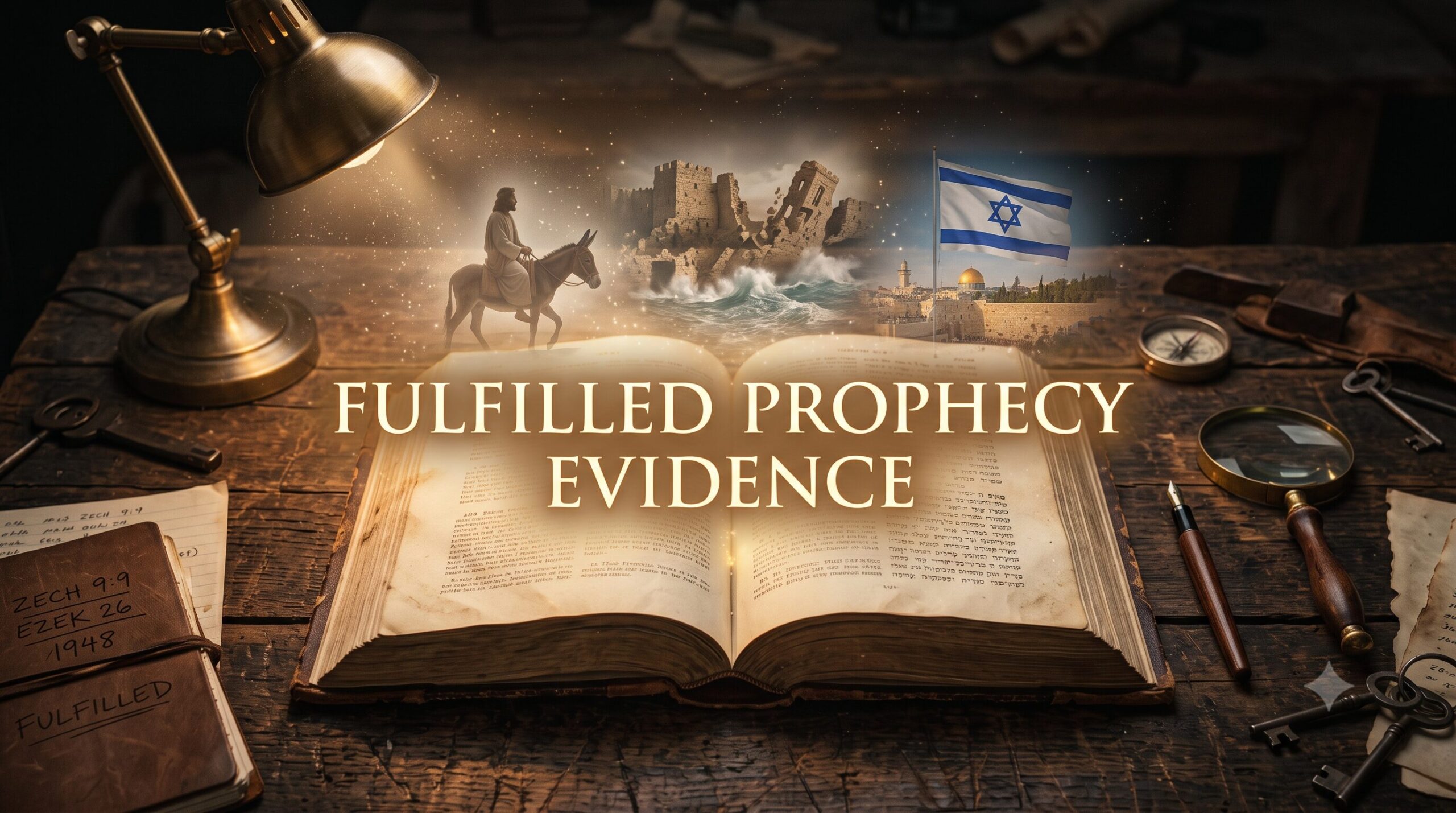
Before we track a single headline, we settle one question — has this book ever actually been right? The record says yes, and it isn’t close. Let’s look at Fulfilled Prophecy: The Evidence
Let’s start somewhere unusual for a prophecy site. Let’s start with a dare.
Most holy books ask for your faith. The Bible does something bolder — it asks for your scrutiny. In Isaiah, God doesn’t say trust me and don’t ask questions. He says the opposite:
“Remember the former things of old: for I am God, and there is none else; I am God, and there is none like me, Declaring the end from the beginning, and from ancient times the things that are not yet done, saying, My counsel shall stand, and I will do all my pleasure”
That’s not a suggestion to believe. That’s a testable claim. I told you the end before it happened — go check. So before we spend a single minute on El Niño charts or digital currencies or anything happening this week, we ought to do the honest thing and check. Because if the book has a track record of getting the future right, its read on our future is worth our attention. And if it doesn’t — well, then none of the rest matters, and I’d rather find that out now.
So let’s put it on the workbench and inspect it.
The Numbers, Honestly
Here’s where a lot of prophecy folks reach for a big round number and a bigger exclamation point. I’m not going to do that, because inflated numbers are how you lose a thinking reader, and I’d like to keep you.
Here’s what we can actually stand on. In his Encyclopedia of Biblical Prophecy, scholar J. Barton Payne cataloged 1,817 separate predictions in Scripture — 1,239 in the Old Testament, 578 in the New — spread across 8,352 verses. That’s roughly 27% of the Bible making some kind of forecast. Better than a quarter of the book is God, in effect, calling His shots in advance.
Of those, the ones pointing to the Messiah are the headline act. How many exactly? Depends who’s counting and how strictly — serious estimates run from about 300 on the conservative end up past 450. I’ll use the floor: over 300. It’s the number I can defend without a footnote fight.
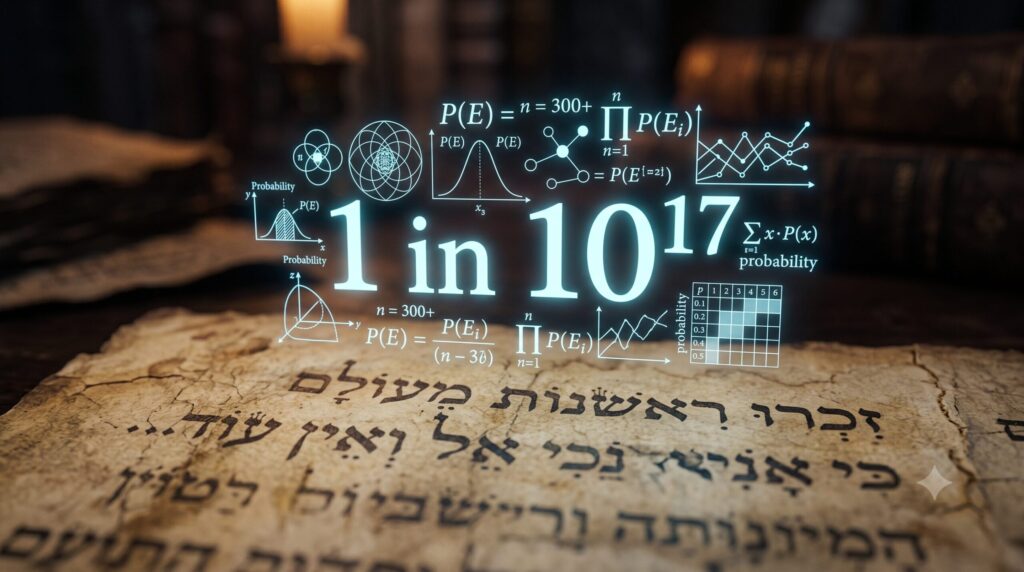
Now, you’ve probably heard the famous one — mathematician Peter Stoner’s calculation that the odds of a single man fulfilling just eight of those prophecies by chance come to something like one in ten to the seventeenth. That’s a one with seventeen zeroes after it. It’s a genuinely striking illustration, and I’ll be the first to tell you it’s exactly that — an illustration. It’s a probability model, not a lab result, and honest people have poked at its assumptions. So I won’t hand it to you as proof. I’ll hand it to you as a way of feeling the size of the thing, and then I’ll show you the individual fulfillments and let you weigh them yourself. Fair?
Good. Let’s look at a few.
The Coming of the Messiah
I’ll lead with my favorite, because it’s the one that broke something open in me years ago.
Five hundred years before it happened, Zechariah wrote down how the King would arrive. Not that He’d come — how.
“Rejoice greatly, O daughter of Zion; shout, O daughter of Jerusalem: behold, thy King cometh unto thee: he is just, and having salvation; lowly, and riding upon an ass, and upon a colt the foal of an ass”
— Zechariah 9:9

A king. Not on a war-horse. On a donkey. It’s almost a contradiction — the arrival of royalty done in the humblest way a man could travel. And centuries later, on the day we call Palm Sunday, that’s precisely how Jesus entered Jerusalem, recorded in Matthew 21 and John 12 — a borrowed colt, a road of cloaks, a crowd shouting the very word Zechariah used. He could have staged a lot of entrances. He staged that one.
And it doesn’t stand alone. Micah named the town — Bethlehem Ephratah — while it was still “little among the thousands of Judah.” The Psalmist described the manner of the death, hands and feet pierced and lots cast for the garments, in Psalm 22 — written centuries before crucifixion was a Roman practice. Zechariah even set the price of the betrayal: thirty pieces of silver, thrown to the potter. Isaiah described the silence of the accused: he opened not his mouth. Piece by piece, a portrait assembled by many hands over many centuries, and one life that walked right into the frame.
We lay out the full messianic set — verse by verse, fulfillment by fulfillment, including the careful handling of the probability illustration — in Every Messianic Prophecy Jesus Fulfilled [LINK TO: Every Messianic Prophecy Jesus Fulfilled].
Empires and Kings, Named in Advance-Fulfilled Prophecy: The Evidence
Now step back from the Messiah for a moment, because the pattern isn’t limited to Him. Scripture also called the rise and fall of empires — and in one case, a king by name.
Isaiah did something that should stop you. He named Cyrus — “He is my shepherd” — and described his decree to rebuild Jerusalem, roughly 150 years before Cyrus was born (Isaiah 44:28; 45:1). In 539 BC Cyrus the Great conquered Babylon. In 538 BC he issued exactly that decree, sending the Jews home to rebuild (Ezra 1:1–4; 2 Chronicles 36:22–23). A prophet naming a specific pagan king a century and a half early is not the sort of thing you brush past. The first-century Jewish historian Josephus even records that Cyrus read the Isaiah prophecy and was moved by it.

Ezekiel called the fate of Tyre — its stones and timber cast into the sea (Ezekiel 26). History obliged, in two acts: Nebuchadnezzar broke the mainland city, and centuries later Alexander the Great literally scraped its ruins into the water to build a causeway out to the island fortress. Ancient sources such as Diodorus Siculus confirm the engineering detail. The stones went into the sea exactly as the prophet said.
And Daniel, from inside the Babylonian court, mapped a succession of world empires that later readers watched unfold.
Here I owe you the honest footnote. Skeptical scholars, uneasy with predictions this precise, have argued that Daniel and parts of Isaiah were written after the events they describe — dated late enough to make the “prophecy” a memory in disguise. That’s a real argument and you should know it exists. I don’t find it persuasive — the manuscript and textual case for early authorship holds up under pressure, which is the only test I care about — but I’m not going to pretend the debate isn’t there. A case that has to hide its critics isn’t a strong case. This one doesn’t need to.
The empire prophecies get the full treatment — with the dating question handled head-on — in Fulfilled Prophecy in Daniel [LINK TO: Fulfilled Prophecy in Daniel].
The Regathering of Israeli Fulfilled Prophecy The Evidence
If the ancient fulfillments feel far away, here’s one your grandparents watched on the news.
“Behold, I will take the children of Israel from among the heathen, whither they be gone, and will gather them on every side, and bring them into their own land: And I will make them one nation in the land upon the mountains of Israel”
— Ezekiel 37:21–22

For roughly 1,878 years after Rome scattered them in AD 70, there was no nation of Israel. A people without a country, spread across a hundred others, holding onto a language most of them no longer spoke. And then, on May 14, 1948, in a single day, it came back — a reborn nation on the old ground, gathering exiles from all over the earth, with Hebrew revived as a living tongue. Show me another people who lost their land for nearly nineteen centuries and then reassembled it. You can’t, because there isn’t one. History doesn’t do that. Prophecy said it would.
The modern Israel thread continues in the Middle East Prophecy Watch [LINK TO: Middle East Prophecy Watch].
From Proof to Present
So here’s where the workbench gets interesting.
Every fulfilled prophecy the evidence we’ve looked at has one thing in common: it’s done. Settled. In the history books, not the forecast. A city, an empire, a named king, the manner of a death, the rebirth of a nation — called ahead of time, and delivered. That’s not a hunch about the future. That’s a track record.
And a track record is exactly what changes the weight of everything else. Because the same book that nailed Bethlehem and Cyrus and 1948 also has things to say about our stretch of road — wars and rumors of wars, the groaning earth, a system where no one buys or sells without a mark. Now, I hold those still-unfolding readings differently than the fulfilled ones. The past prophecies I can point to in a history book. The present ones I can only watch and discern, and I’ll always tell you which is which — that line matters too much to blur. But here’s the honest question the evidence puts to us: if the One who wrote it has been right every single time we can check, what would it be worth to pay attention to the times we can’t yet?
That’s the work of the rest of this site — Prophecy News & Geopolitics [LINK TO: Prophecy News & Geopolitics], the AI & The Beast System [LINK TO: AI & The Beast System], and the character of the age in Moral Decay, Persecution & Love Growing Cold [LINK TO: Moral Decay, Persecution & Love Growing Cold].
What We Do With Fulfilled Prophecy the Evidence?
If you’ve read this far as a skeptic — genuinely, welcome. You’re my favorite kind of reader, because you make me keep my numbers honest.

I’m not going to close by pressuring you. That would insult the whole point of this page, which is that the evidence is allowed to speak for itself. So I’ll just leave the door open. If a pattern this large and this specific gives you pause — if some part of you looked at Bethlehem and the donkey and 1948 lined up in a row and thought that’s a lot of coincidences for one book — then follow that thought. Don’t let anyone, me included, rush you past it. Read the individual cases. Check them against a history book, not a prophecy website. That’s not a threat to faith. That’s how faith earns its footing.
The fulfilled prophecy the evidence were never meant to win an argument. They were meant to answer one question — can this book be trusted? — so that when it speaks about the things we can’t yet see, we know whose word we’re holding.
The One Thing to Carry
If you remember nothing else: the case for taking the Bible’s future seriously is built entirely on its past — and its past is a matter of record, not of faith.
Hundreds of prophecies, written across centuries, already fulfilled in cities you can visit and events you can date. That’s the foundation. Everything else this site tracks stands on it. Fulfilled prophecy doesn’t just prove the book was right before — it tells us the Author can be trusted with what’s still ahead, including the promise that matters most.
Not sure what to make of all this? Start here: https://samuelclark.com/salvation/ [LINK TO: Salvation]. The same Jesus who rode the donkey and rose from the dead still invites anyone who will come.
And if the track record has already settled something for you — if you already know the King — then keep watching with me. The next pieces of the puzzle are already on the table. We just need eyes to see them.
This stuff doesn’t trouble me at all, because I know who my King is.
In expectation,
— Samuel Clark
Subscribe to Converging Times
Stay alert. Keep watch. Receive prophetic updates and world event analysis delivered directly to your inbox.
Sources
1. Holy Bible, King James Version — all Scripture quotations (Isaiah 46:9–10; Zechariah 9:9; Micah 5:2; Psalm 22; Isaiah 53; Isaiah 44:28; 45:1; Ezekiel 26; Ezekiel 37:21–22; Matthew 21; John 12; Ezra 1:1–4; 2 Chronicles 36:22–23).
2. Payne, J. Barton. Encyclopedia of Biblical Prophecy: The Complete Guide to Scriptural Predictions and Their Fulfillment. Harper & Row, 1973 (reprinted Wipf & Stock). Catalog of 1,817 predictions across 8,352 verses.
3. Stoner, Peter W. Science Speaks. Moody Press. Probability illustrations in the tradition of Christian evidential apologetics; assumptions about independence remain open to legitimate critique.
4. Josephus, Flavius. Antiquities of the Jews 11.1.2 — account of Cyrus reading the Isaiah prophecy concerning himself.
5. Diodorus Siculus. Library of History 17.40–46 — primary classical source for Alexander the Great’s siege of Tyre and use of mainland rubble for the causeway.
6. Ezra 1 and 2 Chronicles 36 — biblical record of Cyrus’s decree (confirmed by the Cyrus Cylinder’s broader policy of repatriation).
7. United Nations General Assembly Resolution 181 (1947) and the Declaration of the Establishment of the State of Israel (May 14, 1948) — primary documents for the modern rebirth of the nation.
8. Strobel, Lee. The Case for Christ. Zondervan, 1998. Chapter 10 on Messianic fingerprint evidence.
9. For the complete verse-by-verse Messianic set, see the site’s own Every Messianic Prophecy Jesus Fulfilled [LINK TO: Every Messianic Prophecy Jesus Fulfilled] and the rotating entries in the Fulfilled Prophecy Library under this Discernment pillar.