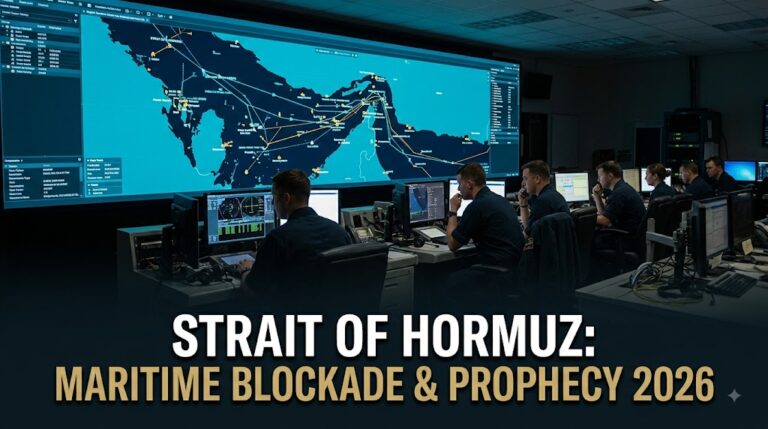
Strait of Hormuz tanker mines used to be a phrase buried in naval history books about the late 1980s or maritime insurance footnotes that nobody outside Lloyd’s of London ever read. Then came one very crowded Friday morning. Within a single news cycle, Iran’s Revolutionary Guards claimed two more oil tankers struck sea mines and caught fire—one east of the chokepoint and one inside the main Strait itself—just days after U.S. forces carried out defensive strikes on Iranian missile batteries on Qeshm Island, while in Jerusalem a deadlocked 67–46 Knesset tally forced President Isaac Herzog to delay naming a prime minister until Sunday. Any one of those headlines you could shrug off as noisy Middle East theater. Stacked together, with crude oil whipsawing near $100 a barrel and diplomats in Doha trading ultimatums behind closed doors, they deserve a calm, careful look.
I want to do something a little different in this report, friend. I will give you the numbers from this morning’s dispatches, but I will also tell you which ones I could confirm in the primary reporting, which ones come with a big asterisk, and where viral social media feeds have run ahead of the verifiable facts. Some of the shipping tallies and “total shutdown” claims bouncing around online leave out crucial context from maritime monitors, and you deserve the version you can actually trust.
Here is the path we will walk: what Iran’s Revolutionary Guards claimed this morning about two tankers hitting mines inside and east of the Strait, why Western maritime monitors put a verification asterisk beside Tehran’s 19-vessel tally, how oil traders and war-risk insurers are pricing the squeeze even after a 12% post-midterm selloff, how Monday’s U.S. strike on Qeshm Island and Sunday’s coalition decision in Jerusalem connect to the prophetic landscape, and what Scripture says to do with all of it, which is neither panic nor a shrug. If you are new here, our guides to the biblical signs of the end times in 2026 and the 2026 Iran war and the Ezekiel 38 Hormuz blockade give you the big map. This report is today’s weather.
What Happened in the Strait of Hormuz Over the Last 12 Hours
Two Tankers Reported Ablaze: One East, One Inside the Main Channel
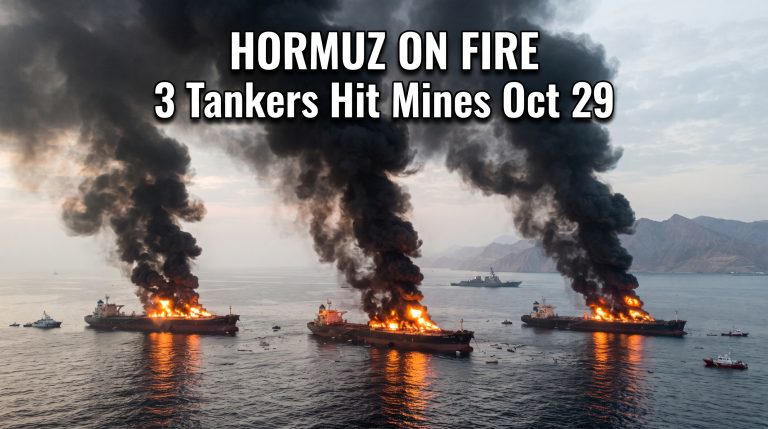
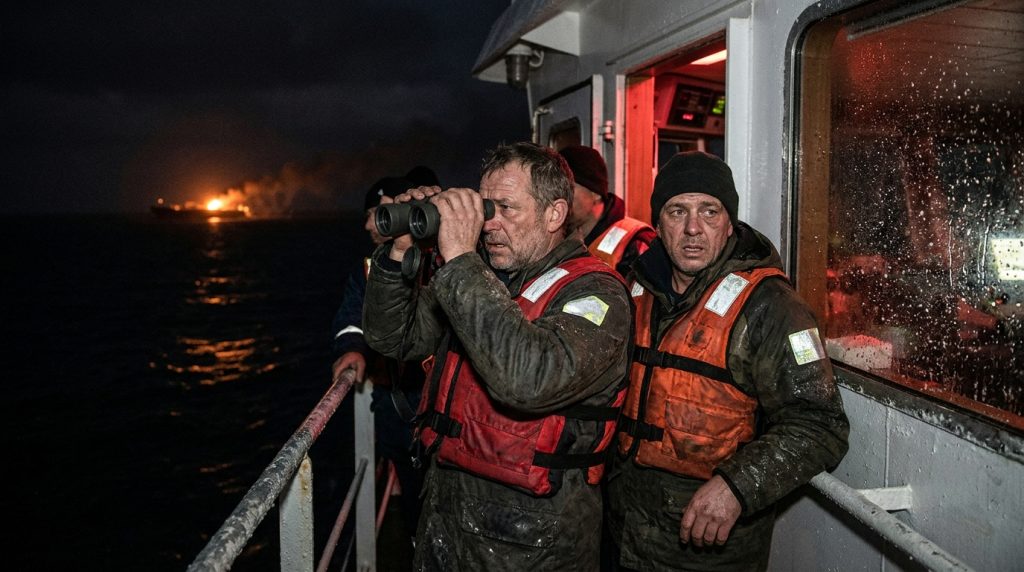
Start with what was officially said on Friday, November 6, 2026. In a statement broadcast on Iranian state television and published at 08:30 UTC by Tasnim News Agency, the Islamic Revolutionary Guard Corps (IRGC) Navy announced that two oil tankers attempting to pass through what Tehran calls unauthorized routes struck naval mines, caught fire, and were brought to a halt.
Zoom in on the geography, because the wording shifted. According to the IRGC statement carried by Arab News via Agence France-Presse and Al Arabiya citing Reuters, one of the violating tankers was struck east of the Strait of Hormuz, while the second was hit within the Strait itself. The IRGC alleged that both vessels had switched off all navigation and identification systems and were attempting to exit the waterway under the protection of the U.S. military.
Why does that phrase—within the Strait itself—matter to naval analysts? For the past two weeks, Tehran’s messaging followed a predictable script: ships that strayed into the southern “prohibited route” outside Iran’s self-declared northern corridor were the ones hitting mines. On November 4, as The Jerusalem Post reported, the IRGC claimed four ships were destroyed and two seized after ignoring warnings. On November 5, Tasnim News and Baird Maritime reported Iranian claims that five tankers and a tugboat caught fire along the southern and eastern approaches. Claiming a mine strike directly inside the main channel signals that Tehran wants commercial captains to believe no lane is safe without Iranian permission.
The IRGC Navy’s statement ended with a blunt political ultimatum reported by Tasnim News Agency: the Strait of Hormuz remains closed to unauthorized traffic and the situation will not change until Iran’s “seven conditions” are met.
The Watchman Audit: Confirmed Facts vs. The Verification Asterisk
Now let’s slow down and separate what is independently verified from what rests solely on Tehran’s microphone. If you scroll through prophecy forums or X feeds today (often tagged under raw search strings like Hormuz 2 tankers mines November 6 2026), you will see claims that 19 tankers are burning in a twelve-day stretch and that not a single drop of oil is leaving the Persian Gulf. Let’s look at what the primary monitors actually show.
| Flashpoint Claim (Nov 6, 2026) | What Primary Sources Confirm | The Watchman Asterisk (Crucial Context) |
|---|---|---|
| Nov 6: Two Tankers Hit Mines Inside & East of Hormuz | Confirmed as an official IRGC Navy statement carried by Tasnim News, Reuters / Al Arabiya, and The Times of Israel. | Unverified by Western Monitors: Arab News (AFP) and The Economic Times note zero independent confirmation from maritime officials for Friday’s two hits. |
| “19+ Vessels Hit in 12 Days” | Tehran’s cumulative claims from Oct 25 to Nov 6 total 19+ vessels (including 4 claimed Nov 4 per Jerusalem Post, 5 tankers + 1 tugboat Nov 5, and 2 tankers Nov 6). | UKMTO Tally Is Lower: The British maritime agency UKMTO has logged at least 5 vessel incidents since Sunday (Baird Maritime; Logistics Middle East), following 35 incidents in October. Tehran routinely inflates battle damage for leverage. |
| “AIS Shows 0 Tankers — Total Strait Shutdown” | Public AIS ship-tracking maps show civilian transponder traffic dropping near zero in the southern lane during alert windows. | Transponders Off ≠ Zero Ships: Even the IRGC statement admits tankers are transiting with AIS switched off under U.S. escort. OilPrice.com notes Gulf crude exports have held near 15M bpd, and CENTCOM reports escorting 1.5B barrels since summer (Arab News). |
| Crude Oil Rebounds Near $100 on Mine Reports | Brent crude bounced to 99.42–99.83/bbl and WTI to 91.08–91.73/bbl on Friday morning (OilPrice.com; Mettis Global). | Still Down ~12% on the Week: Despite Friday’s bounce, both Brent and WTI shed roughly 12% since Monday after U.S. midterm results raised trader hopes for a diplomatic settlement (OilPrice.com). |
| Nov 5 M6.1 Fiji Earthquake & Tibet Aftershocks | USGS confirmed a M6.1 earthquake in the Fiji region on Nov 5 (17:21 UTC), following October’s M7.0 Nagqu, Tibet quake (16 dead, 76 injured, 12,489 relocated, 2,054 aftershocks per AsiaOne). | 540.8 km Deep Mantle Quake: The Fiji M6.1 struck at 540.8 km depth (535 km preliminary on EarthquakeTrack) with a USGS Green PAGER alert—zero surface damage and zero tsunami risk. |
Sources: Tasnim News · Arab News (AFP) · OilPrice.com · Baird Maritime (UKMTO) · USGS
Look closely at that third row, friend. When you see a screenshot online claiming that only one ship crossed the Strait of Hormuz yesterday because public AIS trackers look empty, remember how wartime convoys work. Commercial captains sailing through a mine zone under U.S. Fifth Fleet escort turn off their public transponders so Iranian coastal batteries cannot target them by satellite. Saying “zero tankers showed up on public AIS” is true; saying “zero tankers moved through the Strait” is not.
Even so, do not miss the real danger. Whether five ships were hit this week (as UKMTO logged) or nineteen in twelve days (as Tehran claims), a waterway that normally carries one-fifth of the world’s petroleum is operating under active mine warfare. As we detailed in our foundational report on the global oil crisis in the Strait of Hormuz and Red Sea chokepoints, you do not need to sink fifty supertankers to break global shipping. You only need to convince maritime insurers that the main channel is mined.
Why Markets Whipsawed: Midterm Diplomacy vs. Mine Warfare
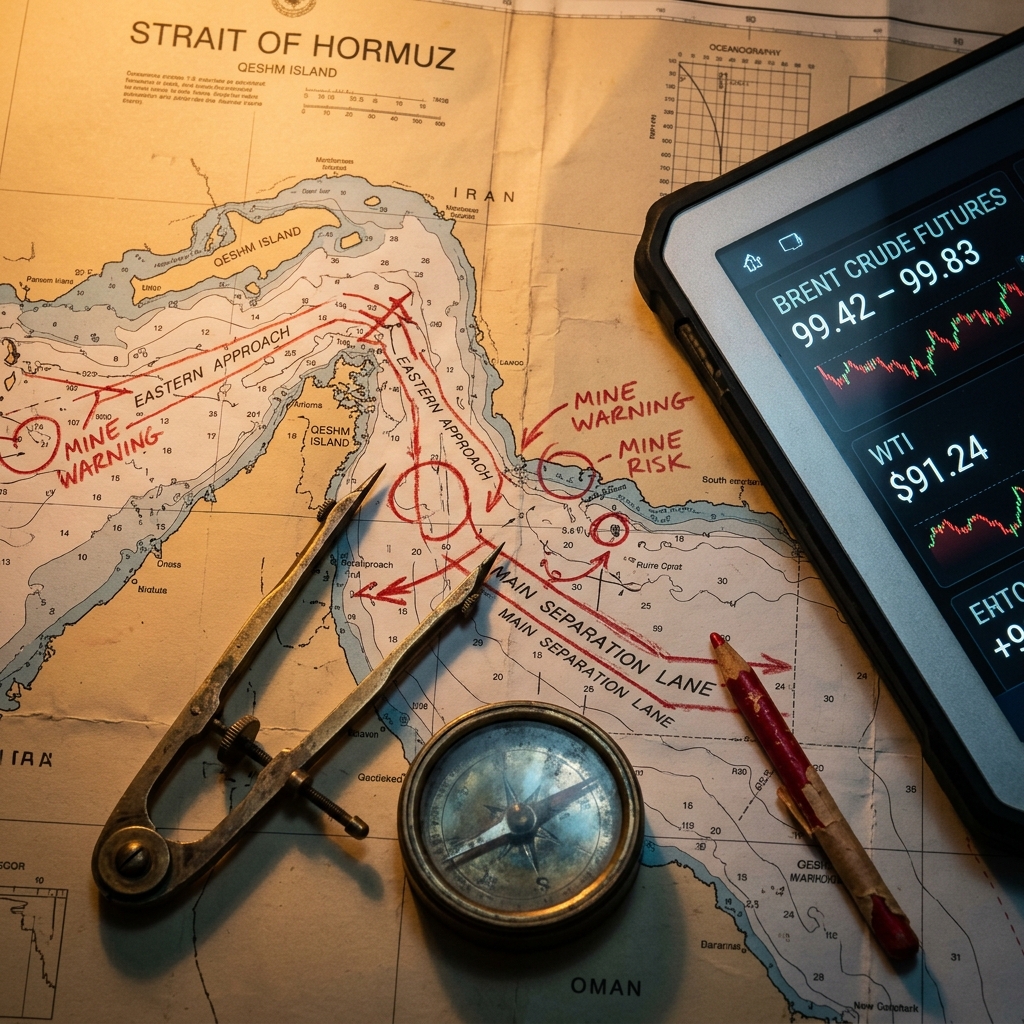
If tankers are being attacked in the world’s most important oil artery, why did crude oil prices actually fall 12% earlier this week before bouncing on Friday? Because traders are caught between two competing realities.
- The Post-Midterm “Peace Trade” Selloff: Following Tuesday’s U.S. midterm elections—which saw Democrats take control of Congress—energy traders sold crude heavily on Wednesday and Thursday, betting that domestic political pressure in Washington would force an early end to the war that began on February 28. As Irina Slav reported for OilPrice.com on November 6, both Brent and WTI were on track for a 12% weekly drop as Qatari mediators shuttled a draft framework between Tehran and Washington.
- Friday’s Mine-Strike Floor Near $100: Then came Thursday’s and Friday’s tanker attack reports. By Friday morning, Brent crude rebounded to $99.42 per barrel on OilPrice.com (touching $99.83 in early Asian/Pakistani futures snapshots tracked by Mettis Global), while West Texas Intermediate climbed back to 91.08–91.73 per barrel.
- The 80% Escalation Warning: As Mettis Global noted on Friday, Rapidan Energy Group founder Bob McNally warned CNBC that he still sees an 80% chance of full hostilities restarting and sending crude back above $100, while FXPro analyst Alex Kuptsikevich pointed out to OilPrice.com that losing the 2006 midterms did not stop President George W. Bush from surging forces in Iraq.
Let me say plainly what I think. Tehran is detonating or claiming mine hits inside the Strait because negotiations are happening in Qatar, not in spite of them. In Middle Eastern bargaining, you squeeze the valve at the exact moment the mediators sit down at the table. As Windward Maritime AI documented earlier this year, Iran established its “Persian Gulf Strait Authority” to turn Hormuz from an open international passage into a state-administered toll booth and holding queue. Mines are the enforcement mechanism for that toll booth.
Three Converging Fronts: Qeshm Island, Doha’s 7 Conditions, and Jerusalem’s Sunday Mandate
A watchman does not look at a burning tanker in isolation. Zoom out to the wider board, because three specific triggers converged with Friday’s mine claims.
1. U.S. “Defensive” Strikes on Qeshm Island (The Mouth of the Strait)
Look at a map of the Strait of Hormuz and your eye goes straight to Qeshm—the long, sword-shaped Iranian island hugging the northern edge of the shipping channel. Overnight Monday into Tuesday (November 2–3, 2026), U.S. military forces carried out limited “defensive” airstrikes on Qeshm Island, as U.S. officials confirmed to CNN and the Institute for the Study of War (ISW). According to The Edge Malaysia (Reuters), the U.S. strike targeted Iranian surface-to-air missile (SAM) batteries on Qeshm that had fired on American aircraft protecting commercial shipping.
Meanwhile, Iranian state outlet WANA News Agency claimed on November 6 that IRGC air defenses downed a fifth and sixth U.S. MQM-170 reconnaissance drone over Qeshm Island. Simultaneously, Qatari mediators returned to Doha after talks in Tehran over Iran’s “seven conditions” to reopen the Strait—demands that CNN reports include lifting the U.S. naval blockade of Iranian ports, unfreezing Iranian assets, and ending the war “on all fronts,” while senior Iranian official Mohsen Rezaei declared Washington’s initial response “not satisfactory.”
2. Jerusalem’s 67–46 Coalition Deadlock Ahead of Sunday’s Mandate
While Washington and Tehran trade blows at the mouth of the Gulf, Israel’s political leadership is in a knot of its own. Following Israel’s elections, consultations with President Isaac Herzog concluded on Thursday with 67 of the Knesset’s 120 lawmakers recommending former IDF chief Gadi Eisenkot to form a government, compared to 46 lawmakers backing Prime Minister Benjamin Netanyahu, as confirmed by The Times of Israel, The Guardian, and Jewish News Syndicate (JNS).
Here is the catch: those 67 endorsements include mutual boycotts between Naftali Bennett’s faction, Yisrael Beytenu, and Arab parliamentary parties that refuse to sit in the same coalition. Because neither camp has a clean 61-seat governing coalition on paper, Herzog announced he will wait until Sunday, November 8 to assign the mandate—just 48 hours before the 26th Knesset is sworn in on November 10 (Ynetnews). Tehran is watching Jerusalem’s political paralysis closely.
3. The Seismic Backdrop: Fiji’s Deep M6.1 and Tibet’s Aftershock Trail
On the physical earth, Thursday, November 5 brought a reviewed Magnitude 6.1 earthquake in the Fiji region at 17:21 UTC, logged by the U.S. Geological Survey (USGS) at a deep-mantle depth of 540.8 km (initially listed at 535 km on EarthquakeTrack). That tremor broke a four-day global pause in M6+ earthquakes and followed the devastating October 22 M7.0 earthquake in Nagqu, Tibet, where Chinese authorities confirmed 16 dead, 76 injured, 339 collapsed homes, 12,489 evacuated residents in sub-zero high-altitude conditions, and 2,054 aftershocks (AsiaOne; Nagqu Relief Data). We track these tectonic and atmospheric patterns weekly in our hub on 2026 global weather events and seismic birth pangs.
The Prophetic Lens: Hinges to Watch, Not Headlines to Hype
Here is where I want to be careful, because careful is what a watchman owes you. When oil tankers burn in the Persian Gulf, American warplanes strike an Iranian island, and Israel’s parliament sits deadlocked, it is easy for prophecy commentators to outrun the text of Scripture. Let’s open the King James Bible and distinguish what is a genuine prophetic pattern from what is premature speculation.
1. Luke 21:25–26 and “The Sea and the Waves Roaring”
In the Olivet Discourse, Jesus described the atmosphere that would precede His return:
“And there shall be signs in the sun, and in the moon, and in the stars; and upon the earth distress of nations, with perplexity; the sea and the waves roaring; Men’s hearts failing them for fear, and for looking after those things which are coming on the earth: for the powers of heaven shall be shaken.” (Luke 21:25–26, KJV)
Read those words slowly: distress of nations, with perplexity. The Greek word behind perplexity (aporia) means having no way out—a strategic cul-de-sac where every option carries a heavy cost. Escort tankers through Hormuz and risk mine strikes; halt escorts and watch global diesel and food prices spike; strike Iranian islands and risk wider war; sign Tehran’s seven conditions and hand permanent toll control of 20% of the world’s oil to the IRGC. I am not saying a naval mine on November 6 is the final fulfillment of Luke 21:25. I am saying the perplexity in the world’s maritime capitals matches the mood in the text.
2. Ezekiel 38:4–5 and Persia’s Forward Posture
Many readers write to ask whether U.S. strikes on Qeshm Island or the Hormuz blockade are the battle of Ezekiel 38. Let’s keep our footing straight on what Ezekiel actually wrote:
“And I will turn thee back, and put hooks into thy jaws, and I will bring thee forth, and all thine army, horses and horsemen, all of them clothed with all sorts of armour, even a great company with bucklers and shields, all of them handling swords: Persia, Ethiopia, and Libya with them; all of them with shield and helmet:” (Ezekiel 38:4–5, KJV)
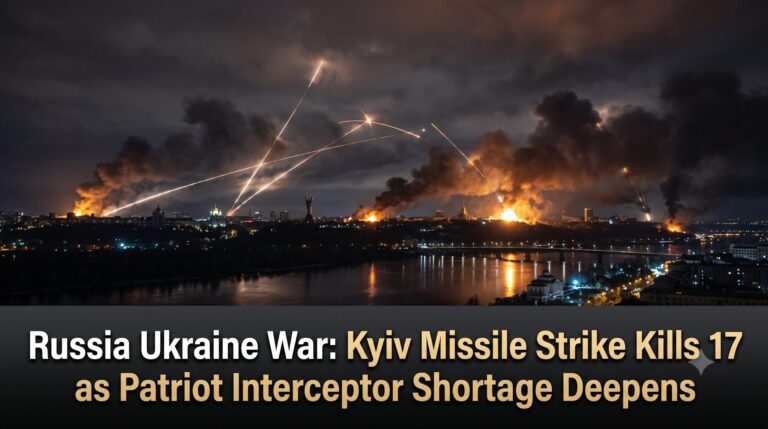
A mine blockade in the Strait of Hormuz or an American strike on Qeshm Island is not the Ezekiel 38 invasion. Ezekiel 38 describes a future northern-led coalition—including Persia (modern Iran)—marching directly against the mountains of Israel at a time when Israel dwells securely. What we are watching in 2026, as we also trace in our analysis of the Russia-Ukraine war and modern missile warfare, is the alignment of the pieces: Iran hardening its underground missile cities on Qeshm, deepening its military coordination with Moscow (IRGC adviser Mohsen Rezaei met with Vladimir Putin this very week, per WANA News Agency), and testing how far it can choke Western commerce. Persia’s posture is a hinge to keep watching, not a fulfillment to declare today.
3. Zechariah 12:3, 1 Thessalonians 5:3, and the Economics of Control
Look at three more scriptures that frame this week’s convergence:
- Jerusalem Under Political Strain (Zechariah 12:2–3): “Behold, I will make Jerusalem a cup of trembling unto all the people round about… And in that day will I make Jerusalem a burdensome stone for all people: all that burden themselves with it shall be cut in pieces, though all the people of the earth be gathered together against it.” (Zechariah 12:2–3, KJV). As President Herzog weighs a 67–46 Knesset split on Sunday while fighting continues on Israel’s regional fronts, every capital from Washington to Doha is trying to manage Jerusalem’s next move.
- Diplomacy Amid Minefields (1 Thessalonians 5:3): “For when they shall say, Peace and safety; then sudden destruction cometh upon them, as travail upon a woman with child; and they shall not escape.” (1 Thessalonians 5:3, KJV). I am not claiming the Qatari mediation in Doha is Paul’s final “peace and safety.” I am noting that a world where oil drops 12% on peace rumors while tankers hit mines in the dark is the exact kind of hair-trigger world Paul warns us not to fall asleep in.
- Maritime Chokepoints and Global Commerce (Revelation 13:16–17 & 18:17–19): John’s vision in Revelation 18 pictures a future commercial Babylon where “every shipmaster, and all the company in ships, and sailors, and as many as trade by sea, stood afar off, And cried when they saw the smoke of her burning” (Revelation 18:17–18, KJV), alongside the economic gatekeeping of Revelation 13:17 (“that no man might buy or sell”). War-risk insurance premiums and Iran’s new administrative “Strait Authority” are not the mark of the beast. But they show how quickly a physical chokepoint crisis pushes governments and insurers toward centralized digital tracking, vessel-permitting regimes, and financial rationing. We unpack how to watch those trends without falling into conspiracy fever in our guide to biblical discernment and our archive of fulfilled prophecy and discernment.
The Honest Historical Counterpoint: Remember 1987–1988
Before anyone concludes that burning tankers in the Strait of Hormuz mean the world ends by Friday night, history deserves a vote. During the 1987–1988 “Tanker War” between Iran and Iraq, both sides attacked hundreds of merchant ships in the Persian Gulf. In July 1987, the supertanker Bridgeton struck an Iranian mine while sailing under U.S. Navy escort during Operation Earnest Will; nine months later, in April 1988, the U.S. guided-missile frigate USS Samuel B. Roberts struck an Iranian mine near Shah Allum Shoal, triggering Operation Praying Mantis.
We have seen mines in Hormuz before, and life went on for nearly four decades. So why pay close attention now? Because of simultaneous convergence. In 1987, the United States had a single-front naval escort mission and ample global spare capacity. In November 2026, the United States and Israel have been in direct war with Iran since February 28, Red Sea routes near Yanbu face simultaneous Houthi threats (commodities dispatch), European and Asian LNG projects are stalling, and sovereign debt loads are vastly higher. That is not a date-setting countdown. It is a reminder of why Paul wrote, “For we know that the whole creation groaneth and travaileth in pain together until now” (Romans 8:22, KJV), and why Jesus called these converging pressures “the beginning of sorrows” (Matthew 24:8, KJV), which we catalog across our main hub on biblical signs of the end times.
Calm Hands, a Settled Heart: How Believers Should Respond Today
If reading about Strait of Hormuz tanker mines and $100 oil leaves a knot in your stomach, take a deep breath, grab a sandwich, and remember who sits on the throne. This stuff does not trouble me at all, because I know who my King is.
Scripture never tells Christians to panic when energy markets shake, and it never tells us to stick our heads in the sand either. Solomon gave us the balance in one sentence:
“A prudent man foreseeth the evil, and hideth himself: but the simple pass on, and are punished.” (Proverbs 22:3, KJV)
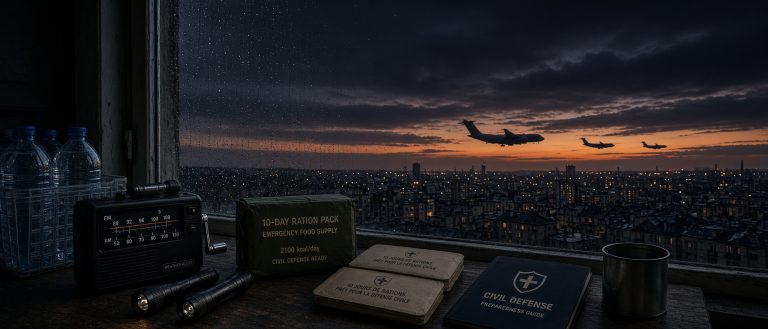
Notice the posture of Proverbs 22:3. The prudent believer looks at the road ahead, sees that a prolonged mine squeeze in the Strait of Hormuz can send retail gasoline, diesel, and grocery freight costs higher within weeks, and takes quiet, practical steps at home:
- Keep your vehicle tanks above the half-mark: Getting in the habit of topping off at half a tank costs no extra money over a month, and it means you are never sitting in a panic line if a weekend escalation in the Gulf spikes local pump prices on a Monday morning.
- Build a modest household fuel and utility buffer: With crude swinging between $91 and $112 in a single fortnight, trimming one or two unnecessary recurring expenses now gives your family breathing room if winter heating oil or diesel surcharges climb.
- Rotate a two-week working pantry of everyday staples: Buy a few extra cans of beans, rice, pasta, or oats that your family already eats. Do it calmly over a few grocery trips, and add a little extra to share with an elderly neighbor or a single parent at church if grocery bills tighten.
- Audit your media diet with the Berean test: When you see a viral post screaming that “19 tankers sank and Hormuz is 100% closed,” pause and ask what UKMTO or primary dispatches actually confirmed. Extra margin in your pantry and extra discernment in your reading: that is stewardship, not fear. That is crisis readiness done the Bible’s way: calm hands, a settled heart.
Above all, lift your eyes higher than the Persian Gulf. Jesus gave His followers a specific command for the season when the sea and the waves roar and nations are perplexed:
“And when these things begin to come to pass, then look up, and lift up your heads; for your redemption draweth nigh.” (Luke 21:28, KJV)
Human empires, naval blockades, and energy cartels are temporary. As the prophet Daniel foretold, “And in the days of these kings shall the God of heaven set up a kingdom, which shall never be destroyed: and the kingdom shall not be left to other people, but it shall break in pieces and consume all these kingdoms, and it shall stand for ever” (Daniel 2:44, KJV).
As pre-tribulation believers who strive to study the Word like the Bereans—who “received the word with all readiness of mind, and searched the scriptures daily, whether those things were so” (Acts 17:11, KJV; see also 2 Timothy 2:15)—we look forward to the blessed hope of Christ’s promise to catch away His bride before the hour of global trial that shall come upon all the world (1 Thessalonians 4:16–17; 1 Thessalonians 5:9; Revelation 3:10, KJV). If you have ever wondered why we trust the prophetic reliability of Scripture so deeply, explore our guides to the historical and archaeological evidence the Bible is true and every Messianic prophecy Jesus fulfilled at His first coming.
And if you are reading this today and do not yet have peace with God—if the headlines from the Middle East fill you with dread because you do not know what happens after this life—the most important preparation you can make has nothing to do with oil prices. It begins at the cross of Jesus Christ:
“For God so loved the world, that he gave his only begotten Son, that whosoever believeth in him should not perish, but have everlasting life.” (John 3:16, KJV)
Jesus died for your sins, was buried, and rose bodily on the third day so that you could be forgiven, reconciled to God, and given eternal life as a free gift of grace through faith. Do not wait for another news cycle. Visit our page on how to be saved and know Jesus Christ personally today.
Sources
- Tasnim News Agency (Nov 6, 2026): Two Tankers Hit Mines in Strait of Hormuz: IRGC — Primary Iranian state-affiliated dispatch reporting the IRGC Navy’s Friday statement that one tanker was hit east of the Strait and one within the Strait itself, and reiterating Iran’s “seven conditions.”
- Arab News / Agence France-Presse (Nov 6, 2026): Iran Guards Say Two Tankers Caught Fire in Hormuz — Confirms the verbatim IRGC broadcast quote, CENTCOM’s statement on escorting 1.5 billion barrels of Gulf oil since summer, and the lack of independent confirmation from maritime officials.
- Al Arabiya / Reuters (Nov 6, 2026): Iran’s IRGC Says Two Oil Tankers Hit Mines, Catch Fire in Strait of Hormuz — Reuters wire confirmation of the Friday IRGC announcement.
- The Economic Times (Nov 6, 2026): Iran Guards Say Two Tankers Caught Fire in Hormuz — Details the February 28 war timeline, the U.S. port blockade, and Thursday’s prior Iranian claim of five tankers and a tugboat catching fire.
- OilPrice.com (Nov 6, 2026): Oil Prices Head for 12% Weekly Loss Despite Fresh Tanker Attacks — Irina Slav’s market breakdown confirming Brent at $99.42 and WTI at $91.24 on Friday morning after a 12% weekly post-midterm slide, and citing Reuters on at least five vessel incidents since Sunday.
- Mettis Global / Investify (Nov 6, 2026): Oil Nears $100 as US-Iran Military Escalation Fears Grow — Tracks Friday’s $99.83 Brent market snapshot, $91.08 WTI print, and Rapidan Energy Group’s 80% escalation warning.
- Baird Maritime (Nov 5, 2026): Hormuz Remains on Edge as Iran Reports Trio of Damaged Tankers — Confirms UKMTO’s independent log of at least five commercial vessel incidents since Sunday.
- The Jerusalem Post (Nov 4, 2026): IRGC Announces Destruction of Four Ships in Strait of Hormuz — Documents Tehran’s November 4 claim of four vessels destroyed and two seized.
- CNN Politics via KRDO (Nov 3, 2026): US Military Conducts Strikes on Iran’s Qeshm Island in Defensive Operation, Officials Say — Confirms Monday night’s limited U.S. defensive strikes on Qeshm Island SAM sites and details Qatari mediation over Iran’s seven demands.
- Institute for the Study of War (Nov 3, 2026): Iran Update, November 3, 2026 — Operational assessment of Iranian SAM fire against a U.S. aircraft near Qeshm Island and subsequent U.S. defensive strikes.
- The Times of Israel (Nov 5, 2026): As Eisenkot Wins 67 Nods to Be PM, Herzog Says He’ll Announce Mandate Decision on Sunday — Confirms the 67–46 Knesset recommendation split between Gadi Eisenkot and Benjamin Netanyahu ahead of Sunday’s mandate decision and the November 10 Knesset swearing-in.
- U.S. Geological Survey — USGS (Nov 5, 2026): M 6.1 — Fiji Region (Event us7000tw8r) — Official USGS reviewed seismic solution confirming the M6.1 earthquake at 540.8 km depth with a Green PAGER alert.
- AsiaOne / Xinhua (Oct 26, 2026): China Says No Secondary Disasters, Casualties From Tibet Earthquake — Confirms the 16 fatalities, 76 injuries, and 2,054 aftershocks from the October 22 M7.0 Nagqu, Tibet earthquake.