Middle East war prophecy used to be a phrase reserved for late-night radio hosts and dusty paperbacks on the back shelf of a church library. Then came one very strange Monday-into-Tuesday news cycle. On the eve of America’s midterm elections, U.S. forces struck Iranian targets on Qeshm Island in the Strait of Hormuz, a Russian double-tap bomb attack killed at least 31 people at a school-turned-aid-hub in southern Ukraine, and aid monitors reported nearly 50,000 Ethiopians—including thousands of frightened Christian families—crowding across the Kenyan border around Moyale. Any one of those headlines you could shrug off as another rough day in a broken world. Stacked together in a single 24-hour window, they deserve a calm, careful look.
I want to do something a little different in this report, friend. I will give you the numbers and the headlines, but I will also tell you which details I could confirm in the primary reporting, which ones come with an asterisk, and where viral social media summaries have run ahead of the facts. Some drafts and commentary circulating today treat limited defensive strikes as an uncontained regional war, or collapse weeks of complex African border fighting into a single overnight raid. You deserve the version you can trust.
Here is the path we will walk: what actually happened in the Strait of Hormuz on Qeshm Island, the real details behind the Komyshuvakha aid center bombing in Ukraine, the two-front tragedy unfolding for Ethiopian believers between Oromia and Moyale, and what Scripture says to do with all of it, which is neither panic nor a shrug. If you are new here, our guides to the biblical signs of the end times in 2026 and the 2026 Iran war and the Ezekiel 38 Hormuz blockade give you the big map. This report is today’s weather.
Chokepoint Reality Check: What Actually Happened at Qeshm Island in the Strait of Hormuz
The Strait of Hormuz is not merely a narrow strip of saltwater between the Persian Gulf and the Gulf of Oman; it is the physical jugular vein of the global petroleum economy.Roughly twenty percent of the world’s oil transits that passage every day. Because the stakes are so high, headlines about U.S. airstrikes inside the Strait immediately trigger talk of World War III. Zoom out, because the details matter.
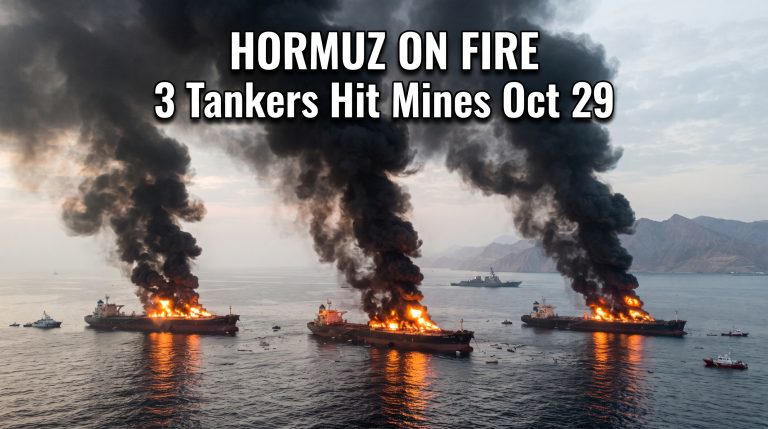
Late Monday, November 2, 2026, the Associated Press and The Times of Israel reported that the U.S. military carried out defensive strikes against Iranian targets in the Strait of Hormuz, specifically where Iranian state television reported explosions on Qeshm Island. You may see viral drafts online claiming U.S. planes wiped out coastal command centers and fast-attack naval fleets after days of tanker mine explosions. Let’s separate what is confirmed in the primary reporting from what comes with an asterisk:
- Surface-to-air missile batteries, not naval fleets: According to a U.S. official speaking to the Associated Press and Fox News, American forces specifically targeted “Iranians using surface to air missiles against U.S. assets” after Iranian units fired on a U.S. aircraft near Qeshm Island. The reporting explicitly described the action as limited and defensive, rather than a return to full-scale hostilities.
- Backchannel diplomacy is still alive, not shattered: While some commentary claims all diplomatic channels have collapsed, the Associated Press reported on the exact same night that Vice President JD Vance said he and President Trump “feel pretty good about the prospects for potentially coming to a negotiated settlement,” and Iranian security chief Mohsen Rezaei told state television that receive-side diplomatic correspondence showed “the tone has completely changed” from Washington, calling it a “very good sign.”
- Saudi defense talks and Houthi fire: On Monday, Saudi Defense Minister Prince Khalid bin Salman spoke by phone with U.S. Defense Secretary Pete Hegseth regarding regional developments and continued Houthi attacks against Saudi Arabia.
- Oil markets rebounded modestly after a steep drop: According to EnergyNow’s Reuters price verification and Reuters on Tuesday morning, crude rose roughly $1 after the Qeshm Island strike—putting WTI near $98 and Brent above $106—recovering only a fraction of Monday’s more than 7% sell-off.
Let me say plainly what I think. When Washington fires on Qeshm Island while exchanging polite diplomatic letters with Tehran, both things can be true at once: a kinetic strike can be a boundary-enforcing slap during negotiations just as easily as the spark for a wider war. Neither I nor anyone outside the Situation Room can tell you which way it breaks next. What we can say, as we have tracked in our analysis of the global oil crisis in the Strait of Hormuz and Red Sea, is that the world’s most sensitive energy corridor now sits one radar lock away from a major supply shock.
Eastern Europe and the Horn of Africa: Separating Headline Summaries from Ground Truth
Now let’s look at the other two flashpoints that landed on the news desk in the same 24-hour cycle. When we examine Russia-Ukraine missile and drone campaigns alongside African displacement, accuracy honors the people actually suffering on the ground.
The Komyshuvakha Aid Site Bombing in Zaporizhzhia
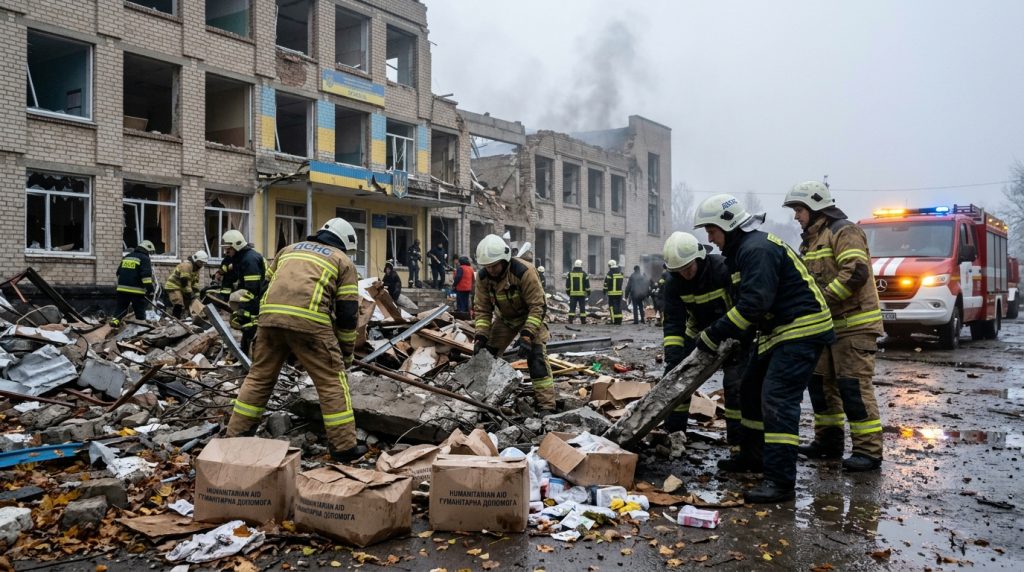
On Tuesday, November 3, 2026, The Washington Post (via AP wires), The Guardian, and Reuters (via The Moscow Times) confirmed that the death toll from a Russian attack in the village of Komyshuvakha in Ukraine’s southeastern Zaporizhzhia region rose to at least 31 killed, with five wounded and nearly 50 people still missing under the rubble.
Here are the verified specifics that make this strike even sobering than a generic headline:
- A school used for Monday aid distribution: Ukrainian President Volodymyr Zelenskyy and Zaporizhzhia acting regional head Mykhailo Semikin reported that Russian aerial bombs struck a local school that serves as a shelter and distributes humanitarian assistance every Monday.
- A deadly “double-tap” strike on first responders: According to AFP and Reuters reporting, Russia launched a second strike as emergency crews dug through the wreckage, killing four police officers and two rescue workers.
- The scale of the overnight barrage: Alongside the Komyshuvakha bombing, The Washington Times noted that Russia launched 289 attack drones, 17 ballistic missiles, and 59 cruise missiles across nine Ukrainian regions overnight, while Moscow’s Defense Ministry claimed it targeted military units in Komyshuvakha and downed 856 Ukrainian drones.
- The diplomatic paradox: Just like the Strait of Hormuz, this carnage unfolded right beside ceasefire diplomacy. The attack came one day after a six-day local humanitarian truce expired in Oleshky, and on the exact day a senior U.S. official told Reuters that Washington plans to bring Russian and Ukrainian delegations together in Abu Dhabi on November 10–11.
Ethiopia’s Dual Crisis: Border Flight at Moyale and Targeted Killings in Oromia
On November 2, 2026, International Christian Concern (ICC) published a sobering dispatch titled “Ethiopia’s Ongoing Conflict Leaves Christian Communities Living in Fear,” reporting that thousands of Christian communities are fleeing clashes around the southern border town of Moyale into neighboring Kenya. A displaced believer named Dadi told ICC: “The situation is very bad; I fled, leaving my family behind… It is Kenyan citizens who are helping us.”
Let’s be precise about the asterisk here so we don’t conflate two distinct events in Ethiopia. First, the mass exodus at Moyale—which UNHCR and Addis Standard estimate has pushed nearly 50,000 Ethiopians into Kenya’s Marsabit County since late October—was sparked by violent intercommunal boundary clashes between Borana (Oromo) and Garre (Somali) communities over a disputed regional administration office and flag in Moyale, as documented by Open Doors UK and World News (AP). Believers in Moyale are caught in an ethnic crossfire and rendered acutely vulnerable in overcrowded schools and churches across the border. Second, inside Ethiopia’s broader Oromia region (in Merti and Shirka districts), the Ethiopian Orthodox Tewahedo Church reported to ICC that at least 60 Orthodox Christians were directly murdered in two brutal late-October attacks. Both realities—ethnic border warfare uprooting 50,000 souls at Moyale and targeted massacres of believers in Oromia—are happening simultaneously.
Draft Claims vs. Verified Primary Reporting (Nov 2–3, 2026)

| Flashpoint & Region | Sensationalized / Viral Draft Claim | Verified Primary-Source Reality | Primary Source & Watchman Verdict |
|---|---|---|---|
| Strait of Hormuz (Qeshm Island) | U.S. strikes hit coastal command centers & naval fleets after tanker mine blasts; diplomacy shattered; all-out war begun. | U.S. conducted limited defensive strikes on Qeshm Island targeting Iranian SAM batteries that fired on a U.S. aircraft. Backchannel talks remain active; oil rose ~$1 after a 7% drop. | Confirmed strike with major context asterisk (AP News, Fox News, Reuters). |
| Eastern Europe (Komyshuvakha, Ukraine) | Russian missile killed 31 civilians waiting for winter heating supplies in eastern Ukraine. | Russian aerial bombs (“double-tap” strike) hit a school used for Monday aid distribution in Komyshuvakha (Zaporizhzhia), killing at least 31 (including 4 police & 2 rescuers) and leaving ~50 missing, even as Nov 10–11 Abu Dhabi talks are planned. | Confirmed death toll; clarified munitions & diplomatic context (Washington Post / AP, The Guardian, Reuters). |
| Horn of Africa (Moyale & Oromia, Ethiopia) | Thousands of Christians fled Moyale overnight solely from targeted anti-church raids. | Nearly 50,000 people—including thousands of vulnerable Christians—fled Borana–Garre ethnic border clashes in Moyale into Kenya since late Oct, while 60 Orthodox Christians were killed in separate targeted attacks in Oromia. | Confirmed displacement; distinguished ethnic border war from targeted Oromia killings (ICC, Open Doors UK, Addis Standard). |
Sources: Associated Press · Washington Post · Reuters · International Christian Concern · Open Doors UK
What Scripture Said: Hinges to Watch, Not Fulfillments to Declare
Nearly two thousand years ago, seated on the Mount of Olives overlooking Jerusalem, Jesus gave His disciples a diagnostic lens for reading history without losing their heads:
“And ye shall hear of wars and rumours of wars: see that ye be not troubled: for all these things must come to pass, but the end is not yet. For nation shall rise against nation, and kingdom against kingdom: and there shall be famines, and pestilences, and earthquakes, in divers places. All these are the beginning of sorrows.” — Matthew 24:6–8 (KJV)
In Luke’s parallel account, Jesus linked geopolitical collision with the vulnerability and testimony of His people, as well as the anxious mood of a world watching crisis stack upon crisis:
“Then said he unto them, Nation shall rise against nation, and kingdom against kingdom… But before all these, they shall lay their hands on you, and persecute you, delivering you up to the synagogues, and into prisons, being brought before kings and rulers for my name’s sake. And it shall turn to you for a testimony.” — Luke 21:10, 12–13 (KJV)
“And there shall be signs in the sun, and in the moon, and in the stars; and upon the earth distress of nations, with perplexity; the sea and the waves roaring; Men’s hearts failing them for fear, and for looking after those things which are coming on the earth: for the powers of heaven shall be shaken.” — Luke 21:25–26 (KJV)
Here is where I want to be careful, because careful is what a watchman owes you. Let’s walk through the prophetic connections with open hands and zero sensationalism:
- On Persia and Ezekiel 38:4–5: A U.S. defensive strike on an Iranian surface-to-air missile battery on Qeshm Island is not the fulfillment of the Ezekiel 38 invasion. That prophecy describes a massive northern and eastern coalition—including Persia (modern Iran)—coming up against the land of Israel (“I will turn thee back, and put hooks into thy jaws, and I will bring thee forth… Persia, Ethiopia, and Libya with them,” Ezekiel 38:4–5, KJV), not American jets hitting an island radar site in the Strait of Hormuz. Persia’s entrenched military posture is a hinge to keep watching, not a fulfillment to declare.
- On Diplomacy Alongside Bombardment (1 Thessalonians 5:3): Notice how both the Qeshm Island strike and the Komyshuvakha bombing happened while diplomats talked warmly about “negotiated settlements” and Abu Dhabi peace tables. Paul wrote, “For when they shall say, Peace and safety; then sudden destruction cometh upon them, as travail upon a woman with child; and they shall not escape” (1 Thessalonians 5:3, KJV). I am not claiming the letters between Washington and Tehran or next week’s talks in Abu Dhabi are Paul’s final “peace and safety.” I am noting that a world which trades peace letters while bombing aid centers and radar islands is the exact kind of world he describes.
- On Ethnos epi Ethnos and the Persecuted Church: When Jesus spoke of “nation against nation” (Greek: ethnos epi ethnos), He pointed to ethnic and communal fracture alongside state-on-state war (“kingdom against kingdom”). What we see in Moyale—Borana and Garre ethnic fighting driving 50,000 people across a border—and in Oromia, where 60 Orthodox believers were slaughtered, mirrors that exact texture of human distress.
Let’s also offer the honest historical counterpoint. The world has seen far bloodier days than November 2–3, 2026. During the Tanker War of 1987–1988, U.S. warships and Iranian forces fought much larger pitched engagements inside the Persian Gulf (Operation Praying Mantis), and World War II and the Cold War produced casualty and refugee numbers that dwarf today’s dispatches. A single strike on Qeshm Island is a warning light, not a countdown.
So why do we pay attention? Because of convergence—how many distinct pressures are lit at the same time across energy chokepoints, European battlefields, African borderlands, and the 2026 global weather events and birth pangs we track every week. Jesus used the word ōdin—birth pangs—in Matthew 24:8. Contractions are measured by frequency and simultaneous intensity. Watching three continents convulse on the same day while maintaining biblical discernment and studying fulfilled prophecy and discernment is not about setting dates. It is about staying awake, because “we know that the whole creation groaneth and travaileth in pain together until now” (Romans 8:22, KJV).
How We Stand: Calm Hands, a Settled Heart, and Gospel Hope
If reading about Middle East war prophecy, bombed aid lines in Ukraine, and displaced Christian families in Kenya leaves a knot in your stomach, take a deep breath, grab a sandwich, and remember who sits on the throne. This stuff does not trouble me at all, because I know who my King is.
Jesus did not give the Olivet Discourse to turn His church into anxious headline-addicts. He looked His disciples in the eye and gave a command: “see that ye be not troubled” (Matthew 24:6, KJV). And in Luke 21:28 (KJV), He gave the posture of the watchman: “And when these things begin to come to pass, then look up, and lift up your heads; for your redemptions draweth nigh.” Human empires and fragile truces will shake, but Daniel 2:44 (KJV) reminds us that “in the days of these kings shall the God of heaven set up a kingdom, which shall never be destroyed.”
At the same time, Scripture pairs spiritual peace with practical wisdom. Proverbs 22:3 (KJV) says, “A prudent man foreseeth the evil, and hideth himself: but the simple pass on, and are punished.” Prudence is not prophecy, and stewardship is not fear. When the Strait of Hormuz is taking fire and winter supply lines are strained, here is how a grounded household responds:
- Keep a steady household margin: Top off your vehicle’s fuel tank at the half-mark, keep a two-week pantry of everyday staples your family actually eats, and set aside a small cash buffer in case energy or cyber hiccups rattle local payment systems. Do it calmly over a few weeks, with enough extra to share with an elderly neighbor.
- Pray specifically for the suffering body of Christ: Pause tonight to intercede by name for believers like Dadi in Moyale, Kenya, for grieving Orthodox families in Oromia, and for rescue workers and families digging out of the rubble in Komyshuvakha.
- Be a Berean with your news feed: When a viral post screams that World War III started ten minutes ago, check the primary reporting first. Search the Scriptures daily like the Bereans in Acts 17:11 (KJV) and study to show yourself approved unto God (2 Timothy 2:15, KJV).
As believers, we watch these converging signs with the blessed hope that our Lord promised to deliver His bride from the coming hour of global judgment (1 Thessalonians 4:16–17; 1 Thessalonians 5:9; Revelation 3:10, KJV). If you have ever wondered whether the Bible can be trusted when it speaks of the future, examine the evidence the Bible is true and the mathematical precision of every messianic prophecy Jesus fulfilled at His first coming. The same Savior who fulfilled every promise in Bethlehem and Calvary will keep His word to return.
Above all, make sure your own anchor holds. “For God so loved the world, that he gave his only begotten Son, that whosoever believeth in him should not perish, but have everlasting life” (John 3:16, KJV). And as Paul wrote in Romans 10:9 (KJV), “That if thou shalt confess with thy mouth the Lord Jesus, and shalt believe in thine heart that God hath raised him from the dead, thou shalt be saved.” If you do not yet have that settled peace with God, visit our page on how to receive the gift of salvation through Jesus Christ today. Calm hands, a settled heart, and eyes on the King.
#StraitOfHormuz #BibleProphecy #EndTimesSigns
Sources
- Associated Press — “US defensive strikes hit Iranian targets in Strait of Hormuz, US official says” (Nov 2, 2026)
- Fox News — “US strike on Iran’s Qeshm Island in Strait of Hormuz not return to full hostilities” (Nov 3, 2026)
- The Times of Israel — “US carries out ‘defensive’ strikes on Iran’s Qeshm island in Strait of Hormuz” (Nov 3, 2026)
- EnergyNow / Reuters — “Oil Prices Rebound as U.S. Strikes Iran’s Qeshm Island – WTI Near $98, Brent Above $106” (Nov 3, 2026)
- The Washington Post (AP Wires) — “Death toll hits 31 after Russian strike on Ukrainian aid site, with dozens still missing” (Nov 3, 2026)
- The Guardian — “Russia bombs humanitarian hub in Ukraine, killing at least 31 people” (Nov 3, 2026)
- Reuters via The Moscow Times — “At Least 31 Killed in Russian Bomb Attack in Zaporizhzhia” (Nov 3, 2026)
- The Washington Times — “Russian strike on Ukraine medical aid site kills 31, leaves dozens missing” (Nov 3, 2026)
- International Christian Concern (ICC) — “Ethiopia’s Ongoing Conflict Leaves Christian Communities Living in Fear” (Nov 2, 2026)
- Open Doors UK — “Christians among around 50,000 displaced in latest Ethiopia conflict” (Nov 2, 2026)
- Addis Standard / UNHCR — “Ethiopian arrivals fleeing Moyale conflict into northern Kenya rise to nearly 50,000” (Oct 29–Nov 3, 2026)