Hearing that the Iran war funded through January has a ticking clock on its budget feels a bit like watching two neighbors argue over a fence while the grass is already on fire. In the same 24-hour news cycle on November 24 and 25, 2026, three separate headlines hit the wire at once. President Donald Trump told the New York Post that Washington’s military campaign against Tehran has money to run “up until really the end of January” before a Democratic majority takes control of Congress on January 3, 2027, as reported by The Times of Israel. Hours later, Iranian state media claimed two oil tankers exploded and caught fire after hitting naval mines in the Strait of Hormuz, according to The Jerusalem Post. And in London, Britain’s energy regulator Ofgem announced that typical household energy bills will jump 26 percent in January, adding roughly 443 pounds ($580) a year because of the war’s chokehold on gas supplies, per The Guardian. Any one of those stories could be shrugged off on a quiet week. Stacked together on the same morning, they deserve a calm, careful look.
I want to do something a little different in this report, friend. I’ll give you the numbers, but I’ll also tell you which ones I could confirm in the original reporting, which ones come with an asterisk, and where the headlines have run ahead of the facts. Some of the figures bouncing around social media and political interviews are bigger than the verified reporting supports, and you deserve the version you can trust.
Here’s the path we’ll walk: what Trump actually said about the January funding window and Israel’s goals, what’s really happening in the Strait of Hormuz and on the Pentagon’s balance sheet, where the facts carry an asterisk, my own Watchman’s Opinion on how this lines up with Bible prophecy, and what Scripture says to do with all of it, which is neither panic nor a shrug. If you’re new here, our guides to the biblical signs of the end times in 2026 and the 2026 Iran war and the Ezekiel 38 Hormuz blockade give you the big map. This report is today’s weather.
What Trump Said About the January Funding Window and Israel’s Goals
Tuesday’s interview was blunt, even by Washington standards. Speaking with the New York Post, Trump was asked whether a new Democratic majority in Congress could restrict his military options in Iran once lawmakers are sworn in this January. His answer drew a clear financial line on the calendar: “But up until really the end of January, pretty much, you know, we’re funded,” as quoted by The Times of Israel.
He didn’t stop there. Trump warned that congressional Democrats would “take a total win and make it a loss,” while insisting Washington holds the off-switch: “We can put that war to bed anytime we want,” according to Anadolu Agency. That gives the White House a narrow window of roughly nine weeks before the new Congress takes office on January 3, 2027, and begins using its power of the purse to rein in the nine-month conflict, as outlined by The Business Standard.
Zoom out, because the details matter. For the first time in months, Trump also stated plainly that Washington’s war aims don’t match Jerusalem’s. When the U.S. and Israel launched the war on February 28, 2026, both capitals talked about degrading Iran’s nuclear and missile programs and creating space for the Iranian public to topple the regime. On Tuesday, Trump drew a narrower boundary. While saying regime change is “probably doable,” he added: “I just don’t want them to have a nuclear weapon. I was never for or against regime change, that was never a criteria for me,” per The Times of Israel.
That sits in sharp tension with what’s coming out of Jerusalem. Just six days earlier, The Times of Israel reported that Prime Minister Benjamin Netanyahu told aides a renewed war with Iran is “unavoidable.” Meanwhile, separate reporting from The Times of Israel noted that Trump administration officials have weighed targeted killings of Iranian leaders as a way to force the conflict to a close, even as skeptics inside the administration warn that assassinations could invite retaliation against U.S. personnel and harden surviving Iranian leaders against any diplomatic exit.
Both things can be true at once, and nobody outside the room knows which way it’ll go. A president talking about a two-month funding window can be signaling real preparation for one last decisive strike before January, or he can be turning up the heat on Tehran to cut a deal before Congress changes hands. I can’t tell you which one it is, and neither can anyone outside the Oval Office.
The Strait of Hormuz, Task Force Iron Gate, and the Real Cost of the War
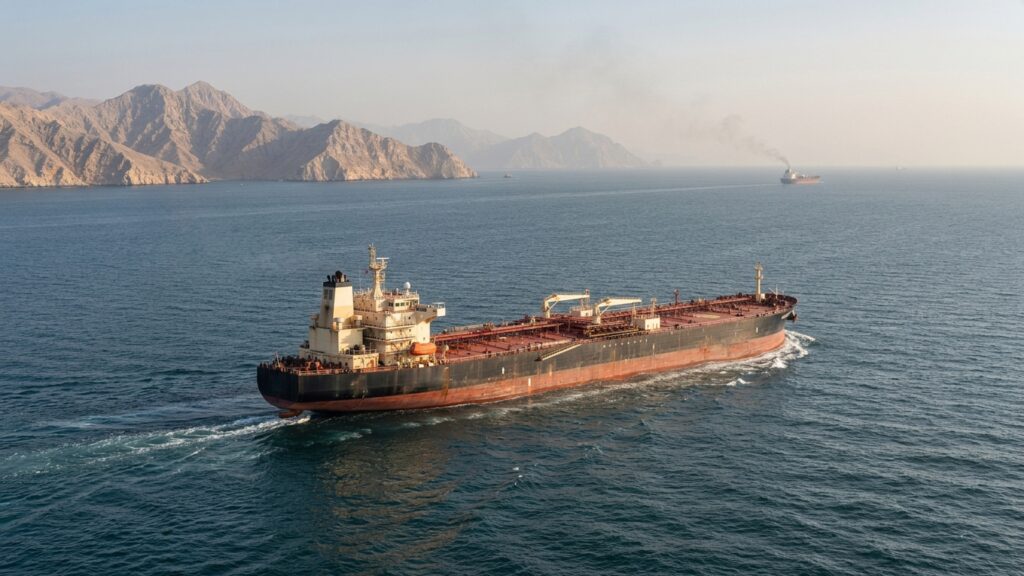
While Washington argues over budgets, the choke point at the center of this war is still burning. Early Wednesday morning, November 25, Iran’s Islamic Revolutionary Guard Corps Navy announced through state media that two oil tankers struck naval mines, exploded, and caught fire while trying to sail through what Tehran called an unauthorized route in the Strait of Hormuz, as reported by The Jerusalem Post. Iranian Army spokesperson Mohammad Akraminia added that Iran has deployed new surveillance systems in the strait and warned ships that skip Iranian coordination face rising danger.
At the same time, Washington has tightened its own grip around Iran’s economy. After reimposing a U.S. naval blockade on Iranian ports in July, U.S. Central Command (CENTCOM) launched Task Force Iron Gate on November 7, 2026, under Admiral Brad Cooper to choke off weapons and sanctioned cargo moving across Iran’s land borders and the Caspian Sea. Tehran insists it isn’t flinching. Iran’s First Vice President Mohammad Reza Aref claimed Wednesday that higher cargo clearance through northern and non-southern borders proves Iran isn’t worried about the blockade, even as the country endures one of its worst inflation spikes in decades, especially on food prices, according to The Times of Israel. Iranian state media say Tehran won’t discuss reopening the Strait of Hormuz unless Washington lifts sanctions, ends the naval blockade, and releases seized Iranian assets.
You can see the ripple effects landing straight on kitchen tables far from the Persian Gulf. Here’s how the financial and energy numbers stack up right now:
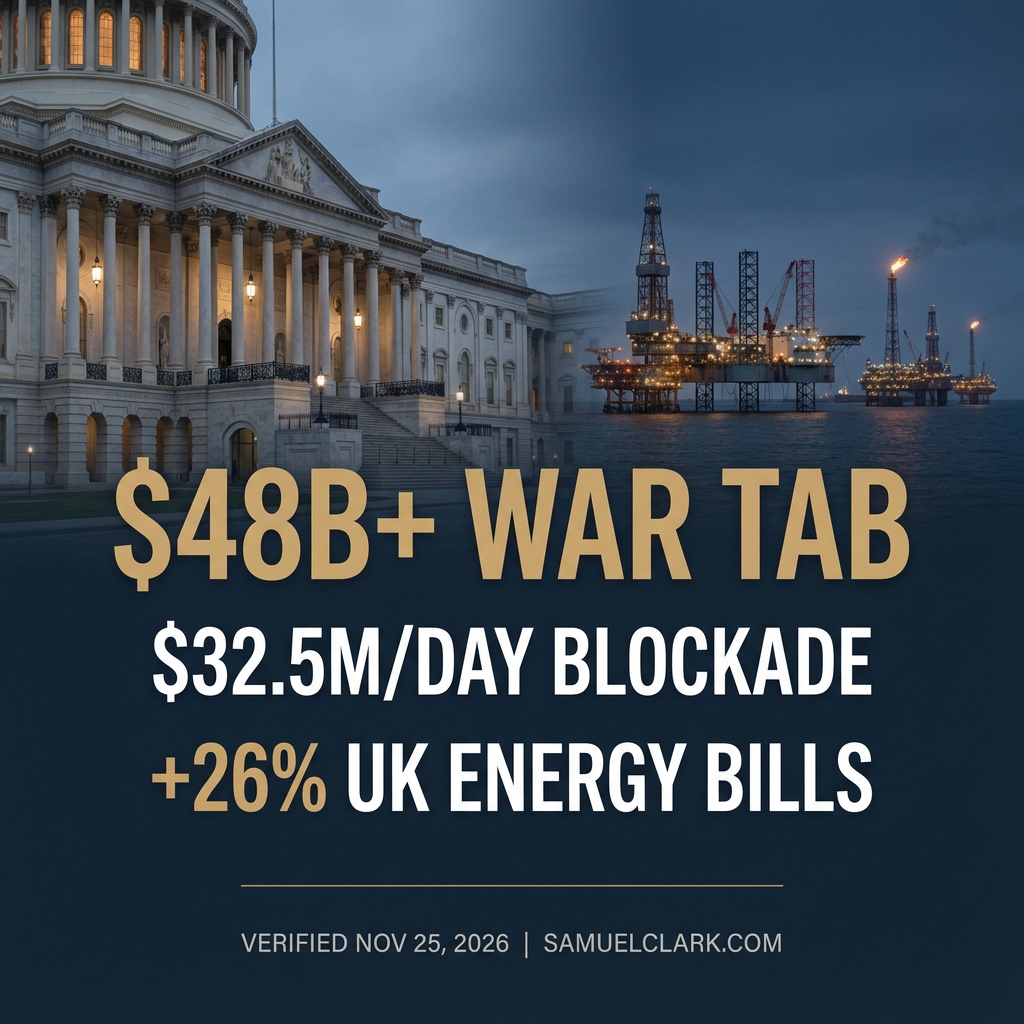
- U.S. taxpayer war tab: By late October, eight months into the conflict, the Associated Press reported the war’s cost had reached an estimated $47.1 billion. By November 19, a Pentagon budget official told the Senate Armed Services Committee that overall costs had surpassed $48 billion, per Arab News.
- Daily blockade burn rate: Acting Navy Secretary Hung Cao confirmed to senators that the U.S. naval blockade on Iranian shipping alone costs roughly $32.5 million per day, while Sen. Elizabeth Warren cited estimates of at least $400 million in damage from an Iranian strike on the Navy’s regional headquarters in Bahrain, according to Arab News.
- Stalled war supplemental: Back in June, the White House requested an $87.6 billion emergency supplemental (including $67.1 billion for defense and $21 billion just to replace spent munitions), as documented by Breaking Defense. House Republicans later passed a $95 billion reconciliation package in July, but Senate resistance and November’s midterm flip left long-term funding in limbo.
- Household energy shock in Europe: Britain’s regulator Ofgem announced Wednesday that the UK household energy price cap will surge 26 percent in January 2027, pushing the average annual bill to about 2,166 pounds (up roughly 443 pounds, or $580), directly driven by wholesale gas spikes tied to the 2026 global oil crisis in the Strait of Hormuz, per Gulf News.
Confirmed vs. Asterisk: Auditing the Biggest Claims in Today’s Headlines
Whenever a war drags into its ninth month and a political deadline approaches, both sides start tossing around big numbers. Let’s separate what’s confirmed from what carries a heavy asterisk so you don’t get pulled around by headlines.
| Claim in the News Cycle | Status | What Primary Reporting Actually Shows |
|---|---|---|
| U.S. Iran war operations are “funded” through late January 2027 | Confirmed (with caveat) | Trump stated this on the record to the New York Post (The Times of Israel). However, Pentagon officials already requested $87.6B in June to replenish depleted munitions (Breaking Defense), and a Democratic-led Congress takes office January 3, 2027 (The Business Standard). |
| Two oil tankers hit IRGC naval mines in Hormuz on Nov. 25 | Reported by Iran (Asterisk) | Carried by Iranian state media citing the IRGC Navy (The Jerusalem Post). Independent confirmation of Tehran’s minefield claims remains unverified, and The New Region notes CENTCOM has repeatedly insisted U.S. forces cleared underwater explosives and escorted 1.7 billion barrels of oil through the strait as of Nov. 14. |
| Iranian regime killed “75,000 protesters in the last seven months” | Inflated / Unverified (Asterisk) | Trump cited 75,000 in his New York Post interview (The Times of Israel). The January 2026 crackdown was horrific, with senior Iranian health officials estimating up to 30,000 killed on Jan. 8 and 9 (TIME; The Guardian), while HRANA’s named, verified count stood at 7,007 dead with 11,744 under review. The 75,000 figure is more than double the highest independent estimates. |
| U.S. Iran war costs have passed $48 billion, with UK energy bills jumping 26% | Confirmed | Confirmed in Senate Armed Services Committee testimony (Arab News) and Ofgem’s official quarterly price cap announcement on Nov. 25 (The Guardian). |
Sources compiled from The Times of Israel, The Jerusalem Post, The New Region, Arab News, TIME, and The Guardian.
Look closely at those two asterisks, because they matter for your discernment. First, Tehran has every incentive to claim the Strait of Hormuz is packed with mines so insurers hike premiums and global shipping slows to a crawl, even when CENTCOM disputes those claims. Second, the Iranian regime’s January massacre of its own citizens was genuinely awful, and there’s no need to inflate a 30,000-death estimate into 75,000 to prove the regime is brutal. Accuracy builds trust. Exaggeration burns it.
Watchman’s Opinion: A Nine-Week Clock, a Split Between Allies, and the Prophetic Mood
Watchman’s Opinion Note: The section below shares Samuel Clark’s personal perspective and prophetic commentary, kept separate from the verified news reporting above.
[INSERT IMAGE: watchman-protocol-ezekiel-scroll-hormuz-tactical-map.jpg]
Let me tell you what jumps off the page to me as a watchman looking at today’s headlines. It isn’t just that the war has dragged on for nearly nine months. It’s the growing gap between Washington’s political calendar and Israel’s survival math.
When a U.S. president says out loud that his war chest runs through late January, and in the very same breath says regime change in Tehran was never his criterion, two capitals hear that message very differently. Tehran hears a countdown clock: hold out nine more weeks, keep the Strait of Hormuz tense, let Western energy bills climb, and wait for a new U.S. Congress to tie the White House’s hands. Jerusalem hears something else entirely: if America isn’t committed to finishing off the regime and its clock is ticking down, Israel may feel forced to act sooner or stand more alone than it ever expected.
Now, hold that thought. Let’s open the Bible carefully, because careful is what a watchman owes you.
First, look at Persia. In Ezekiel 38:5 (KJV), God lists the coalition that will one day move against Israel in the latter years: “Persia, Ethiopia, and Libya with them; all of them with shield and helmet.” Here’s where I want to slow down and keep our feet on the ground. A U.S. or Israeli strike on Iran isn’t the Ezekiel 38 invasion. That prophecy describes a northern coalition coming down against a dwelling-safely Israel, not Western airstrikes on Iranian ports. Still, watching Persia locked in a grinding standoff with Israel while Washington publicly steps back from regime change is a hinge worth watching, not a fulfillment to declare. That’s the exact posture we teach in our fulfilled prophecy and discernment guide.
Second, read Luke 21:25-26 (KJV) slowly: “And there shall be signs in the sun, and in the moon, and in the stars; and upon the earth distress of nations, with perplexity; the sea and the waves roaring; Men’s hearts failing them for fear, and for looking after those things which are coming on the earth: for the powers of heaven shall be shaken.” I’m not saying Ofgem’s 26 percent energy hike or a budget fight on Capitol Hill is a direct fulfillment of Luke 21. I’m saying the mood on the earth is starting to match the mood in the text. Nations are perplexed. Leaders talk about being able to “put that war to bed anytime we want” while tankers burn in the Gulf and families in Britain brace for a winter heating shock. That also brings to mind Paul’s description in 1 Thessalonians 5:3 (KJV): “For when they shall say, Peace and safety; then sudden destruction cometh upon them, as travail upon a woman with child; and they shall not escape.” I’m not claiming today’s diplomatic backchannels are Paul’s final “peace and safety.” I’m noting that a world talking about quick exits while quietly debating targeted assassinations is the exact kind of world Paul described.
Now let’s be honest and bring in the historical counterpoint, because Christians should never wear tunnel vision. The Persian Gulf has seen dark days before. In 1973, an Arab oil embargo sent Western energy prices through the roof and left drivers sitting in miles-long gas lines. Throughout the 1980s, the Tanker War between Iran and Iraq saw hundreds of commercial ships hit by mines and missiles in these very same waters, and the U.S. Navy ran Operation Earnest Will to escort oil tankers through the Strait of Hormuz. The world didn’t end in 1973, and it didn’t end in 1988. A naval blockade isn’t an automatic countdown clock. Prudence isn’t prophecy.
So why stay awake right now? Because of how many pressures are lit at the exact same time. You’ve got an active nine-month war involving Israel and Persia, a choked global energy artery hitting Western households in real time, a fractured alliance over war aims, a $48 billion-plus tab colliding with a polarized Congress, and global supply chains already stretched thin. That isn’t a prediction of a date. It’s a warning light, not a countdown, reminding us of Paul’s words in Romans 8:22 (KJV): “For we know that the whole creation groaneth and travaileth in pain together until now.” We watch the direction of travel loosely and with open hands, just as we explain in our guide to biblical discernment.
Calm Hands, a Settled Heart: What to Do While the Clock Ticks

If reading about a January war window, burning tankers, and 26 percent winter energy spikes leaves a knot in your stomach, take a deep breath, grab a sandwich, and remember who sits on the throne. This stuff doesn’t trouble me at all, because I know who my King is.
Scripture never asks believers to panic, and it never asks us to stick our heads in the sand either. Proverbs 22:3 (KJV) gives us a simple, practical balance: “A prudent man foreseeth the evil, and hideth himself: but the simple pass on, and are punished.” If energy prices and shipping costs stay bumpy through winter, a little calm household stewardship goes a long way:
- Trim energy waste now: Check weather stripping, service your heater, and budget a small cushion for winter utility bills before January hits.
- Keep a modest pantry buffer: Pick up a few extra shelf-stable groceries and essentials each week so a short-term price jump doesn’t rattle your family budget.
- Hold a little extra to share: When you prepare calmly over a few weeks, you put yourself in a position to bless a struggling neighbor or elderly family member. Extra to share is stewardship, not fear.
- Guard your media diet: Read primary sources, skip the breathless clickbait, and test every headline against the facts and against Scripture.
That’s readiness done the Bible’s way: calm hands, a settled heart.
More than anything, keep your eyes up. Jesus didn’t give us prophetic signs to scare us; He gave them to steady us. In Luke 21:28 (KJV), He tells us: “And when these things begin to come to pass, then look up, and lift up your heads; for your redemption draweth nigh.” Every earthly empire, budget battle, and naval blockade has an expiration date. Daniel 2:44 (KJV) reminds us that “in the days of these kings shall the God of heaven set up a kingdom, which shall never be destroyed.” As Bereans who search the Scriptures daily (Acts 17:11, KJV) and rightly divide the word of truth (2 Timothy 2:15, KJV), we hold to the blessed hope that God hasn’t appointed His Church to wrath (1 Thessalonians 5:9, KJV), that He has promised to keep His faithful from the hour of temptation coming on the whole world (Revelation 3:10, KJV), and that the Lord Himself will descend to catch up His people in the air (1 Thessalonians 4:16-17, KJV).
If you’re still kicking the tires on whether the Bible can really be trusted, I’d love for you to spend a few quiet minutes with our look at the evidence the Bible is true and every Messianic prophecy Jesus fulfilled. And if you don’t yet have peace with God, today is a wonderful day to settle the only question that lasts forever. “For God so loved the world, that he gave his only begotten Son, that whosoever believeth in him should not perish, but have everlasting life” (John 3:16, KJV). You can read the simple, clear gospel message right here on our Salvation page.
Sources
- The Times of Israel (Nov. 25, 2026): Trump says Iran war ‘funded’ through January, suggesting limited window for new op
- Anadolu Agency (Nov. 25, 2026): Trump says US has funds to sustain Iran war until January
- The Jerusalem Post / Reuters (Nov. 25, 2026): Iran warns vessels to coordinate passage in Hormuz to avoid mines
- The New Region (Nov. 25, 2026): Two oil tankers hit naval mines in Hormuz: IRGC (with CENTCOM escort and mine-clearance context)
- The Guardian (Nov. 25, 2026): Energy bills in Great Britain to rise 26% in January, lifting annual cap
- Gulf News / AFP (Nov. 25, 2026): British household energy bills to jump 26% on Iran war shock
- The Business Standard (Nov. 23, 2026): How Democrats plan to use Congress’s funding power to push Trump to end Iran war
- Arab News (Nov. 19, 2026): Iran war costs surpass $48bn amid calls for base damage estimates
- The Times of Israel (Nov. 19, 2026): PM reportedly tells aides renewed war with Iran ‘unavoidable’ as Trump weighs options
- The Times of Israel (Nov. 24, 2026): Trump administration mulls targeted killings of Iranian leaders to end war
- U.S. Central Command (Nov. 7, 2026): CENTCOM Launches Task Force Iron Gate to Disrupt Iranian Ground Transit Routes
- Associated Press (Oct. 28, 2026): Iran war’s cost to American taxpayers grows to an estimated $47.1 billion
- Breaking Defense (June 24, 2026): White House sends $87.6B supplemental to Congress, with $67B for defense
- TIME (Jan. 25, 2026): More Than 30,000 Killed in Iran, Say Senior Officials
- The Guardian (Jan. 27, 2026): Disappeared bodies, mass burials and ‘30,000 dead’ in Iran protests
#IranWar #StraitOfHormuz #BibleProphecy