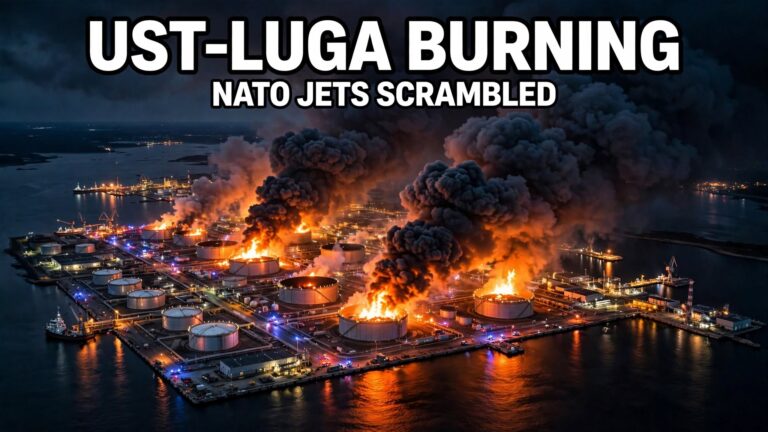
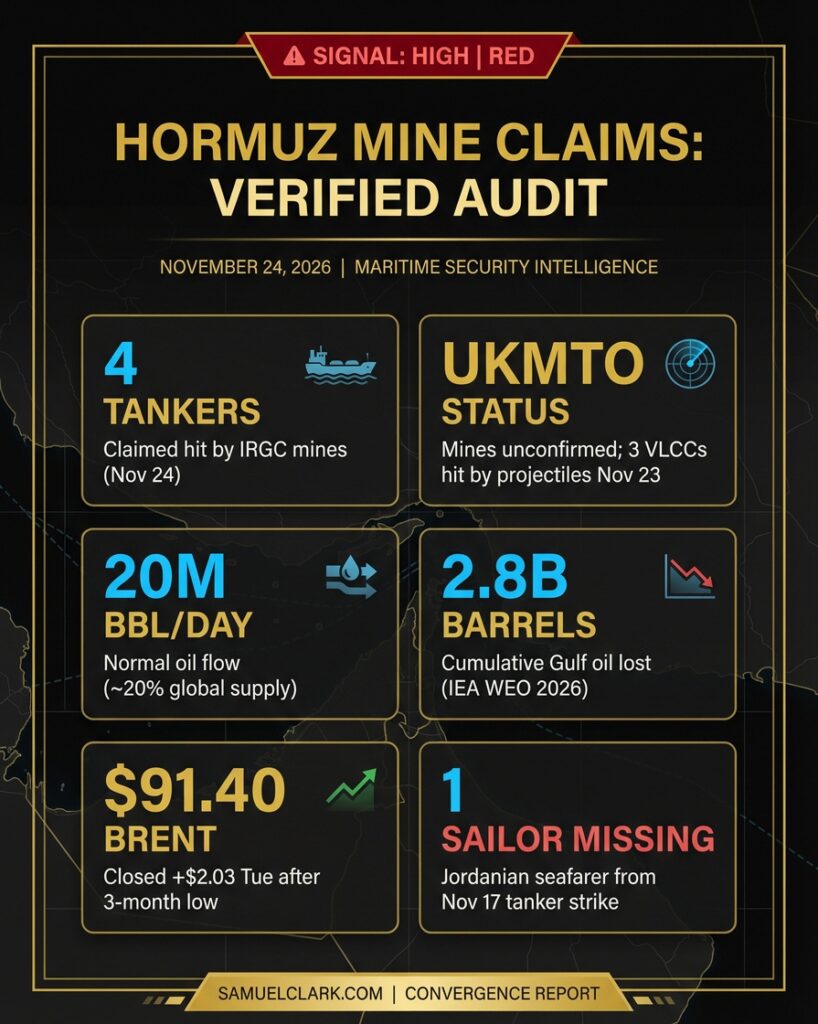
If you sat down with your morning coffee hoping for a quiet Tuesday on the global shipping wires, the Persian Gulf had other plans. Early on November 24, 2026, Iran’s Islamic Revolutionary Guard Corps (IRGC) Navy announced that a fourth oil tanker had exploded and caught fire after hitting a naval mine east of the Strait of Hormuz, pushing Tehran’s claimed mine toll to four vessels in a single push (Mehr News; Middle East Eye). Across the very same news cycle, Western maritime monitors had not yet confirmed those fresh Hormuz mine claims with ship names, photos, or vessel IDs, rescue teams from the UAE and Oman were still searching for a Jordanian sailor missing since a November 17 tanker strike (Gulf News), and Brent crude swung off a three-month intraday low to close up $2.03 at $91.40 a barrel (Nation Thailand). Any one of those alerts would make an energy desk sit up straight. Stacked together on the same Tuesday, they deserve a calm, clear-eyed audit.
My friend, I want to handle this report the way a good watchman should. I’ll give you the verified numbers from both Iranian state channels and Western maritime security agencies, but I’ll also tell you plainly what is confirmed, what carries an asterisk, and where war-zone claims are running ahead of hard proof. When headlines start throwing around words like “mines” and “four burning tankers,” social media usually hits the panic button before anyone checks the ship logs. You deserve the version you can actually trust.
Here is the path we’ll walk together: first, we’ll lay Iranian state statements side by side with Royal Navy and commercial maritime tracking so you can see where the two accounts split; second, we’ll look at the human toll behind the steel hulls, including the ongoing search for a missing Jordanian crewman; third, we’ll run the hard chokepoint math on why naval mines in the Strait of Hormuz threaten a fifth of the world’s oil and why markets are reacting the way they are; and finally, we’ll step into the Watchman’s Opinion and look at what Scripture says to do with all of it, which is neither panic nor a shrug. If you’re new here, our guides to the biblical signs of the end times in 2026 and the 2026 Iran war and the Ezekiel 38 Hormuz blockade give you the big map. This report is today’s weather.
What Iran Claimed on Tuesday vs. What Western Monitors Actually Confirmed
Let’s start with the exact wording coming out of Tehran, because precision matters when military press offices start talking. On Tuesday, November 24, 2026, statements from the IRGC Navy carried by Iranian state broadcaster IRIB and outlets including Mehr News, WANA News, and Middle East Eye reported that a fourth oil tanker had exploded and caught fire after striking a naval mine in restricted waters east of the Strait of Hormuz. According to the IRGC Navy Public Relations Office, the vessel had violated Tehran’s designated maritime regulations by entering what Iran called a false and unauthorized shipping route. The same announcement claimed that two additional tankers witnessing the blast turned back toward the Persian Gulf after receiving a radio warning from the IRGC Navy’s Strait of Hormuz Vessel Traffic Control Center.
That brings Tehran’s claimed mine total on Tuesday to four oil tankers, following earlier state broadcasts that three vessels had caught fire from mine blasts. In separate dispatches carried by Iranian media, Tehran even claimed that some of the vessels had been attempting to transit with their identification systems switched off or under U.S. military air cover.
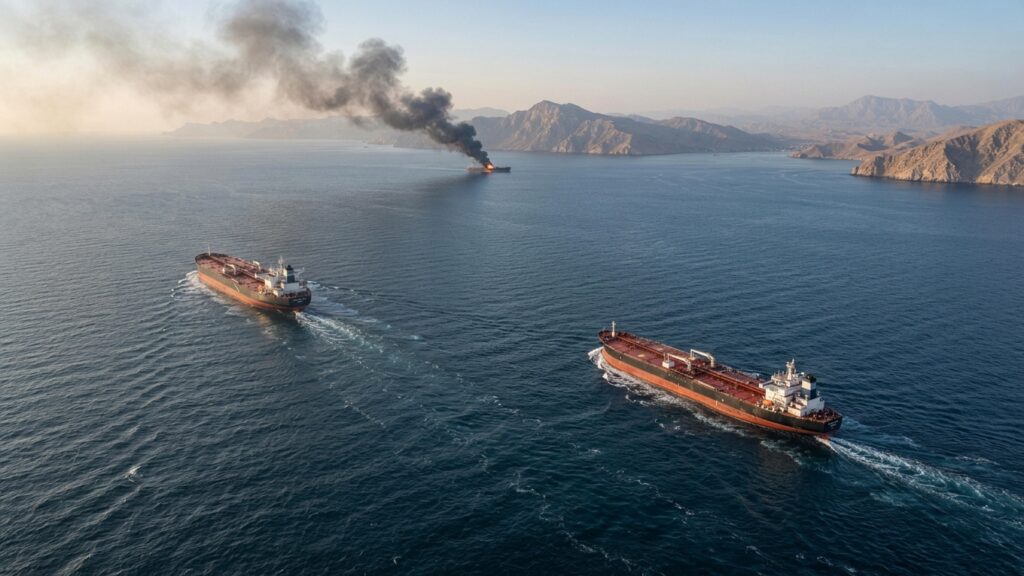
Now here is the Watchman’s Asterisk, and it’s a big one. As of Tuesday evening, the United Kingdom Maritime Trade Operations (UKMTO), the Royal Navy-led clearinghouse that logs verified commercial shipping incidents in the region, has not corroborated this fresh four-tanker mine round with vessel names, photographs, or IMO ship identification numbers. In fact, when you compare Tehran’s mine narrative against Western commercial maritime security reporting, a sharp split jumps off the page.
According to detailed maritime intelligence published by Riviera Maritime Media, maritime security firms tracked three very large crude carriers (VLCCs) commercially managed by South Korean shipping giant Sinokor taking fire from projectiles, not confirmed mines, on November 23 at roughly 20:25 UTC while transiting eastbound through the strait. Those three Liberia-flagged supertankers were identified as the Bahrain Prosperity, the Cameroon Prosperity, and the Romania Prosperity. Security firm Ambrey placed the strikes roughly 20.7 nautical miles northeast of Lima, Oman. Remarkably, all three vessels continued their voyages after the incidents with all crew members accounted for, and the full extent of any hull damage remained unclear.
Why were those three specific ships targeted? All three appear on the Persian Gulf Strait Authority’s (PGSA) 240-vessel “non-compliance list,” an Iranian domestic blacklist (not an international sanctions registry) updated on November 2 that threatened fines, detention, or action against Sinokor ships starting November 1 (Riviera Maritime Media).
Even without verified mine debris, the confirmed tempo of attacks in the waterway over the past week has been relentless. Look at the documented ledger from UKMTO, Riviera Maritime Media, and gCaptain:
- November 21, 2026: Two Hong Kong-flagged crude oil tankers were struck by unknown projectiles while heading outbound from the Strait of Hormuz. The Torkel (also on the PGSA non-compliance list) took fire to its stern around 11 nautical miles north of Khasab, Oman, forcing the crew to evacuate with no casualties reported. Roughly an hour later, the Arina took a hit to its engine room about 17 nautical miles east of Khasab, sparking an onboard fire, again with no casualties (logged under UKMTO Warnings 215-26 and 216-26).
- November 22, 2026: The Panama-flagged bulk carrier CTI Helen was hit on its port side by an unknown projectile while anchored roughly 23 nautical miles northeast of Khor Fakkan, UAE, causing a fire onboard with no casualties reported. On the same day, UKMTO Advisory 217-26 logged an incident in the Gulf of Oman where a U.S. military helicopter intercepted the Comoros-flagged LPG tanker GM 2 (also identified as Hong Gui) and ordered it to hold position.
- The Broader 2026 War Ledger: According to the Joint Maritime Information Center (JMIC), seven tankers were struck in the Strait of Hormuz between November 16 and November 21 alone, bringing total logged incidents against commercial vessels to nearly 200 since March 1, 2026. The International Maritime Organization (IMO) has formally confirmed more than 140 commercial shipping incidents and the deaths of 25 seafarers since the conflict began (Riviera Maritime Media).
Maritime security analyst Martin Kelly summed up the exact gap between Tehran’s claims and Western verification in a sober assessment quoted by Riviera Maritime Media: “In the Strait of Hormuz, Iran struck seven vessels with eight strikes, all of them outbound tankers off Khasab. That is the heaviest week of attacks since the conflict began. It is also likely that more ships were hit and never reported. There is still no evidence of mines, and CENTCOM says the southern route is clear.”
Notice how holding both truths together keeps us honest. We don’t swallow IRGC state claims as proven mine warfare until independent maritime monitors produce hull evidence, vessel IDs, or minesweeper confirmations. At the same time, we don’t shrug off the strait as peaceful when seven tankers took fire in a single week and nearly 200 commercial incidents have been logged since March. You can track the earlier stages of this maritime escalation in our ongoing coverage of tankers hit by mines in Hormuz, the Iran Kharg tanker convoy, and Iran’s pledge to break the blockade.
The Human Cost: One Missing Sailor and Rising Crew Risks
When news desks talk about supertankers and barrel counts, it’s way too easy to forget that ordinary men are standing watch on those steel decks just trying to send a paycheck home to their families.
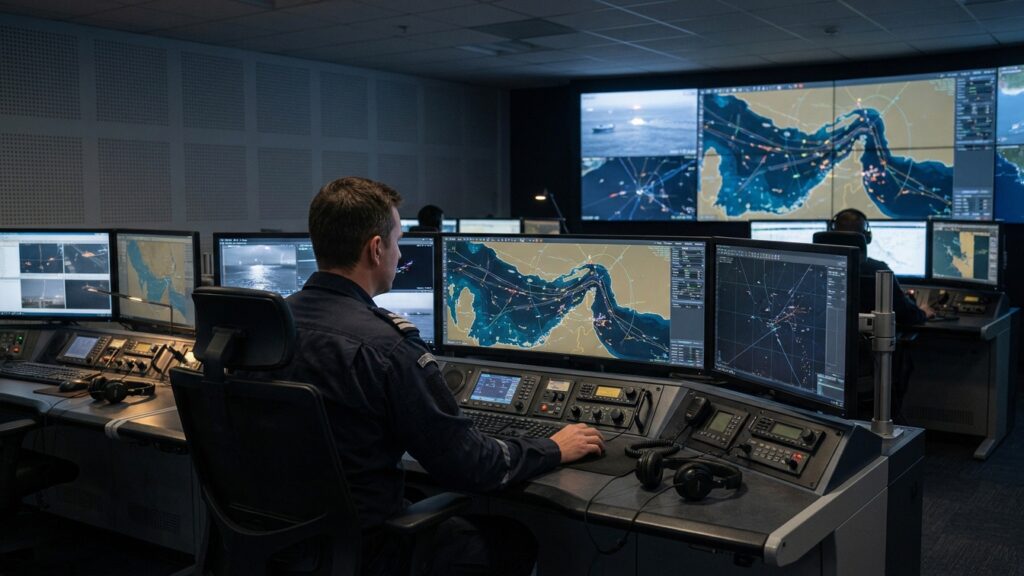
First, the verified casualty check on Tuesday’s announcements: there are no confirmed deaths or injuries reported in Tuesday’s fresh IRGC mine claims themselves, and Western monitors noted all crew members were accounted for on the three Sinokor VLCCs struck on November 23 (Riviera Maritime Media).
Second, the human wound that is still open right now in those same waters. Search-and-rescue teams from the United Arab Emirates and Oman, working in direct coordination with Jordan’s Ministry of Foreign Affairs and the Jordan Maritime Commission, are still searching for missing Jordanian sailor Mohammad Hussam Al Din Al Otaibi (Gulf News; Arab News). Al Otaibi disappeared on Tuesday, November 17, 2026, when an oil tanker operated by UAE state energy firm ADNOC Logistics & Services was struck by an unknown projectile roughly 13 nautical miles north of Khasab on Oman’s Musandam Peninsula. That strike injured 11 other crew members, who were evacuated for medical treatment, while the Jordan Maritime Commission issued an international navigational warning asking every vessel in the corridor to watch for any sighting that could bring Al Otaibi home (Roya News).
That November 17 strike occurred in the exact same escalation window as U.S. strikes on Iran on November 17 and earlier reports of a Hormuz supertanker sunk. Twenty-five merchant mariners have already lost their lives in this conflict according to IMO tallies, and JMIC currently rates the commercial threat level in the Strait of Hormuz as severe, citing persistent GPS jamming, AIS spoofing, and hostile IRGC activity. Whatever happens to oil futures this week, pause and pray for Al Otaibi’s family and for the crews steering cargo through those waters tonight.
Chokepoint Math: Why Naval Mines Change the Global Energy Equation
If you want to understand why energy traders and naval planners treat the word “mine” completely differently from a drone or rocket strike, you have to look at the geography and the math of the Strait of Hormuz.
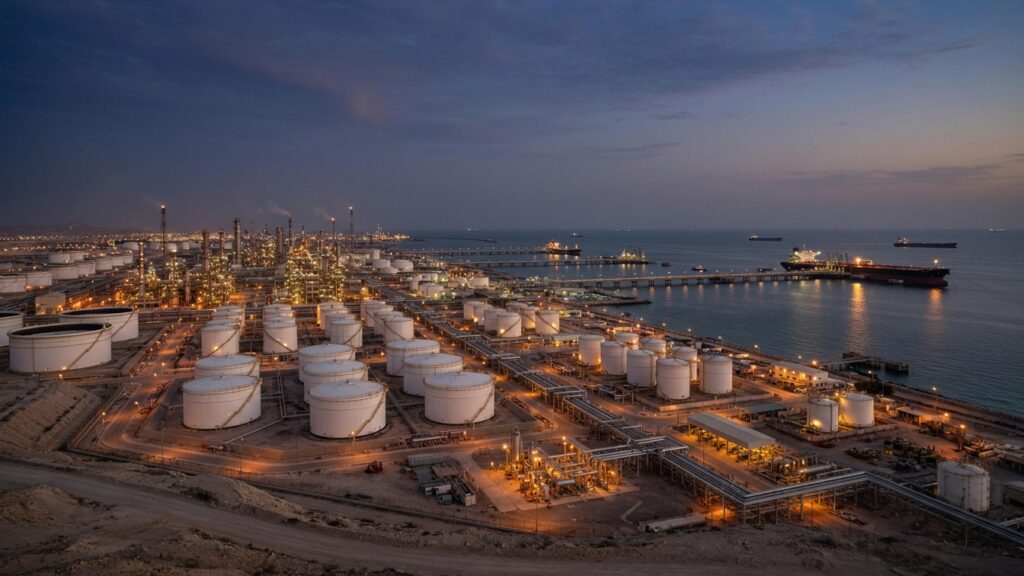
According to the U.S. Energy Information Administration (EIA) and Britannica, the Strait of Hormuz is the only sea passage linking the Persian Gulf to the Gulf of Oman and the open Arabian Sea. Before the 2026 conflict disrupted traffic, roughly 20 to 20.3 million barrels per day of crude oil, condensate, and petroleum products flowed through that narrow channel. That equals roughly 20% of global petroleum liquids consumption and about 25% of all seaborne oil trade on earth. On top of crude oil, the EIA documented that 11.4 billion cubic feet per day (more than 20% of global liquefied natural gas trade, primarily from Qatar) also transited the strait in the first half of 2025.
And unlike other maritime passages, you can’t simply steer around Hormuz. Overland bypass pipelines in Saudi Arabia and the UAE can divert only a fraction of Persian Gulf output, and EIA figures show that 89% of Hormuz crude and condensate normally heads straight to Asian refineries, with China, India, Japan, and South Korea taking 74% of the total. Even though the United States imports only about 0.4 million barrels per day directly through Hormuz (roughly 2% of U.S. petroleum consumption), oil is priced in a single global pool. When a fifth of the world’s supply gets squeezed, every gas pump, diesel truck, fertilizer plant, and grocery aisle feels the ripple.
Just how big has the 2026 shock already been? On November 19, 2026, the International Energy Agency released its World Energy Outlook 2026 and called the Hormuz crisis “the largest energy supply shock in history,” calculating cumulative losses of 2.8 billion barrels of oil and 60 billion cubic meters of natural gas from the Gulf as of November, pushing global 2026 spending on imported oil and gas to $1.6 trillion, up 25% over 2025 (MLQ / IEA World Energy Outlook 2026).
Now here is our second Watchman’s Asterisk, because honesty with market data builds trust. If four tankers supposedly hit mines on Tuesday, why didn’t oil immediately rocket past $130 a barrel?
Look at what Trading Economics, Polity, and Nation Thailand actually recorded on November 24:
- Earlier Tuesday, Brent crude actually dipped to $89.10 a barrel (and WTI touched $79.97), hovering near three-month lows last seen in late August. Why? Because the IEA reported that Persian Gulf crude exports had clawed back to roughly 74% of pre-war levels, forecasted a fourth-quarter global oil surplus, and traders were watching diplomatic talks after U.S. Vice President JD Vance met Qatar’s prime minister on Monday.
- By Tuesday’s close, however, geopolitical gravity reasserted itself. Brent crude bounced $2.03 to settle at $91.40 a barrel, while WTI crude climbed to $81.65. Behind that rebound sits a tightening military and financial vise: Washington deployed a third aircraft carrier to the Gulf last week to enforce its naval blockade of Iranian ports, the U.S. Treasury slapped fresh sanctions on more than two dozen Iranian exchange houses and front companies on Monday, and U.S. officials are actively investigating suspected Iran-linked cyberattacks targeting up to 50 commercial ships (Trading Economics; Riviera Maritime Media).
For deeper context on how this maritime squeeze ties into wider global energy shocks, read our pillar report on the global oil crisis and Strait of Hormuz disruption.
Hormuz Mine Claims: Confirmed vs. Asterisk Audit: November 24, 2026 Hormuz Fronts
| Front | Claimed / Verified Metric | Risk Window | Watchman’s Asterisk & Primary Source |
|---|---|---|---|
| IRGC Mine Claims | 4 oil tankers claimed exploded and caught fire after hitting mines east of Hormuz; 2 more turned back | Nov 24, 2026 (Active) | Asterisk: Carried by IRIB, Mehr News, and Middle East Eye; UKMTO has not confirmed names, photos, or vessel IDs. |
| Western Maritime Tracking | 3 Sinokor VLCCs (Bahrain, Cameroon, Romania Prosperity) hit by projectiles Nov 23; 7 tankers hit Nov 16 to 21; nearly 200 total JMIC incidents since March 1 | Nov 16 to 24, 2026 | Confirmed: Logged by Riviera Maritime Media, UKMTO, and gCaptain. CENTCOM says southern route is clear; no independent mine proof yet. |
| Crew Casualties | 0 confirmed casualties in Tue mine claims; 1 Jordanian sailor (Mohammad Al Otaibi) missing since Nov 17 ADNOC strike (11 injured); 25 IMO seafarer deaths in 2026 | Ongoing Search | Confirmed: UAE, Oman, and Jordan maritime rescue coordination ongoing (Gulf News; Arab News). |
| Chokepoint & Oil Markets | ~20M bbl/day normal flow (~20% global oil, >20% LNG); 2.8B bbl lost in 2026; Brent closed +$2.03 at $91.40/bbl Tue | Q4 2026 to 2027 | Asterisk: IEA sees Gulf exports back to 74% of pre-war levels and Q4 surplus, cushioning prices for now, yet 3 U.S. carriers and new sanctions keep escalation risk razor-thin (EIA; Trading Economics). |
Watchman’s Opinion: Why the Hormuz Chokepoint Matters Prophetically
Watchman’s Opinion Note: The section below shares Samuel Clark’s personal perspective and prophetic commentary, kept separate from the verified news reporting above.
Let me speak plainly from the watchtower for a minute, friend. Signal level on this one is HIGH, RED.
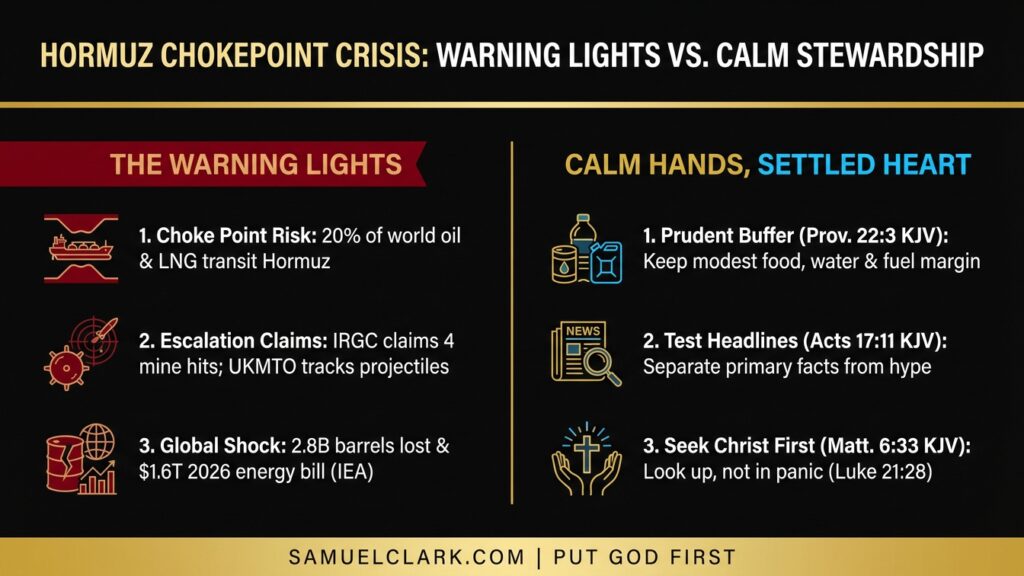
This is the choke point story. Even with our honest asterisk on whether Tuesday’s four vessels hit mines or took projectile fire, think about what changes the moment naval mines are credibly in play. A missile or drone strike is a targeted event you can try to intercept or dodge. A minefield in a narrow shipping lane is an indiscriminate lock on the door. If mines are genuinely deployed in the Strait of Hormuz, that marks a new phase beyond projectiles, and it puts a fifth of the world’s oil and liquefied natural gas in the crosshairs in one move.
Look at how cleanly this lines up with the pattern Jesus laid out on the Mount of Olives. In Matthew 24:6-8 (KJV), our Lord told His disciples, “And ye shall hear of wars and rumours of wars: see that ye be not troubled: for all these things must come to pass, but the end is not yet. For nation shall rise against nation, and kingdom against kingdom: and there shall be famines, and pestilences, and earthquakes, in divers places. All these are the beginning of sorrows.” A contested Strait of Hormuz fits wars and rumors of wars plus sudden global economic distress at the exact same time. When marine insurers pull coverage or double war-risk premiums, shipping slows, diesel climbs, fertilizer costs jump, and the strain lands right on family kitchen tables halfway around the world.
Just as telling is who sits at the strategic center of the storm. Even when the flashpoint is a strip of water between Iran and Oman, Israel remains right at the center of the chessboard because U.S., Israeli, and Iranian tension is the engine driving the blockade, the carrier deployments, and Tehran’s maritime retaliation. In Ezekiel 38:4-5 (KJV), ancient Persia (modern Iran) stands explicitly on the prophetic roster of nations aligned against Israel in the latter days. Now let me be careful here, because a watchman owes you honesty rather than hype: a shipping war in Hormuz is not the Ezekiel 38 invasion itself, which describes a specific coalition marching against a peaceful, unwalled Israel. Rather, Persia’s central role in today’s global standoff is a major geopolitical hinge showing the stage being set.
Let’s also hold a fair historical counterpoint, because sober judgment keeps us grounded. This isn’t the first time mines and burning tankers have rattled the Persian Gulf. During the 1980s “Tanker War” between Iran and Iraq, hundreds of merchant vessels were attacked, the U.S. Navy ran Operation Earnest Will to escort reflagged tankers, and the frigate USS Samuel B. Roberts struck an Iranian naval mine in April 1988, yet global commerce eventually recovered and history kept moving forward. So no, a headline out of Hormuz does not hand anyone a calendar date for the end of the world.
What makes November 2026 different is the convergence. You have the IEA calling this the largest energy supply shock in history, three U.S. aircraft carriers in the Gulf, suspected cyberattacks targeting commercial fleets, a hot regional conflict centered on Iran and Israel, and global debt and food pressures flashing across multiple continents at once. In Luke 21:25-26 (KJV), Jesus described “upon the earth distress of nations, with perplexity; the sea and the waves roaring; Men’s hearts failing them for fear, and for looking after those things which are coming on the earth: for the powers of heaven shall be shaken.” And Paul reminds us in Romans 8:22 (KJV), “For we know that the whole creation groaneth and travaileth in pain together until now.” These are warning lights on the dashboard, not reasons to lose our peace, and they call us to sharp biblical discernment.
Calm Hands, a Settled Heart: How Believers Respond
If reading about naval mines, burning tankers, and global oil chokepoints puts a knot in your stomach, take a slow breath, go grab a sandwich, and remember who sits on the throne. None of this catches the Lord off guard. This stuff doesn’t trouble me at all, because I know who my King is.

Scripture never tells believers to hoard supplies in fear or doom-scroll maritime alerts at two in the morning. Instead, Proverbs 22:3 (KJV) gives us calm, practical wisdom: “A prudent man foreseeth the evil, and hideth himself: but the simple pass on, and are punished.” Quiet stewardship looks ordinary and peaceful:
- Keep a modest household buffer: Don’t wait for a sudden spike at the pump or a local supply hiccup. Keep your car’s fuel tank above half full, maintain a couple of weeks of shelf-stable groceries, clean drinking water, and a little emergency cash on hand, plus enough extra to quietly bless an elderly neighbor if prices jump. Extra to share is Christian stewardship, not panic.
- Test every breaking headline before sharing it: Be a Berean like Acts 17:11 (KJV), who “received the word with all readiness of mind, and searched the scriptures daily, whether those things were so.” When war-zone claims hit social media, wait for primary verification before forwarding fear to your friends.
- Put God first and lift up your head: Jesus gave us our daily marching orders in Matthew 6:33 (KJV): “But seek ye first the kingdom of God, and his righteousness; and all these things shall be added unto you.” And when we see these birth pangs converging, Jesus didn’t tell His people to duck and cover. He said in Luke 21:28 (KJV), “And when these things begin to come to pass, then look up, and lift up your heads; for your redemption draweth nigh.”
As a student of Scripture, I hold to a pre-tribulation Rapture reading, rooted in promises like 1 Thessalonians 5:9 (KJV), “For God hath not appointed us to wrath, but to obtain salvation by our Lord Jesus Christ,” alongside 1 Thessalonians 4:16-17 (KJV) and Daniel 2:44 (KJV), which promises that “in the days of these kings shall the God of heaven set up a kingdom, which shall never be destroyed.” Other faithful, serious Christians study these same passages and arrive at different timing views, so I always encourage you to open your own Bible and study it out like a Berean.
If you want to examine the historical track record behind why Christians trust the Bible’s prophetic word in the first place, take a look at our guides on the evidence the Bible is true, fulfilled prophecy and discernment, and every Messianic prophecy Jesus fulfilled.
Most of all, if you aren’t sure where you stand with God tonight, don’t wait for the next crisis headline to settle the only question that lasts forever. The Bible gives us the clearest promise in history in John 3:16 (KJV): “For God so loved the world, that he gave his only begotten Son, that whosoever believeth in him should not perish, but have everlasting life.” You can read plainly how to place your trust in Jesus Christ today on our salvation page. Keep calm hands, a settled heart, and your eyes fixed on the King.
Sources
- Mehr News Agency: IRGC Navy announcement claiming a fourth oil tanker exploded and caught fire after hitting a naval mine east of the Strait of Hormuz on Tuesday, November 24, 2026.
- Middle East Eye: Live blog coverage of Iran’s fourth tanker mine claim and earlier three-vessel mine reports (November 24, 2026).
- WANA News: Details of the IRGC Navy Public Relations Office statement and radio warning to two nearby tankers turning back toward the Persian Gulf (November 24, 2026).
- Riviera Maritime Media: Primary maritime security report on the three Sinokor VLCCs (Bahrain Prosperity, Cameroon Prosperity, Romania Prosperity) hit by projectiles on Nov 23, PGSA 240-vessel non-compliance list, Nov 21-22 vessel strikes (Torkel, Arina, CTI Helen, GM 2), JMIC/IMO 2026 incident totals, and analyst Martin Kelly’s mine verification note (November 24, 2026).
- United Kingdom Maritime Trade Operations (UKMTO): Official Royal Navy-led maritime security incident log and recent advisories (Warnings 215-26, 216-26, Advisory 217-26).
- gCaptain: Coverage of UKMTO warnings detailing attacks against commercial tankers and a bulk carrier in the Strait of Hormuz corridor (November 24, 2026).
- Gulf News: Ongoing UAE and Omani search operations for missing Jordanian sailor Mohammad Hussam Al Din Al Otaibi after the November 17 ADNOC tanker attack (November 22, 2026).
- Arab News: Jordanian Ministry of Foreign Affairs confirmation of 11 injured crew members and search coordination north of Khasab, Oman (November 19, 2026).
- Roya News: Jordan Maritime Commission international navigational warning for missing seafarer Mohammad Al Otaibi (November 21, 2026).
- U.S. Energy Information Administration (EIA): World Oil Transit Chokepoints analysis documenting ~20M bbl/day oil flow, 11.4 Bcf/d LNG transit (>20% global LNG), and 89% Asian export share.
- Britannica: Reference breakdown of Strait of Hormuz maritime share (~25% of world maritime oil trade) and pipeline bypass constraints.
- MLQ / IEA World Energy Outlook 2026: International Energy Agency report calling the Hormuz crisis the largest energy supply shock in history, with 2.8 billion barrels of oil and 60 bcm of gas lost and $1.6 trillion in 2026 import spending (November 19, 2026).
- Trading Economics: Live Brent and WTI crude pricing, IEA 74% export recovery note, third U.S. aircraft carrier deployment, U.S. Treasury sanctions, and cyberattack probe (November 24, 2026).
- Nation Thailand: Market settlement confirming Brent crude closed up $2.03 at $91.40 a barrel on Tuesday, November 24, 2026.
- Polity: Intraday oil market report noting Brent’s earlier Tuesday dip to $89.10 near three-month lows (November 24, 2026).
#StraitOfHormuz #BibleProphecy #OilCrisis