Iran break US Blockade?
Will that be the headline in the news in a few days?Those are not our words. Those are Tehran’s words, spoken on the record by its foreign minister, while tankers sit staged at Kharg Island and Washington tightens the rules at sea. If you want the short version, here it is: the threat is real, the staging is real, the economic pressure is real, and the sailed convoy is not yet confirmed. This is the story where we have to be careful, friend, because the gap between staging and sailing is where hype lives, and hype is how watchmen lose credibility.
On November 20, Iranian Foreign Minister Abbas Araghchi said, “We are making every possible effort regarding oil exports and negotiations. The naval blockade must be broken.” That quote matters because it moves this story out of IRGC media commentary and into official Iranian policy talk. We will lay out what is verified, what is staged, what the US just did in response, and what would prove a breakout is actually happening. And we will keep opinion in its own box, clearly labeled, so you can tell the difference between reporting and discernment.
What Araghchi Actually Said
Let’s start with the one fact that changed this story overnight. Anadolu, via ANews, reported Araghchi’s November 20 statement in direct response to questions about reports that Iranian oil was being loaded for export. He did not hedge. He did not say Iran hopes the blockade fades. He said the blockade must be broken so Iran can resume oil exports.
That is a different kind of statement than a Fars News commentary. A commentary urges. A foreign minister signals intent. When the man who sits across the table in negotiations says the blockade must be broken, you listen, even if you do not yet see ships moving.
Araghchi also tied the two tracks together, exports and negotiations. That pairing is important. Tehran is saying it will keep talking, and it will keep trying to sell oil. It is not choosing one or the other. It is trying to do both at the same time, and the blockade is the wall in the middle of that plan.
Do not over-read the quote, though. Saying the blockade must be broken is not the same as saying a convoy sailed this morning. It is a statement of intent under pressure, not a battle report. We have to hold both truths at once, or we will either miss the signal or invent a sailing that has not happened yet.
How We Got Here: From Fars Commentary to Foreign Minister
The timeline matters, because it shows how fast this moved from suggestion to state signal.
November 18: IRGC-affiliated Fars News Agency published a commentary urging Tehran to send a group of oil tankers through the blockade. The piece said, in effect, to break the naval blockade, Iran can move a group of oil tankers to break out of it. It also warned that any interference could bring retaliation against regional energy infrastructure.
November 18, same day: US Central Command widened the blockade to cover ship-to-ship transfers. We will get to that in a minute, because it is the direct answer to the workaround Tehran was already testing.
November 19-20: Satellite and tracker reporting showed more than 14 tankers gathered at Kharg Island, many with tracking switched off, crews assigned, and Iranian flags raised.
November 20: Araghchi went on the record. The blockade must be broken.
That sequence is why this is no longer just Fars hype. Al Jazeera’s November 20 report lays out both the Fars proposal and the US response in one place, and the Institute for the Study of War’s November 20 Iran Update assesses that Iran will likely attempt to run the blockade in the coming days. ISW points to the deteriorating economic situation and the Hamshahri staging claim. It also notes the risk, which is real: losing tankers, or triggering renewed conflict.
We are not saying ISW is prophecy. We are saying a serious open-source assessment now treats an attempt as likely, not fanciful. That is a step change from a week ago.
Kharg Island: Why This Location Is the Whole Story As Iran Break US Blockade?
If you want to understand why 14 tankers at Kharg matters, you have to understand what Kharg is. Kharg Island is Iran’s primary crude export hub in the northern Persian Gulf, about 25 kilometers off the Iranian coast and hundreds of kilometers northwest of the Strait of Hormuz. Deep water lets very large crude carriers berth there. Oil arrives by undersea pipeline from onshore fields like Ahvaz and Gachsaran, and from nearby offshore fields.
Kharg handles roughly 90 percent of Iran’s crude exports, according to Columbia University’s Center on Global Energy Policy and CNN’s Kharg explainer. Storage on the island is estimated at roughly 28 to 30 million barrels. That is a major share of Iran’s onshore storage. When Kharg cannot export, Iran cannot export at scale. There is no easy substitute. The Jask terminal on the Gulf of Oman was meant to reduce that single-point dependence, but it has not meaningfully replaced Kharg.
The island has two main crude loading systems. The western Azarpad, or Sea Island, jetty sits offshore and can berth up to three large vessels at once, including very large crude carriers that carry about 2 million barrels. It is served by two large pipelines. The eastern T-Jetty is L-shaped, closer to shore, and can handle multiple smaller to medium vessels at once, in the Suezmax and Aframax range and below. It is served by four large pipelines. There are also southeast facilities for LPG, naphtha, and sulfur.
Under normal conditions, a full very large crude carrier load takes roughly 24 to 48 hours when berths are active. Pre-blockade throughput at Kharg was often in the 1.5 to 2 million barrels per day range. That is the normal world. This is not the normal world.
Under the blockade, independent trackers have repeatedly shown the main crude loading berths largely idle for extended periods since late August, after the blockade was reimposed in mid-July. No sustained visible crude loading at the jetties in recent weeks. Automated detection found no dark tankers at the terminals for long stretches. Occasional Iranian media reports of resumed activity have not been matched by consistent independent confirmation of large-scale jetty loadings.
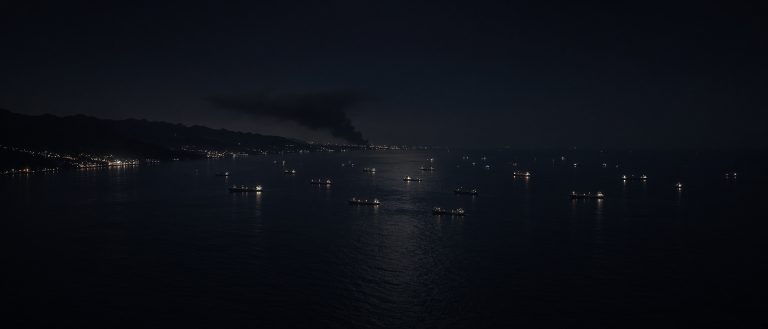
What trackers have seen instead is the anchorage. Multiple tankers, reports of 14 to 16 plus in recent days, gathered in the anchorage east and south of the island, many with AIS switched off, crews aboard, and Iranian flags raised. That is the source of the staged convoy reports. Windward and others have noted limited or no recent movement of those specific vessels, and empty berths.
Put it together and you get the real picture: storage and waiting tankers absorbing pressure, rather than exporting at scale. Production has been curtailed. The system is in a holding pattern. And a holding pattern cannot last forever when a government needs oil revenue to function.
The Staged Convoy: What Trackers Actually See
Let’s be precise about numbers, because numbers are where this story gets inflated online.
Tracked at Kharg: More than 14 tankers, with some counts at 14 to 16 plus, and Kpler cited as identifying about 20 vessels near Kharg in some reporting. The core tracked number is in the mid-teens at Kharg, not dozens.
Dozens claim: That language comes from Fars. Fars said dozens of tankers had been crewed and loaded and Iranian flags raised. That has not been independently verified. Do not report dozens as tracked fact.
Movement: As of the morning of November 21, no verified report from independent trackers, UKMTO, Reuters, or similar that a convoy has actually sailed toward the Gulf of Oman or the blockade line. Reports say preparing, staged, in coming days, not sailed.
Unverified sailing claims: Claims of 2 to 7 Iran-flagged tankers having put to sea and approaching Hormuz remain unverified. No UKMTO or Reuters confirmation.
Euronews Persian, citing satellite imagery and ship-tracking data, reported more than 14 tankers gathered at Kharg to form a convoy that would try to break the blockade. Europe Says, summarizing the same reporting, notes Al-Monitor also reported more than 14 tankers near Kharg, most with tracking transponders switched off. Hamshahri, a Tehran municipality-affiliated outlet, claimed on November 20 that Iran has staged 14 tankers at Kharg to attempt to run the blockade. That claim is carried in the ISW update, with attribution.
AIS off matters. When a tanker turns off its Automatic Identification System, it goes dark to public tracking. That does not prove it is loaded, and it does not prove it is about to sail. It does show intent to move without being easily tracked. Combined with crews aboard and flags raised, it fits staging, not normal commercial anchorage.
We also have to note what Windward and others have flagged: imagery gaps exist, so limited dark movement cannot be fully ruled out. That is honest. We cannot prove a negative from satellite gaps. What we can say is there is no confirmed, tracked, sailed convoy as of this morning.
The Workaround: One Small Ship-to-Ship Transfer That Changed the Rules
While the big convoy sits staged, a much smaller move already happened, and it is the most confirmed piece of this whole story.
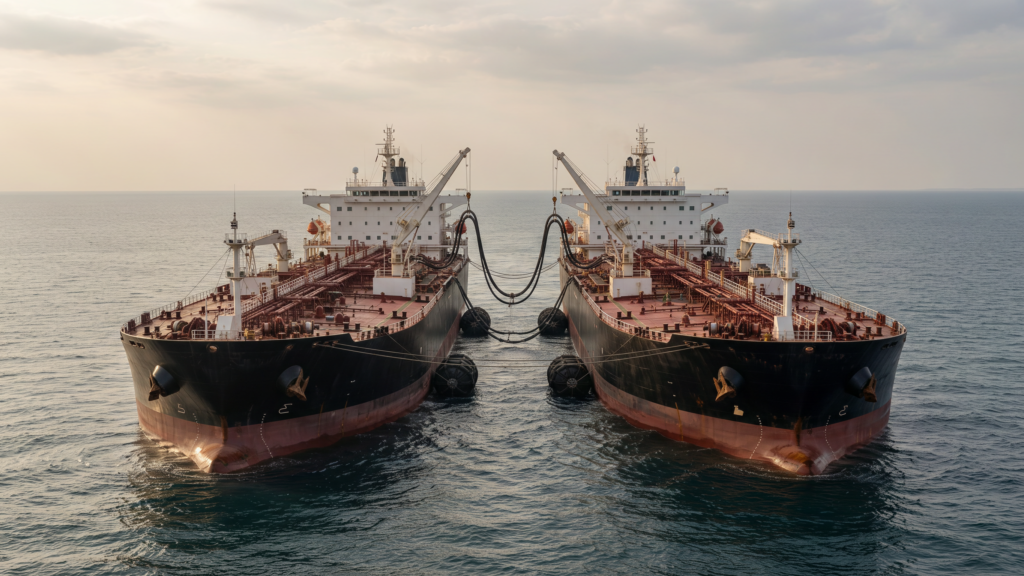
On or around November 17, the sanctioned Suezmax Olym transferred about 200,000 barrels of Iranian crude to the non-sanctioned medium-range tanker Hao Fan, south of Kharg Island, with both vessels running dark. United Against Nuclear Iran’s November 19 shipping update gives the details: Olym had been loitering in the anchorage east of Kharg since August, and fed Hao Fan about 200,000 barrels. Bloomberg, via Rigzone, confirmed the same transfer, citing UANI and Kpler, and noted Hao Fan was spoofing its location near Shinas, Oman.
200,000 barrels is small. It is not an economical long-haul cargo by itself. A very large crude carrier holds about 2 million barrels. So why does this matter?
It matters for three reasons. First, it is the first observed crude ship-to-ship transfer since the blockade was reimposed in mid-July. Second, it shows the workaround: avoid the main jetties, which are highly visible, and do the transfer in the anchorage, dark. Third, it tests the US response. If a small transfer gets through, a bigger one might be tried. If it gets stopped, Tehran learns the cost without risking the whole staged fleet.
TankerTrackers also told Reuters on November 19 that a tanker was loading Iranian crude via ship-to-ship transfer in the Gulf, and could become the first export since July, though it had not sailed yet. That aligns with the Olym to Hao Fan pattern, and with a second possible loading in the same window. We are treating the Olym transfer as confirmed, and any second loading as reported but not yet fully detailed.
UANI also reports a broader leakage picture, at smaller scale. About 12 small LPG tankers have passed the blockade line since it resumed. About 54 laden tankers, crude, products, and LPG, are along the Iranian coast. Windward notes 31 laden sanctioned tankers already past Hormuz and within roughly a day’s sail of the blockade line, mostly LPG and products, a few crude. These are not the convoy from Kharg, but they show the blockade is not airtight for smaller or product cargoes.
And here is the line UANI draws that we must keep: no laden Iranian crude tanker has successfully cleared the blockade line and avoided enforcement since before the July reimposition. LPG is not crude. Products are not crude. The big test, a crude breakout at scale, has not yet succeeded.
The US Response: CENTCOM Widens the Blockade to Ship-to-Ship Transfers
Washington did not wait for the convoy to sail. On November 18, US Central Command widened the rules.
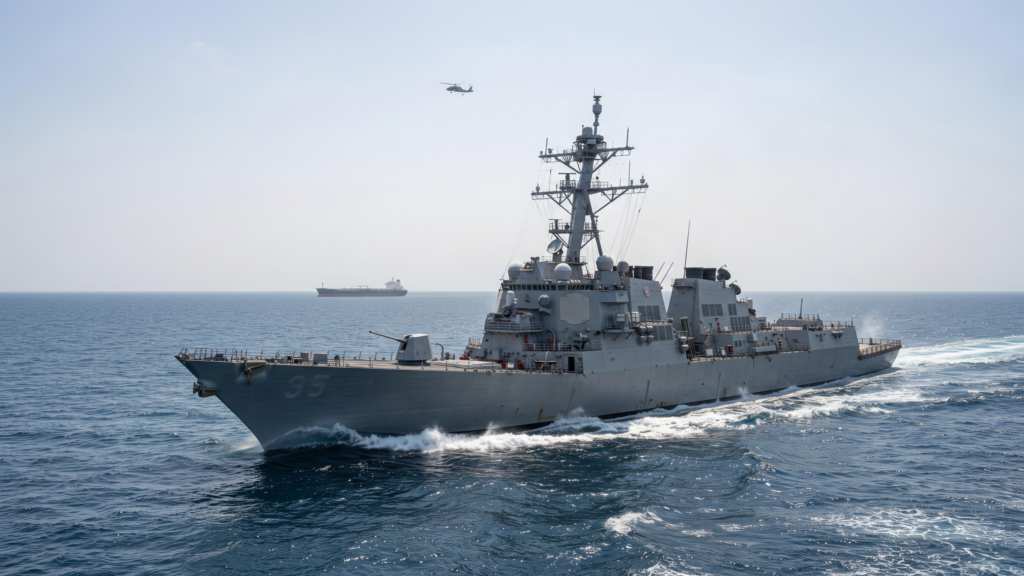
CENTCOM, in an advisory shared through the Joint Maritime Information Center, said ships receiving cargo via ship-to-ship transfer from a vessel carrying cargo loaded at an Iranian port or coastline may be considered to be evading the blockade, even if the receiving ship never entered Iranian ports or coastline. The full JMIC Advisory 017-26 carries that exact language.
Read that carefully. Before November 18, the loophole was: load at Kharg, go dark, transfer at sea to a clean ship, and the clean ship sails on. After November 18, the US says the clean ship is also evading. It can face boarding, diversion, capture, or force.
That is a direct answer to Olym to Hao Fan. It is also a warning to the staged fleet. If those 14 plus tankers try to transfer at sea and then run, the receiving ships are now in the same category.
This is why the next move matters so much. Tehran has staged. Washington has widened. The next step is not another statement. It is either movement, or a stand-down, or an interdiction that tests both sides at once.
What Is Still Not Confirmed – Read This Before You Share
We need a clear box here, because social media is already running ahead of the reporting.
NOT confirmed: A convoy has sailed. Staged is not sailed. Preparing is not sailing.
NOT confirmed: Dozens loaded and crewed. That is Fars language. Tracked number is mid-teens at Kharg.
NOT confirmed: A 2-million-barrel very large crude carrier breakout this week. That 2-million-barrel report dates back to August, not this week.
NOT confirmed: That any Iranian crude tanker has cleared the blockade line since July. UANI says none has.
NOT confirmed: That the US has seized or struck a convoy tanker in this specific Kharg attempt. No such report as of November 21 morning.
If you see a post claiming the convoy sailed last night, ask for the tracker, the UKMTO notice, or the Reuters wire. If it cannot show one of those, treat it as rumor. We will update this article when, and if, that confirmation comes.
Watchman’s Opinion: Pressure, Pride, and the January Clock
Watchman’s Opinion Note: The section below shares Samuel Clark’s personal perspective and prophetic commentary, kept strictly separate from the verified news reporting above.
When I read Araghchi’s words alongside the Kharg staging, what jumps out is not just oil. It is pressure meeting pride, on a clock that is running out for both sides.
Iran’s economy cannot live on storage forever. Tanks fill. Production gets cut. Revenue dries up. A government that cannot sell its main export cannot pay its bills, cannot fund its proxies, and cannot keep its people quiet. That is why the foreign minister is talking about breaking the blockade in public. He is not boasting from strength. He is signaling from a corner.
And Israel is watching the same clock from the other side. In my Zechariah 12 piece, I laid out how Netanyahu wants action now, Trump says wait until January, and the alliance is fraying in plain sight. That January clock is still ticking. Tehran knows Washington is holding off on major decisions until after the beginning of the year. If Iran thinks it can break the blockade before January, it changes the leverage. If it waits, it risks a new US posture in January that is even harder.
I am not saying this convoy fulfills a specific prophecy. I am not date-setting, and I am not saying a tanker sailing proves the tribulation started. What I am saying is we are watching stage-setting that fits the trajectory Scripture lays out: nations in distress, perplexity, economies shaking, and Israel increasingly alone in the middle of it.
Luke 21:25-26 talks about distress of nations, with perplexity, the sea and the waves roaring, and men’s hearts failing them for fear. I am not claiming that verse is fulfilled by 14 tankers at Kharg. I am saying that when you watch a nation try to break a naval blockade with a staged fleet, while another superpower widens the rules to stop ship-to-ship transfers, while ordinary people in the Gulf wonder if fuel and food will keep moving, you get a small, real taste of what distress of nations looks like in our time.
Deception is still the number one sign to watch, just as Jesus warned in Matthew 24:4, Take heed that no man deceive you. That warning applies to both sides here. It applies to Fars inflating dozens when trackers see mid-teens. It applies to anyone online claiming a sailed convoy with no tracker to back it. And it applies to officials who tell us everything is contained while tankers sit dark in an anchorage.
My take, and I will own it as opinion: I believe Tehran will try something in the coming days, not because it wants a war at sea, but because it cannot afford to sit still. The most likely try is not a glorious 14-ship charge in formation. It is a dark, messy, ship-to-ship test, a small cargo like Olym to Hao Fan, followed by a run for the blockade line to see if the US actually stops it. If Washington stops it cleanly, Tehran will have learned the cost. If Washington hesitates, or if a boarding goes wrong, the Fars threat about Gulf energy infrastructure stops being commentary and starts being a live risk.
That is why we watch, and why we do not hype. We watch the trackers, not the Telegram channels. We watch UKMTO, not rumors. And we keep looking up, because the One who controls the sea is not surprised by a convoy, a blockade, or a January deadline.
Just as predicted. Stay ready. Keep looking up.