Wars and Rumors of Wars: Hormuz Burns and Kyiv Is Hit While Oil Falls to $91
November 12, 2026 | Prophecy News Watch | By Samuel Clark
“And ye shall hear of wars and rumours of wars: see that ye be not troubled: for all these things must come to pass, but the end is not yet.” (Matthew 24:6, KJV)
If you’re standing at the gas pump this morning watching the price tick down a few cents while your phone buzzes with alerts about wars and rumors of wars, you’re not crazy for feeling a little whiplash. Over the last 72 hours, two supertankers carrying more than 4 million barrels of crude caught fire in the Strait of Hormuz, Russian drones and missiles slammed into a nine-story apartment building in Kyiv just as American envoys touched down in Moscow, and an Israeli strike hit the surgery floor of Nasser Hospital in southern Gaza. Any one of those headlines on its own would dominate a normal week. Stacked together on the exact same morning that cable news is celebrating “peace momentum” and crude oil is sliding toward $91 a barrel, they deserve a calm, careful look.
I want to do something a little different in this report, friend. I’ll give you the hard numbers across all four fronts, but I’ll also tell you which ones I could confirm in the original reporting, which ones come with an asterisk, and where the political headlines have run ahead of the physical facts. Some of the victory laps and viral tallies bouncing around online skip right over what’s actually happening on the water and on the ground, and you deserve the version you can trust.
Here’s the path we’ll walk: what actually happened overnight in the Strait of Hormuz, where things stand between Israel and Iran, the triple wave of drones over Ukraine alongside the Baltic airspace alerts, the hospital strike in Khan Younis, why oil prices are falling while ships are still burning, and what Scripture says to do with all of it, which is neither panic nor a shrug. If you’re new here, our guides to the biblical signs of the end times in 2026 and the 2026 Iran war and the Ezekiel 38 Hormuz blockade give you the big map. This report is today’s weather.
1. The Strait of Hormuz: Two Supertankers Burn, Zero Ships Cross, and the Asterisk You Need to Know
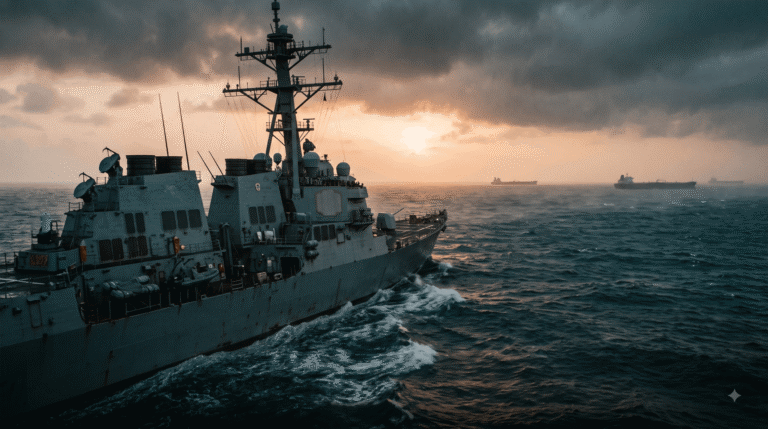
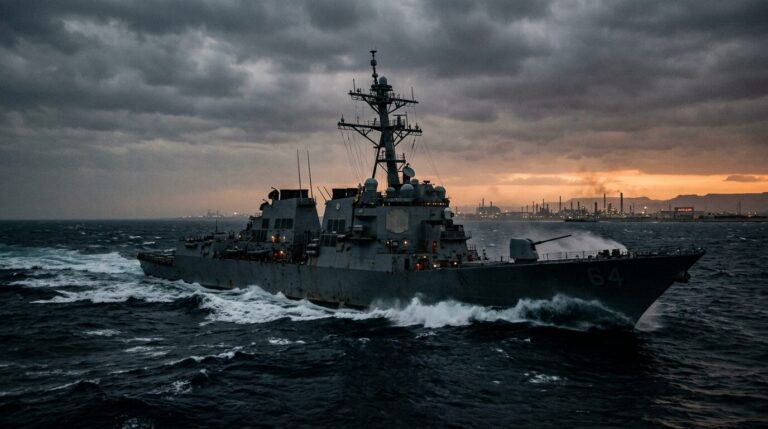
Let’s start in the Persian Gulf, because that’s where the gap between the headlines and the water is widest. On Thursday morning, Iran’s Islamic Revolutionary Guard Corps (IRGC) Navy announced that two supertankers carrying a combined 4 million barrels of crude oil exploded, caught fire, and were disabled overnight after using what Tehran called an “unauthorized southern route” and ignoring naval warnings, as reported by the International Business Times and Iran International. Regional coverage from Voice of Emirates and the Times of India added that a rescue tug also caught fire while responding and that Tehran renewed its warning to any vessels cooperating with the United States.
Now let’s put the watchman asterisk right where it belongs. Notice who made the announcement: the IRGC Navy. In several recent incidents tracked by the Iran Conflict Scenario Monitor at Global Trade Alert, Tehran has claimed unnamed supertankers struck mines on unauthorized routes without independent maritime authorities immediately verifying the vessel names or the exact cause of the blasts. At the same time, other strikes in the waterway are independently verified, such as Tuesday’s projectile hit on a Liberia-flagged tanker that injured four crew members, including an Indian seafarer confirmed by India’s shipping minister in Yahoo News reporting.
Even with that asterisk on Tehran’s exact hull claims, the shipping freeze itself is undeniable. Here are the hard numbers from the waterway:
- Zero AIS-visible commercial crossings: As of 08:43 UTC Thursday, zero commercial vessels broadcasting on Automatic Identification System (AIS) crossed the Strait of Hormuz. Before the war began in late February, roughly 78 ships a day made that transit. In the week leading up to November 8, that trickle had already dropped to about 4 ships a day.
- At least 12 vessels reported hit in November: Counting the 10 ships tracked between November 1 and November 10 plus Thursday’s two disabled supertankers, at least a dozen vessels have been caught in the crossfire this month alone.
- The cargo and hull math: Four million barrels of crude valued at Thursday’s Economic Times Brent benchmark of $91.62 equals roughly $367 million in cargo alone, sitting inside hulls worth between $80 million and $260 million. Across November so far, direct losses in hulls, cargo, and salvage sit between $800 million and $1.5 billion before you even count war-risk insurance or rerouting costs.
- Sanctions vs. tolls: Iran says the strait stays shut until its leadership orders it reopened and seven conditions are met, while Washington warned shippers on Thursday that paying Iranian transit “donations” or tolls carries severe U.S. sanctions risk.
This isn’t a solved energy crisis. It’s a blocked choke point with burning steel in it. If you want the deeper background on how this maritime choke point fits into the wider conflict, read our global oil crisis 2026 Strait of Hormuz and Red Sea guide.
2. Israel and Iran: Military Preparations vs. Political Victory Laps
Next, Persia. While Washington talks about winding things down, Jerusalem and Tehran are talking like two fighters taping their fists for the next round. On Thursday, Israeli Defense Minister Israel Katz stated that Israel will continue to act against Iran as needed and emphasized that regarding Iran’s nuclear threat, “the mission is not yet complete,” as reported by Iran International. Israeli military planners have stepped up preparations for potential follow-on operations even as IRGC commanders vow that missile production and reverse-engineering of foreign hardware will continue unimpeded.
Meanwhile, Iranian Foreign Minister Abbas Araghchi warned that while Tehran’s two-day framework proposal remains on the table, if Washington chooses renewed military action, Iran’s forces will “rain down hell,” according to Al Jazeera and Anadolu Agency. Neither Israel nor the United States launched a new strike inside Iran overnight. Still, armies rehearse worst cases. That’s their job, and preparation isn’t peace.
3. Ukraine, Moscow, and the Baltic Rim: 123 Drones and Failed NATO Shoot-Downs as Envoys Land
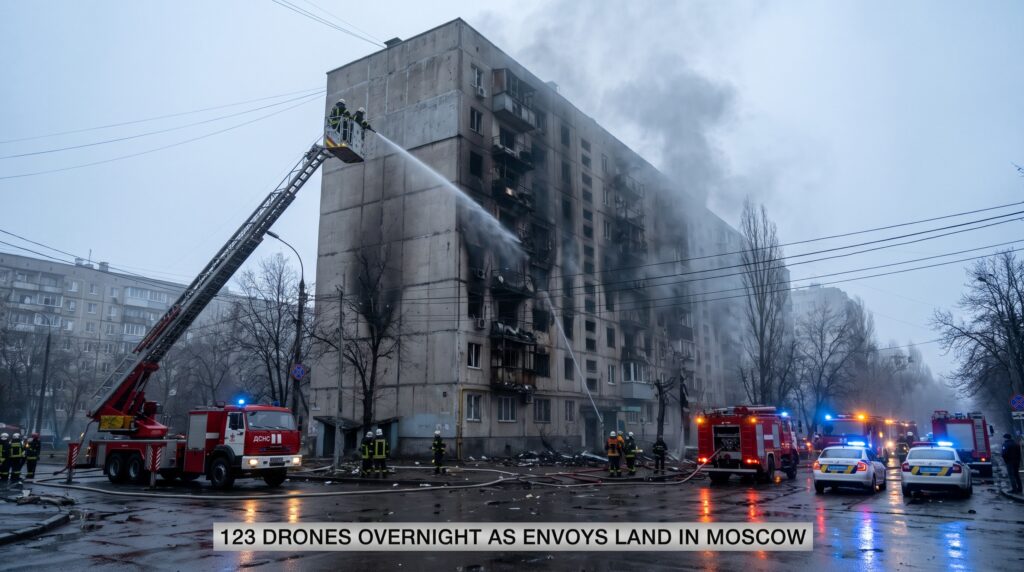
Now turn north to Ukraine and Russia, where diplomacy and bombardment happened in the exact same hour on Thursday morning. Overnight between November 11 and November 12, Russia launched a combined salvo of Iskander-M, KN-23, and S-400 ballistic missiles, Zircon anti-ship missiles, and 123 attack drones (including 73 jet-powered variants alongside Gerbera, Banderol, Dan-T, and Parodiya decoys), with Ukraine’s Air Force reporting 94 aerial targets downed and impacts across 17 locations, per Ukrainian National News (UNN) and Anadolu Agency.
In Kyiv’s Solomianskyi district, a drone slammed into a nine-story residential building, setting fire to the third through sixth floors, collapsing part of the fifth floor, killing a 44-year-old woman, and injuring five others, while a separate morning drone strike in Kherson killed a 58-year-old woman, as documented by Daily Sabah and the Odessa Journal. That marks the third straight night of 120-plus Russian drone waves: 162 drones on Tuesday night, 163 on Wednesday night, and 123 plus ballistic and Zircon missiles on Thursday morning.
Right as emergency crews in Kyiv were pulling hoses up charred stairwells, U.S. Special Envoys Steve Witkoff and Jared Kushner landed at Moscow’s Vnukovo Airport on Thursday morning, where they were met by Kremlin envoy Kirill Dmitriev for Witkoff’s tenth meeting with Vladimir Putin before flying onward to Dublin to brief Volodymyr Zelenskyy, according to the Washington Post, Radio Free Europe / Radio Liberty, and Ukrainska Pravda.
Zoom out 24 hours earlier, because the Baltic details matter too:
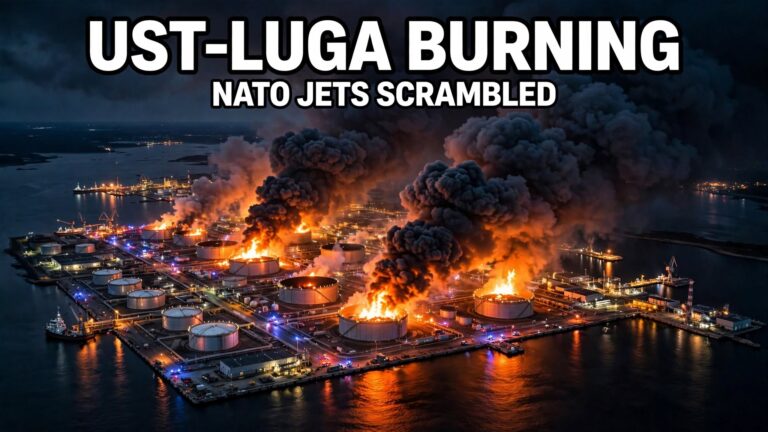
- Ust-Luga oil port set ablaze: On the night of November 10 to 11, Ukrainian long-range drones struck Russia’s massive Baltic Sea oil terminal at Ust-Luga in the Leningrad region, sparking fires at two thermal clusters and injuring three workers, as tracked by Dnes na Ukrajine and Ukrainian News.
- NATO fighters fire twice and miss over Lithuania: During that same overnight wave, at least four stray drones crossed into Baltic airspace, triggering red phone alerts across Lithuania, Latvia, and Estonia and scrambling NATO Baltic Air Policing fighter jets, per Estonian Public Broadcasting (ERR). Lithuanian military officials confirmed that NATO fighters made two unsuccessful missile attempts to shoot down a drone over northern Lithuania near Birzai before it flew into Latvia, with Lithuanian Defense Minister Robertas Kaunas noting the off-course drones were likely Ukrainian craft aimed at Ust-Luga, according to MiGFlug’s Baltic air defense report.
- The POW numbers asterisk: Two days of trilateral talks in Abu Dhabi wrapped up Wednesday with no ceasefire and Russian Foreign Minister Sergey Lavrov rejecting European security frameworks. While negotiators agreed in principle to a large-scale prisoner swap within two to three weeks, the exact headcount is still being finalized today. You may see numbers like 157, 314, or 1,500 floating around social media, but none of those figures are confirmed yet. We wait for the verified list. For context on how this northern theater has been building, see our Russia-Ukraine war and Kyiv missile strike analysis.
4. Gaza: The Midnight Strike on Nasser Hospital and the Winter Shelter Standoff
The fourth flashpoint hit shortly after midnight Thursday in Khan Younis, southern Gaza. An Israeli airstrike struck the second-floor Al-Yassin surgical department at the Nasser Medical Complex, killing six people and wounding more than 20 others, according to Gaza Civil Defence and Health Ministry officials cited by Al-Monitor and the Financial Times. Medics identified two of the dead as 52-year-old surgeon Dr. Rezik Abushira and 13-year-old Jihad Abu Teilakh.
To be fair and complete, we have to state both accounts side by side without merging them. The Israel Defense Forces (IDF) confirmed the strike, stating it was a precision operation targeting Muhammad Abu Ismail, the commander of Hamas’s Khan Younis Brigade, along with other operatives whom the military said were operating from inside the hospital complex, as reported by the Times of Israel. Meanwhile, Al-Monitor’s dispatch notes that at least 1,600 Palestinians and four Israeli soldiers have been killed since the October 2025 ceasefire deal took effect, while the United Nations issued an emergency winter aid appeal Thursday morning amid warnings that daily aid deliveries remain well below the 600-truck target.
5. Headline vs. Reality: A Side-by-Side Audit of November 12, 2026
When you put the political quotes next to the field reports, you can see right away why your gut tells you something doesn’t add up. Look at the four theaters side by side:
| Theater / Market | The Political or Market Headline | Confirmed Reality on the Ground (Nov 12, 2026) | The Watchman Asterisk |
|---|---|---|---|
| Strait of Hormuz | War “terminated” and hostilities muted since April 7 ceasefire | 0 AIS commercial crossings as of 08:43 UTC; 2 supertankers (4M+ bbls, ~$367M cargo) reported ablaze; 12+ vessels hit in Nov | IRGC Navy claimed the 2 supertanker blasts; vessel names and exact mine/missile causes await independent maritime confirmation |
| U.S., Israel & Iran | “Iran, militarily, is effectively over” and new U.S. strikes “not necessary” | Israeli DM Katz says mission “not yet complete” and orders strike prep; Iran FM vows to “rain down hell” if attacked | Direct U.S.-Iran fire has paused since April 7, which is a narrow legal War Powers distinction, not a regional peace treaty |
| Ukraine & Baltic Rim | Witkoff and Kushner land in Moscow after Abu Dhabi talks; POW swap ahead | 123 drones + Zircon & Iskander missiles hit Ukraine (3rd night of 120+ drones); Kyiv high-rise struck; Ust-Luga port burned; NATO jets missed stray drone twice | Rumored POW swap numbers (157, 314, or 1,500) are unconfirmed; off-course drone over Lithuania was likely Ukrainian aimed at Ust-Luga |
| Gaza (Khan Younis) | Year-old October 2025 ceasefire framework continues under Board of Peace | Midnight strike hits Nasser Hospital 2nd floor; 6 killed including surgeon Dr. Rezik Abushira & 13-year-old; 1,600+ killed since ceasefire began | Health Ministry reports civilian/medical casualties while IDF confirms targeting Hamas Khan Younis Brigade commander Muhammad Abu Ismail |
| Crude Oil & Gas Prices | Brent crude drops over 1to~91.29-$91.62 on peace optimism | Physical Hormuz transit remains frozen at 0 ships; gap temporarily masked by +2.04M bpd OPEC+ output and U.S. inventory draws | Paper futures price tomorrow’s U.S. strike odds, not today’s blocked strait; U.S. SPR sits near 44-year lows (~282.7M bbls) |
Sources: Compiled from International Business Times, The Washington Post, Ukrainian National News, MiGFlug, Al-Monitor, The Times of Israel, and The Economic Times.
6. Why President Trump Says It’s “Effectively Over” (And Why Crude Oil Is Falling)
So why is the White House talking like the war is in the rearview mirror? Because President Trump has been saying it in those exact words all week. Speaking to reporters at the White House on Monday after meeting Qatari Prime Minister Sheikh Mohammed bin Abdulrahman, Trump declared, “Iran, militarily, is effectively over. We’re just keeping it the status quo,” adding, “At this point, taking the military action doesn’t seem to be a very necessary thing… I think it’s going to be ending fairly soon,” as reported by The Washington Post and Anadolu Agency.
He repeated that message on Wednesday, telling reporters that talks had gone “very good” and telling a Veterans Day audience that while the conflict wasn’t completely finished, “We won, it’s just a question of when we’ll want to end it. We want to make sure we have total victory, not just a 93 percent victory.” Earlier, in a formal War Powers letter to congressional leaders, the administration stated that U.S. hostilities with Iran had “terminated” because “there has been no exchange of fire between United States Forces and Iran since April 7, 2026,” according to Forbes and Iran International.
Read that legal wording carefully, friend. The administration’s claim is narrow: direct bilateral fire between U.S. forces and Iran has been paused under an extended ceasefire since April 7 (aside from localized naval blockade enforcement). President Trump isn’t claiming the Strait of Hormuz is open to normal traffic. He isn’t claiming Israel and Iran have made peace, or that Kyiv and Gaza are quiet. When television chyrons compress “no direct U.S.-Iran exchange of fire since April 7” into “War Is Over,” that’s where the confusion starts.
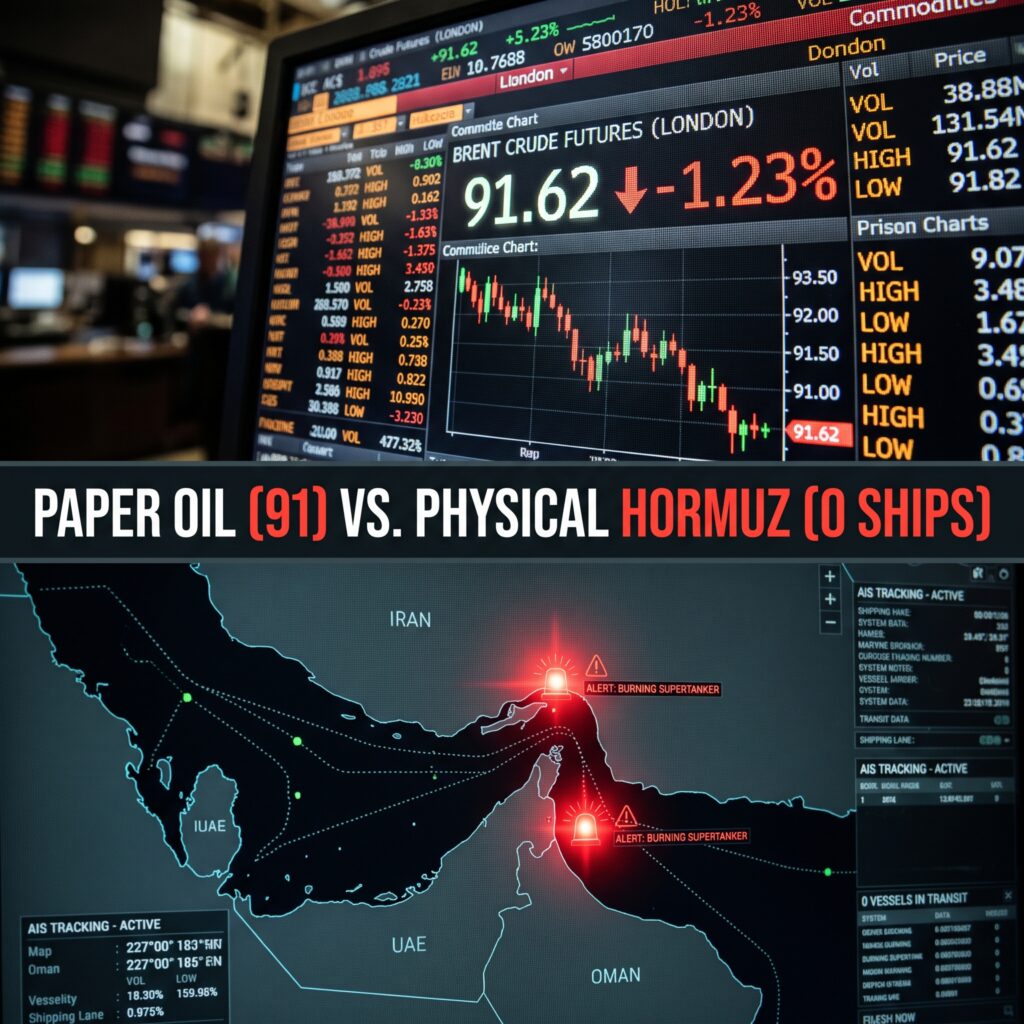
And what about the gas pump? How can crude oil drop past $91 when supertankers are burning? There’s nothing mystical about it. Right now, paper oil and physical oil are disconnected for three concrete reasons:
- The war premium is unwinding on Wall Street: As Euronext financial news and Investing.com tracked on Thursday morning, oil fell more than $1 per barrel, with Brent crude slipping to $91.29 and $91.62, because traders priced out an immediate American bombing campaign against Iranian oil fields this week. Futures traders don’t trade yesterday’s burning hull; they trade tomorrow’s U.S. strike probability.
- OPEC+ is pumping hard to mask the gap: According to The Economic Times and ANI News, OPEC+ crude output surged by 2.04 million barrels per day in October led by Saudi Arabia’s recovery, while U.S. crude inventories ticked higher. More barrels outside the choke point plus less fear of an imminent U.S. airstrike equals lower paper prices.
- The Hormuz blockade is already priced in: Markets already assumed normal Hormuz traffic was frozen. Two more tankers catching fire in a strait where zero AIS ships crossed today doesn’t subtract new barrels from a spreadsheet that already wrote Hormuz off. And because retail gas prices lag crude futures by weeks and follow winter seasonal demand dips, pump prices can drift down even while a tanker burns at midnight.
Here’s the catch every family budget needs to understand: covering a closed Strait of Hormuz by leaning on spare OPEC+ capacity, pipeline bypasses, and emergency stockpiles (with the U.S. Strategic Petroleum Reserve already down around 282.7 million barrels, its lowest level since 1982 per Global Trade Alert) works until it doesn’t. If spare capacity runs thin or a major spill locks the channel for months, that paper discount can snap back fast.
7. The Prophetic Lens: Holding Matthew 24 and 1 Thessalonians 5 with Watchman Care
So how should a Bible-believing Christian read a week like this? First, look again at what Jesus told His disciples on the Mount of Olives in Matthew 24:6 (KJV): “And ye shall hear of wars and rumours of wars: see that ye be not troubled: for all these things must come to pass, but the end is not yet.”
Notice that Jesus didn’t say you’d only hear of wars. He said you’d hear of both at the exact same time: real shooting wars and swirling rumors of wars, threats, ultimatums, and diplomatic brinkmanship. The Apostle Paul adds the flip side of that coin in 1 Thessalonians 5:3 (KJV):
“For when they shall say, Peace and safety; then sudden destruction cometh upon them, as travail upon a woman with child; and they shall not escape.” (1 Thessalonians 5:3, KJV)
And Jesus describes the broader global pressure in Luke 21:25-26 (KJV):
“And there shall be signs in the sun, and in the moon, and in the stars; and upon the earth distress of nations, with perplexity; the sea and the waves roaring; Men’s hearts failing them for fear, and for looking after those things which are coming on the earth: for the powers of heaven shall be shaken.” (Luke 21:25-26, KJV)
Here’s where I want to be careful, because careful is what a watchman owes you. We don’t set dates, and I’m not claiming that envoy flights to Moscow, talks in Abu Dhabi, or a White House press conference are the final fulfillment of Paul’s “peace and safety.” I’m noting that a world that talks peace on camera while supertankers burn in the Gulf and apartment blocks burn in Kyiv is the exact kind of world Paul and Jesus described. Similarly, when we watch Israel preparing for potential action against Iran while Russian envoys negotiate across the table, a strike on Iran wouldn’t be the Ezekiel 38 invasion. That prophecy in Ezekiel 38:4-5 (KJV) describes a northern coalition led by Gog and joined by Persia (Iran) coming against a restored Israel, not Israel or America striking Iran first. Persia’s posture and its deepening ties with Moscow are hinges to keep watching, not a fulfillment to declare. You can read how we separate real prophetic alignment from internet hype in our guide to fulfilled prophecy and biblical discernment and our watchman discernment pillar.
Let’s also give the honest historical counterpoint. The world has lived through double-screen moments before. During the 1973 Yom Kippur War oil embargo and the 1980s Tanker War in the Persian Gulf, diplomats held peace summits in Geneva while Lloyd’s of London tracked burning oil tankers in the Gulf. During the Cold War, superpowers signed arms treaties while proxy wars raged. History has been loud before. What makes November 2026 worth watching isn’t any single headline in isolation. It’s how many pressures are lit at once across the exact geographic fault lines Scripture tells us to watch, alongside the global weather events and birth pangs groaning across creation. That isn’t a countdown clock. It’s a reason to stay awake, because “the whole creation groaneth and travaileth in pain together until now” (Romans 8:22, KJV).
8. Calm Hands, a Settled Heart: What to Watch Next and How to Stand Firm
If reading about burning supertankers, midnight hospital strikes, and stray drones over NATO borders leaves a knot in your stomach, take a deep breath, grab a sandwich, and remember who sits on the throne. This stuff doesn’t trouble me at all, because I know who my King is.
Jesus didn’t give us Matthew 24:6 so we’d glue ourselves to doom-scrolling feeds at 2:00 a.m. He gave it to us with a direct command right in the middle of the verse: “see that ye be not troubled.” At the same time, Scripture commends practical wisdom for your household. Proverbs 22:3 (KJV) says, “A prudent man foreseeth the evil, and hideth himself: but the simple pass on, and are punished.”
While paper crude is giving us a breather around $91 a barrel and winter is setting in, here are four calm, practical ways to practice stewardship this week without an ounce of fear:
- Top off the tank and winter fuel early: Don’t wait for a Hormuz headline snap-back to fill your car’s gas tank, check your home heating oil or propane levels, or pick up a stabilized fuel can for your generator. Doing it when pump prices are calm is just good housekeeping.
- Keep a two-week pantry and medicine buffer: Whenever shipping lanes like Hormuz or Baltic ports take hits, freight and grocery costs eventually feel the ripple. Pick up a few extra staples, prescription refills, and winter basics over the next couple of weeks so you have enough for your family and extra to share with an elderly neighbor.
- Watch five concrete indicators, not the cable chatter: Over the next seven days, keep a quiet eye on (1) whether AIS commercial crossings in Hormuz budge from zero, (2) the verified POW swap headcount coming out of the Moscow and Dublin meetings, (3) whether Israel’s military preparations remain deterrence or turn kinetic, (4) whether Brent crude holds $91 or snaps back if OPEC+ spare capacity tightens, and (5) whether winter aid trucks actually clear into Gaza.
- Guard your family’s peace at the dinner table: Check the news once, verify the primary sources, pray for the hurting families in Kyiv, Gaza, Israel, and across the Middle East, and then turn the screen off and be present with your kids and your church.
Extra to share with your neighbors: that’s stewardship, not fear. That’s watching the news done the Bible’s way: calm hands, a settled heart.
Above all, remember where this story is heading. Jesus told us in Luke 21:28 (KJV), “And when these things begin to come to pass, then look up, and lift up your heads; for your redemption draweth nigh.” Human empires, peace summits, and oil markets rise and crack, just as Daniel foresaw in Daniel 2:44 (KJV): “And in the days of these kings shall the God of heaven set up a kingdom, which shall never be destroyed.”
Here at SamuelClark.com, we hold with humble conviction to the pre-tribulation Rapture of the Church, looking for the blessed hope when the Lord Himself descends from heaven with a shout (1 Thessalonians 4:16-17, KJV), trusting that God has not appointed us to wrath (1 Thessalonians 5:9, KJV) and has promised to keep His people from the hour of temptation that shall come upon all the world (Revelation 3:10, KJV). Good Christians who love the Lord and study their Bibles sometimes differ on the exact timing of end-times events, so don’t take my word for it. Be like the Bereans in Acts 17:11 (KJV) who searched the Scriptures daily to see whether those things were so, and study to show yourself approved unto God (2 Timothy 2:15, KJV). If you want to see why we trust the reliability of the Bible with our lives, explore our guides to the evidence the Bible is true and every messianic prophecy Jesus fulfilled, along with our foundational hub on biblical signs of the end times.
And if you don’t yet know for certain that your sins are forgiven and that you belong to Jesus Christ, don’t wait for the next headline to settle your eternity. The heart of the whole Bible fits in one verse: “For God so loved the world, that he gave his only begotten Son, that whosoever believeth in him should not perish, but have everlasting life” (John 3:16, KJV). Come read how you can know Him today on our salvation page.
#WarsAndRumorsOfWars #StraitOfHormuz #BibleProphecy
Sources
- International Business Times: Iran Says Two Supertankers Carrying 4 Million Barrels Were Disabled in Strait of Hormuz (Nov 12, 2026)
- Iran International: IRGC Navy Statement on Two Supertankers & Israeli Defense Minister Israel Katz Remarks (Nov 2026 Live Updates)
- Voice of Emirates: Revolutionary Guard Announces Two Oil Tankers and Rescue Tug Caught Fire in Hormuz (Nov 12, 2026)
- Yahoo News / Reuters: Oil Prices and Strait of Hormuz Shipping Disruption & Indian Seafarer Injury Confirmation (Nov 11, 2026)
- Global Trade Alert: Iran Conflict Scenario Monitor – Hormuz Transit & U.S. SPR Data (Nov 2026)
- The Washington Post: Trump Says He Sees No Need for New Military Strikes Against Iran, Calls War “Effectively Over” (Nov 9-10, 2026)
- Anadolu Agency: Trump Says Military Action Against Iran “Doesn’t Seem to Be a Very Necessary Thing” (Nov 9, 2026)
- Forbes: Trump Tells Congress in War Powers Letter That Iran Hostilities “Have Terminated” Since April 7 Ceasefire (2026)
- Al Jazeera: Iran Foreign Minister Abbas Araghchi Warns Forces Will “Rain Down Hell” If Attacked (Nov 9, 2026)
- Ukrainian National News (UNN): Russian Drone Struck High-Rise Building in Kyiv’s Solomianskyi District; 94 of 123 Drones Neutralized (Nov 12, 2026)
- The Washington Post / AP: U.S. Envoys Witkoff and Kushner Meet Putin at the Kremlin Following Abu Dhabi Talks, Head to Dublin (Nov 12, 2026)
- MiGFlug: Lithuania Drone Incursion – NATO Fighters Fire Twice and Miss Amid Ust-Luga Strike & Baltic Alerts (Nov 12, 2026)
- Al-Monitor / Reuters: Israeli Strike on Southern Gaza’s Nasser Hospital Kills Six Including Surgeon Dr. Rezik Abushira (Nov 12, 2026)
- The Times of Israel: IDF Targets Top Hamas Khan Younis Brigade Commander Muhammad Abu Ismail in Strike on South Gaza Hospital (Nov 12, 2026)
- The Economic Times: OPEC+ Oil Output Rises 2.04 Million bpd in October as Brent Trades Around $91.62 (Nov 12, 2026)
- Euronext Financial News: Oil Falls Over $1 on Easing Geopolitical Fears and Oversupply Worries (Nov 12, 2026)