Every November, a high-priced British magazine drops an illustrated forecast cover that looks less like financial journalism and more like an art-school fever dream. When The Economist released The World Ahead 2027 this week, internet commentators immediately began dissecting its red, black, and white symbols of chained oil tankers, dueling tanks, missiles, syringes, and a circuit-board brain. Around the exact same news cycle, the Dow Jones Industrial Average plunged nearly 875 points in a single session on November 17, 2026, led by steep drops in software and tech giants, while major global network outages disrupted millions of users across more than 70 countries in mid-November. Any single headline could be brushed off as routine end-of-year noise, yet stacked side by side, they deserve a calm, clear-eyed look.
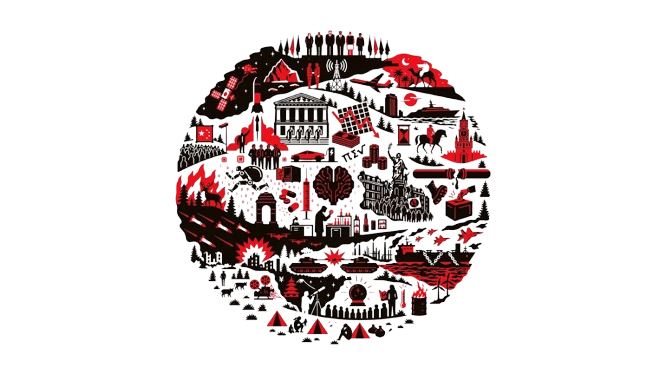
Here is the Economist World Ahead 2027 Cover
In this analysis, friend, I want to take a distinct approach. Beyond walking you through the data and detailing what is rendered on that cover, I will directly clarify which assertions are validated by primary sources, which carry significant caveats, and where viral speculation has outpaced the documented facts. Some of the interpretations bouncing around prophecy circles this week are stretched past what the reporting supports, and you deserve the version you can trust.
Here’s the path we’ll walk: what the magazine’s ownership and cover illustration actually depict, what the editors wrote versus what social media read into the artwork, where the market and network numbers stand, and what Scripture says to do with all of it, which is neither panic nor a shrug. If you’re new here, our guides to the biblical signs of the end times in 2026 and the 2026 Iran war and the Ezekiel 38 Hormuz blockade give you the big map. This report is today’s weather.
What The Economist Actually Is and Who Owns It
Before we read symbols into a magazine cover, it helps to know what the outlet actually is. The Economist was founded in London in September 1843 by Scottish businessman and banker James Wilson to campaign for free trade and the repeal of Britain’s Corn Laws. Today it remains a weekly current-affairs publication with a global circulation around 1.225 million, heavily read by central bankers, corporate executives, and policy-makers across London, New York, and Washington.
Viral posts often frame the magazine as a secret blueprint written by a single banking dynasty. Let’s check the actual ownership record. Sir Evelyn Robert de Rothschild did serve as chairman of the company from 1972 to 1989, and Rothschild family interests still hold a roughly 21 percent stake alongside the Cadbury and Schroder families, while the Agnelli family’s holding company Exor holds the largest single block at 43.4 percent and Canadian businessman Stephen J.R. Smith acquired a 26.9 percent stake in March 2026. Editorial independence is overseen by a formal board of trustees that appoints the editor, currently Zanny Minton Beddoes, while deputy editor Tom Standage edits the annual forecast issue.
That distinction matters. The magazine isn’t issuing marching orders from a hidden bunker. It’s broadcasting the consensus anxieties of the Western financial and political establishment, which is plenty revealing on its own without adding conspiracy fog.
Fact-Checking the Viral Cover Claims: Confirmed vs. Asterisk

The cover artwork for The World Ahead 2027, illustrated by artist Cleon Peterson in stark red, black, and white, packs dozens of visual vignettes into a circular disc. Viral commentary circulating on Prophecy News Watch and The Economic Collapse Blog treats almost every symbol as a coded warning of imminent world war, engineered bioweapons, and total collapse. When you compare the artwork against the actual ten themes published by editor Tom Standage, some interpretations line up cleanly and others carry a clear asterisk.
| Cover Symbol | Viral / Blog Interpretation | Verified Editorial Context & Audit |
|---|---|---|
| Chained oil tanker & jets | Ongoing Iran conflict and Strait of Hormuz blockade continuing through 2027 | Confirmed: Matches Theme 2 (“Aftershocks from Iran”), warning of disrupted energy flows, fertilizer shortages, and strained U.S. alliances. |
| Dueling tanks & Kremlin tower | Direct NATO entry into the Russia-Ukraine ground war in 2027 | Asterisk: Tanks and Moscow’s Spasskaya Tower with an hourglass appear on the art, though Russia-Ukraine isn’t one of the main ten cover themes. |
| Missiles over a city skyline | Iranian strikes on Israel, Russian strikes on Ukraine, or imminent nuclear war | Asterisk: Positioned directly beneath a Chinese flag and surveillance camera, linking primarily to Theme 6 (“Taiwan’s moment of peril”) and Xi Jinping’s 2027 military readiness benchmark. |
| Syringe, pills & lab vial | Weaponized smallpox or Ebola bioweapon release with a 50% death rate | Asterisk: The editors’ actual Theme 8 (“The Ozempic effect”) focuses on GLP-1 weight-loss drugs reshaping consumer spending on fitness, cosmetics, and clothing, not a bioweapon plot. |
| Circuit-board brain & red arrow | AI bubble burst, market crash, and widespread AI-driven cyberattacks | Confirmed: Matches Theme 4 (“The AI backlash grows”), explicitly warning of debt-fueled opaque AI deals, market correction risks, and AI-powered cyberattacks. |
Sources: Cover visual breakdown via Promptowy and Medium; official editorial themes via The Economist Group Press Centre and The Economic Times.
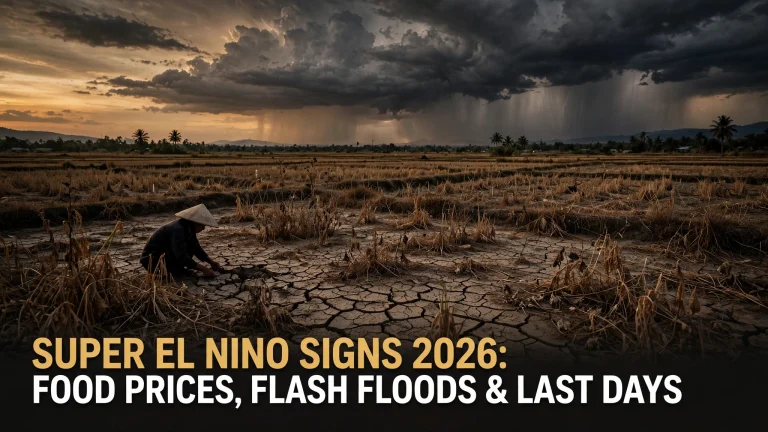
Look closely at that syringe and pill pairing in the center of the disc. When you see a syringe next to capsules on a dramatic red-and-black cover, it’s easy to jump straight to plague scenarios. Yet the editors’ own published table of contents points to commercial weight-loss medications and consumer spending shifts rather than a hidden bioweapon confession. Meanwhile, the real geopolitical alarms on the cover are plenty serious on their own: the aftermath of the global oil crisis and Strait of Hormuz disruption, fertilizer and food supply strain worsened by a developing El Nino, sovereign bond-market stress in indebted Western nations like France, and Beijing’s 2027 readiness timeline around Taiwan.
Market Volatility and November’s Internet Disruptions

Part of the reason this cover struck such a raw nerve is that real-world headlines in mid-November 2026 echoed two of its central warnings in real time.
- Wall Street’s 875-Point Drop: On November 17, 2026, MarketWatch data confirmed that the Dow Jones Industrial Average fell nearly 875 points in a single trading session, dragged down by sharp losses in major software and tech names including Salesforce (down 9.85 percent), IBM, and Microsoft. That selloff followed warnings from both Vanguard and The Economist that heavy debt financing and opaque circular deals among AI infrastructure firms raise the risk of a broader equity correction heading into 2027. Calling a single rough week “2008 all over again” goes beyond the current data, yet the debt leverage behind the AI boom is a genuine vulnerability.
- Global Network Outages: In the accompanying forecast, the magazine warns that more capable AI models will power a wave of cyberattacks. Just days earlier, from November 12 to 14, 2026, a massive global Microsoft 365 outage disrupted Outlook, Teams, and Copilot for millions of users across more than 70 countries, temporarily halting legislative staff work in Washington, delaying court deadlines in Brazil and the Philippines, and costing an estimated $7 billion in lost productivity. As Fast Company reported across five major network outages in three days, that specific disruption stemmed from a software gateway defect and traffic-routing change rather than a foreign cyberattack, yet it proved just how fragile our digital nervous system really is.
Watchman’s Opinion: Reading the Room Without Chasing Shadows
Watchman’s Opinion Note: The section below shares Samuel Clark’s personal perspective and prophetic commentary, kept separate from the verified news reporting above.
Let me say plainly what I think when I look at a cover like this. I don’t believe a room full of London editors is secretly orchestrating plagues and wars like cartoon villains, and I don’t think Christians do the gospel any favors when we turn a pharmaceutical illustration into a bioweapon prophecy. When we overreach on details that don’t hold up under scrutiny, skeptical neighbors tune out the things that actually matter.
At the same time, you don’t need a secret decoder ring to see what the secular establishment itself is admitting out loud. For decades, modern elites promised that global trade, technocratic governance, and digital progress would smooth out history’s rough edges. Now their flagship magazine is staring into 2027 and seeing energy choke points, fertilizer and food shortages, sovereign debt stress, fragile digital networks, and major-power friction around Iran, Russia, and Taiwan all flashing at the same time.
Hold that thought. We’ll come back to it in Luke 21.
In Luke 21:25-26 (KJV), Jesus described a coming season marked by “distress of nations, with perplexity; the sea and the waves roaring; Men’s hearts failing them for fear, and for looking after those things which are coming on the earth: for the powers of heaven shall be shaken.” Read verse 26 slowly: “looking after those things which are coming on the earth.” That word perplexity describes leaders and experts running out of easy exits while watching multiple crises collide. I’m not saying a magazine cover is fulfilling prophecy. I’m saying the mood among the world’s sharpest secular analysts is starting to match the mood in the text.
The same principle applies when we watch ongoing wars and rumors of wars alongside Middle East energy choke points and global food strain. In Matthew 24:6-8 (KJV), Jesus told His disciples to expect wars, rumors of wars, famines, pestilences, and earthquakes as “the beginning of sorrows,” the birth pangs that intensify before His return. And when we look at Ezekiel 38:4-5 (KJV), Persia (modern Iran) sits squarely on the prophetic map of nations that eventually align against Israel. Here’s where I want to be careful, because careful is what a watchman owes you. Current regional clashes and shipping disruptions aren’t the Ezekiel 38 invasion itself, which describes a specific coalition marching on a peaceful, unwalled Israel. Persia’s prominence on today’s geopolitical board is a hinge to keep watching, not a fulfillment to declare.
To be fair, every generation has had anxious forecast covers. During the Cold War in the 1970s and 1980s, newsweeklies regularly ran stark illustrations of nuclear mushroom clouds, oil embargoes, and stagflation charts, and life kept rolling forward. What makes today’s picture worth sober attention isn’t one scary drawing, it’s how many structural pressures are lit simultaneously across energy, food, debt, AI infrastructure, and great-power flashpoints. That isn’t a date-setting prediction. It’s a reason to stay awake and practice biblical discernment, because “the whole creation groaneth and travaileth in pain together until now” (Romans 8:22, KJV).
Calm Hands, a Settled Heart: How Believers Respond
If reading about 2027 forecasts, market drops, or global supply chains leaves a knot in your stomach, take a deep breath, grab a sandwich, and remember who sits on the throne. This stuff doesn’t trouble me at all, because I know who my King is.
Scripture never tells believers to hide in a bunker or refresh panic feeds at two in the morning. Proverbs 22:3 (KJV) gives us balanced, practical wisdom: “A prudent man foreseeth the evil, and hideth himself: but the simple pass on, and are punished.” Prudence isn’t prophecy, and quiet preparation isn’t fear. A few steady habits go a long way:
- Keep a modest household buffer: Gradually set aside a few weeks of shelf-stable food, drinking water, basic medications, and cash on hand in case a regional power outage or payment-network hiccup knocks card readers offline for a couple of days. Extra to share with an elderly neighbor is stewardship, not panic.
- Check every viral claim before sharing: Test sensational headlines against primary sources and Scripture like the Bereans in Acts 17:11 (KJV), who searched the scriptures daily to see whether those things were so, and remember 2 Timothy 2:15 (KJV) on rightly dividing the word of truth.
- Anchor your hope in Christ’s promise: Jesus told believers watching these birth pangs, “And when these things begin to come to pass, then look up, and lift up your heads; for your redemption draweth nigh” (Luke 21:28, KJV). God hasn’t appointed His church to wrath, “but to obtain salvation by our Lord Jesus Christ” (1 Thessalonians 5:9, KJV; compare 1 Thessalonians 4:16-17 and Revelation 3:10, KJV), and Daniel 2:44 (KJV) reminds us that the God of heaven will set up a kingdom that shall never be destroyed.
If you want to examine the historical and prophetic track record behind that confidence, explore our resources on the evidence the Bible is true, fulfilled prophecy and discernment, and every Messianic prophecy Jesus fulfilled. God doesn’t guess about the future; He declares the end from the beginning.
And if you aren’t sure where you stand with God today, don’t wait for the next headline to settle the biggest question of your life. Scripture says, “For God so loved the world, that he gave his only begotten Son, that whosoever believeth in him should not perish, but have everlasting life” (John 3:16, KJV). You can read clearly how to place your faith in Jesus Christ today on our salvation page. Calm hands, a settled heart, and eyes fixed on the King.
Sources
- The Economist Group Press Centre: Official launch announcement and ten editorial themes for The World Ahead 2027 (November 16, 2026).
- The Economic Times: Detailed breakdown of The Economist’s 10 predictions for 2027, including Iran war fallout, fertilizer shortages, AI debt risks, and Taiwan.
- Promptowy Visual Analysis: Symbol-by-symbol breakdown of Cleon Peterson’s cover artwork for The World Ahead 2027.
- The Economist Historical & Ownership Record: Founding history (1843), circulation data, and shareholder structure (Exor, Rothschild, Cadbury, Schroder, and Stephen J.R. Smith).
- MarketWatch / Dow Jones Market Data: Report on the Dow’s nearly 875-point drop led by losses in Salesforce, IBM, and Microsoft (November 17, 2026).
- Incrypted / Vanguard 2027 Outlook: Analysis of Vanguard and The Economist warnings regarding AI debt financing and equity valuation risks in 2027.
- 2026 Microsoft Outage Summary: Verified timeline, root-cause gateway defect analysis, and global impact of the November 12-14, 2026 Microsoft 365 disruption.
- Fast Company: Engineering breakdown of the five major network outages in mid-November 2026.
- Prophecy News Watch and The Economic Collapse Blog: Source draft commentary by Michael Snyder reviewed in this Watchman Protocol audit.
#TheEconomist2027 #BibleProphecy #EndTimesNews