The Congo massacre in eastern Congo has left at least 33 people dead, villages burned to the ground, and Ebola patients fleeing for their lives — yet most of the world barely noticed.
On the night of November 5-6, Islamic State-linked ADF militants stormed the village of Cantine in North Kivu, killing civilians, looting homes, and setting fire to a health post. Days later, as graphic images and conflicting claims flooded social media, the Congo massacre became a trending topic under hashtags like #FreeCongo and #PrayForCongo.
But what actually happened? And why is a claim about “70 Christians beheaded in a church” going viral when the verified death toll is different? In this article, we break down the facts, the timeline, and why the world is staying silent.
What Happened in the Congo Massacre?
The Attack on Cantine, North Kivu
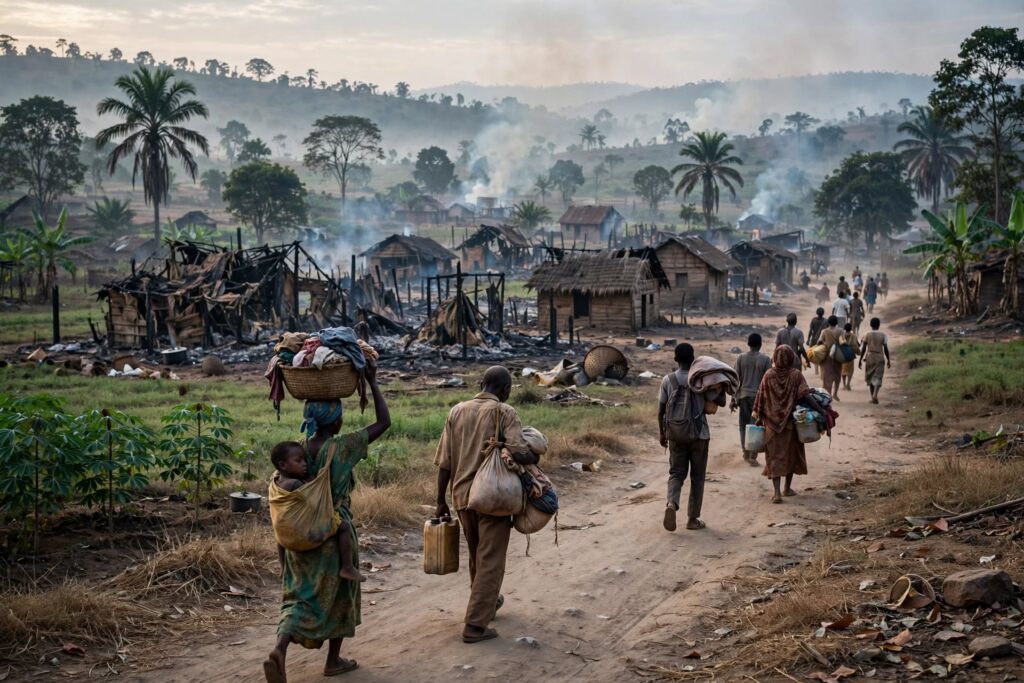
Cantine is a small village about 50km west of Beni, in North Kivu province in the eastern Democratic Republic of Congo. It is not a big city. It is a farming community where families live in simple homes, grow food, and rely on a small local health post.
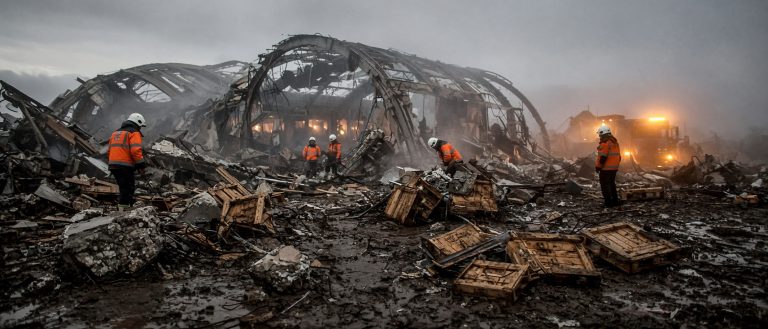
On Thursday night, November 5, fighters believed to be from the Allied Democratic Forces (ADF) entered the village. According to civil society leaders and local officials who spoke to the Associated Press and Reuters, the attackers killed at least 33 people, burned more than 50 houses, looted homes and shops, and set fire to the health post.
Survivors described chaos. People ran into the bush in the dark. Others hid as their homes burned. By morning, bodies were found in homes and on the roads leading out of the village.In a deeply heart-wrenching twenty-four-hour sequence that underscores the solemn reality of Last Days persecution and global upheaval, the diagnostic indicators delivered by Jesus Christ in the Olivet Discourse have converged with undeniable urgency. On November 10, 2026, what is now being called the Congo Massacre International Christian Concern reported that armed jihadist militants belonging to the Allied Democratic Forces (ADF) launched a devastating overnight assault on the Christian village of Cantine in the Madiwe sector of North Kivu, Democratic Republic of the Congo. The terrorists systematically slaughtered more than thirty Christian civilians, torched dozens of homes, and looted community food supplies, forcing hundreds of terrified women, children, and elderly residents to flee for their lives into the surrounding dense equatorial forests.
Yet this tragic slaughter of the saints does not unfold in isolation. Simultaneously in Western Europe, the Times of Israel reported that German political leaders marked the anniversary of Kristallnacht by warning that antisemitism across Germany has reached an “omnipresent” and historic crisis point, with Jewish citizens increasingly terrified to speak Hebrew or wear religious symbols in public. This sobering warning coincided with a comprehensive global audit documenting 244 violent assaults targeting synagogues and Jewish worshipers across 34 nations over the past three years. Concurrently across the Middle East, the Institute for the Study of War reported that senior Iranian leadership demanded absolute control over the Strait of Hormuz as a prerequisite for nuclear negotiations, even as Saudi-led coalition warplanes conducted retaliatory airstrikes leveling Hudaydah International Airport in Yemen. When faithful Christian families are massacred in Africa, ancient ethnic hatred paralyzes European cities, and superpowers trade kinetic bombardments over strategic global energy chokepoints on the exact same day, we are witnessing the textbook multidimensional convergence that Jesus Christ declared would herald the beginning of sorrows.
Timeline: November 5-9, 2026
November 5, around 11pm: ADF fighters attack Cantine, west of Beni.
November 6: Civil society leader Justin Paluku confirms at least 33 people killed. News agencies AP and Reuters report the attack. Local officials say more than 50 houses were burned.
November 6-7: Separate reports emerge of another ADF attack in Beni territory killing at least 24 civilians overnight.
November 9: Graphic posts about the Congo massacre explode on Instagram, Facebook, and Threads. A post reporting 21 Christians killed in Mabiolo, in Lubero territory, also starts circulating.
November 10: The Congolese army accuses M23 rebels of killing 50 civilians in Kishishe, north of Goma. The news cycle becomes a mix of three different attacks, which causes massive confusion online.
How Many People Were Killed?
This is where most people get confused.
The verified death toll for the Cantine attack — the main Congo massacre everyone is sharing — is at least 33 people, according to civil society and AP reporting.
That number is separate from:
- The 24 civilians killed in a different ADF attack in Beni territory the same week
- The 21 Christians reported killed in Mabiolo
- The 50 civilians the army says were killed by M23 in Kishishe
When you see posts saying “50 dead” or “70 dead,” they are often mixing these different attacks together, or sharing unverified claims. That does not make the tragedy smaller — it makes it harder to understand. The truth is bad enough on its own: 33 people murdered in one night, in one village.
Who Carried Out the Congo Massacre?
Who Are the ADF Militants?
The Allied Democratic Forces (ADF) started in Uganda in the 1990s, but for almost 30 years it has operated in eastern Congo. It is now affiliated with Islamic State and is known as Islamic State Central Africa Province.
The ADF is notorious for brutal attacks on civilians: machete killings, kidnappings, burning villages, and attacks on churches and health centers. The United Nations and the United States have sanctioned the group for its atrocities.
Why Did They Target Cantine?
Cantine sits in an area that has become a hotspot for both ADF activity and the Ebola outbreak. The ADF often attacks villages to steal food and supplies, to terrorize communities, to punish people for cooperating with the army, and to show it can still strike even when the military is present.
There is no evidence Cantine was a military target. It was a civilian village. That is why human rights groups call this a massacre, not a battle.
The Link to Islamic State
The ADF pledged allegiance to Islamic State in 2019. Since then, Islamic State has claimed many ADF attacks, including church bombings and village massacres.
That link matters because it explains why this attack is being framed in some Christian advocacy posts as persecution of Christians. While the ADF does target Christians, it also kills Muslims and people of all faiths in eastern Congo. The victims in Cantine were Congolese civilians — farmers, mothers, children, and patients.
Why Did Ebola Patients Have to Flee?
Congo’s Largest Ebola Outbreak
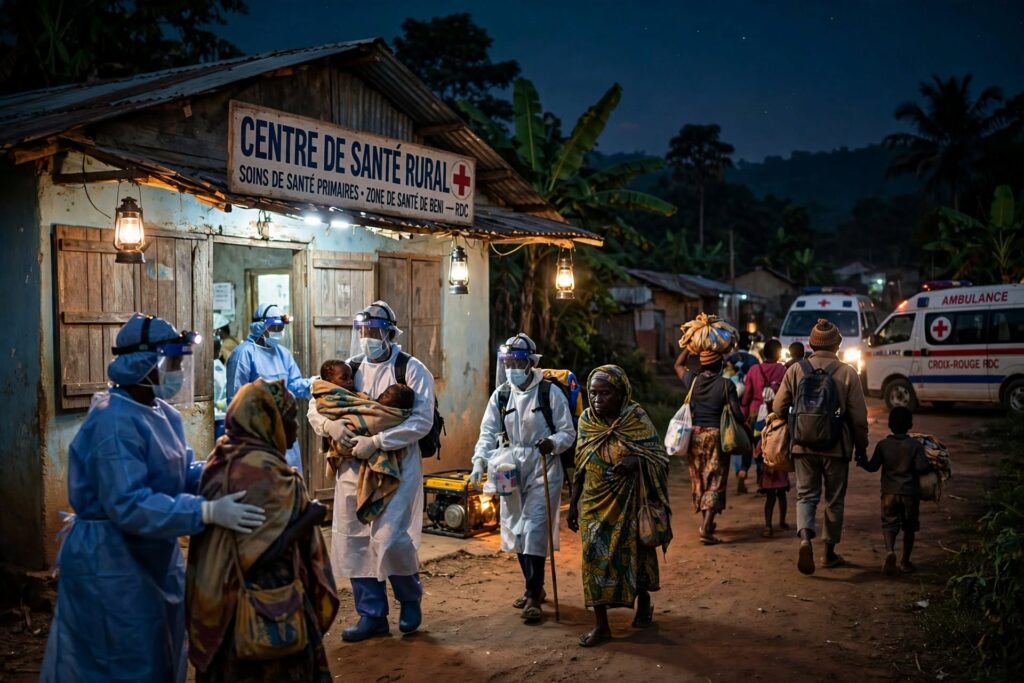
At the same time as the violence, the Democratic Republic of Congo is facing what Doctors Without Borders (MSF) has called its largest and deadliest Ebola outbreak.
North Kivu has been at the center of it. Thousands have been infected. Health workers have been working in extremely dangerous conditions, often in villages with no electricity, no roads, and active rebel activity.
Attack on the Health Post in Cantine
When the ADF attacked Cantine, they did not just burn homes. They burned the health post.
About 180 patients — including people with confirmed and suspected Ebola infections — were forced to flee into the night. That is what made this Congo massacre different from other attacks. It was not just a killing. It was an attack on the health system during an epidemic.
When Ebola patients flee, health workers lose track of them. They cannot be isolated, treated, or monitored. That puts entire communities at risk of new infections.
What MSF and Health Workers Are Saying
MSF field teams in Mongbwalu and Beni have warned that violence is making it almost impossible to control Ebola. Every time a health center is burned, every time patients flee, the outbreak gets harder to stop.
For the people of Cantine, it means they lost loved ones, lost their homes, and lost their only local clinic in one night.
The Viral Claim: Were 70 Christians Beheaded in a Church?
If you have seen a video on TikTok, Facebook Reels, or Instagram claiming “70 Christians Beheaded in a Church in Congo,” you are not alone. That video went viral on November 9-10, right as the Cantine news was spreading.
Here is what you need to know:
Where the “70 Christians” Video Came From
The video uses a three-panel layout with images of a damaged church, text overlays, and emotional music. It claims ADF / ISIS militants beheaded 70 Christians inside a church.
No major news agency — AP, Reuters, Al Jazeera, or the UN — has verified a 70-person beheading in a church during this November attack.
What Is Verified vs. What Is Unverified
Verified: At least 33 civilians killed in Cantine by ADF-linked militants, houses burned, health post destroyed.
Reported, but not yet independently verified: 21 Christians killed in Mabiolo, Lubero territory.
Unverified viral claim: 70 Christians beheaded inside a church.
That does not mean Christians are not being killed in Congo — they are. The ADF has attacked churches before, including a Pentecostal church bombing in Kasindi that killed 17 people. But sharing an unverified number makes it easier for people to dismiss the real tragedy.
If you want to help Congo, share the verified numbers. The truth is powerful enough.
The Other Reported Attack in Mabiolo (21 Christians Killed)
On November 9, a separate post reported that 21 Christians were killed in a new assault on the village of Mabiolo in Lubero. That report has not yet been confirmed by AP or Reuters in the same way Cantine has, but it fits the pattern of ADF attacks in the region.
It shows why eastern Congo feels like it is under constant attack — because in many ways, it is.
Why Is No One Talking About the Congo Massacre?
The Long War in Eastern Congo
Eastern Congo has been in conflict for nearly 30 years. More than 6 million people have been killed and displaced since the 1990s. Armed groups, foreign interference, and the fight over minerals like cobalt, gold, and coltan have turned the region into one of the deadliest places on earth.
Because the violence never stops, the world has become numb to it. A massacre that would dominate headlines for weeks in Europe or America gets one day of coverage in Congo, then disappears.
M23, Kishishe, and the Bigger Crisis
The Congo massacre in Cantine did not happen in isolation.
M23 rebels — backed by neighboring Rwanda, according to the UN — seized Goma and Bukavu in early 2025. A US-brokered peace deal was signed in Washington in December 2025, but the ceasefire has not held.
On November 10, the Congolese army accused M23 of killing 50 civilians in Kishishe, 70km north of Goma. The Southern African Development Community (SADC) has condemned the killings.
So in one week, Congolese civilians have been attacked by ADF in Cantine and Beni, and allegedly by M23 in Kishishe. It is a war on multiple fronts, and civilians are paying the price.
Why Western Media Is Silent
There are three reasons:
- No Western victims. Western media covers conflicts where Western citizens are involved.
- No easy narrative. Congo’s war is complex, with dozens of armed groups. It does not fit a 30-second news segment.
- Fatigue. After 30 years, editors think audiences will not care. That is why activists have turned to social media to force the world to look.
How the World Is Reacting to the Congo Massacre
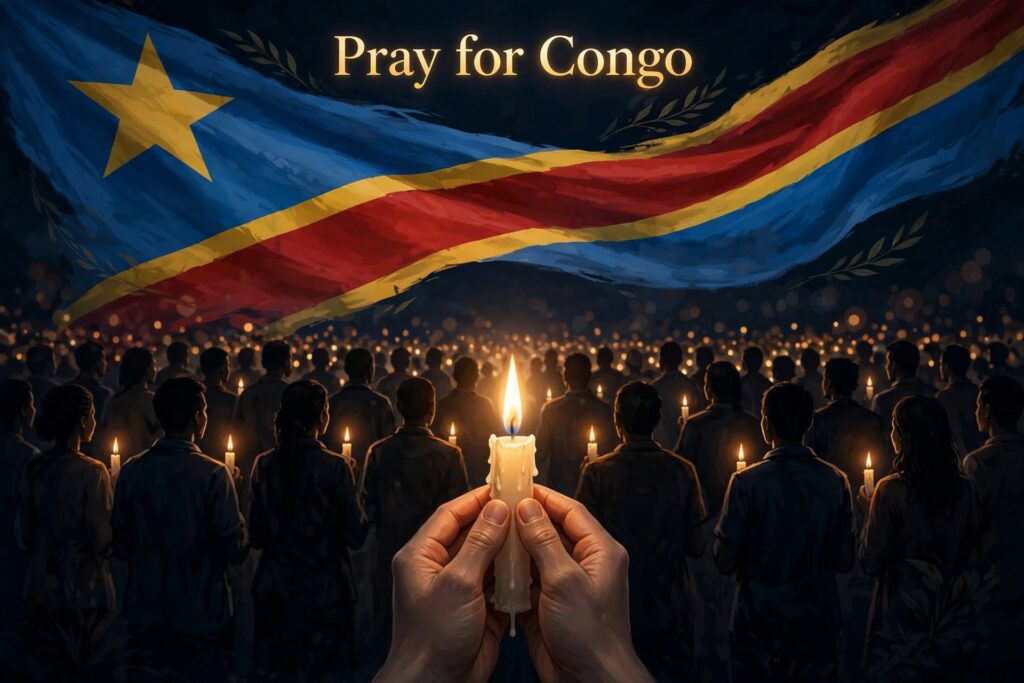
#FreeCongo, #PrayForCongo, and #AllEyesOnCongo
On social media, the response has been loud.
#FreeCongo has become the main activist tag, used by Congolese diaspora creators, Pan-African activists, and human rights groups.
#PrayForCongo has become the main faith-based tag, used by churches and Christian advocacy groups calling for prayer for victims.
#AllEyesOnCongo has surged again, echoing the earlier #AllEyesOnRafah campaign. It is being used to demand that global media pay attention.
#StandWithCongo is being used by organizations like Focus Congo and Team Congo, who are organizing charity matches and fundraisers.
What Churches and Human Rights Groups Are Saying
Churches in Congo and abroad have called for prayer and solidarity. Human rights groups have called for protection of civilians and health workers. The Anglican Communion’s Francophone Network issued a call to prayer for DRC in November 2026.
But prayer without action is not enough. Advocates are asking for three things: protection for civilians, access for humanitarian aid, and accountability for armed groups.
What You Can Do to Help
- Share verified information. Share this article using #FreeCongo and #PrayForCongo.
- Support Congolese-led organizations. Groups like Friends of the Congo and Focus Congo work directly with communities.
- Don’t look away. The reason the Congo massacre trends for one day and disappears is because people move on. Don’t.
Frequently Asked Questions
How many people died in the Congo massacre?
At least 33 people were killed in the verified attack on Cantine, North Kivu. Other attacks reported the same week killed 24 in Beni territory and 21 in Mabiolo, but those are separate incidents.
Where did the Congo massacre happen?
The main attack happened in Cantine, a village about 50km west of Beni in North Kivu province, eastern Democratic Republic of Congo.
Who is responsible for the Congo massacre in Congo?
The attack on Cantine has been blamed on the Allied Democratic Forces (ADF), an Islamic State-linked rebel group. The attack in Kishishe was blamed by the army on M23 rebels.
Is it safe to travel to Eastern Congo right now?
No. Eastern Congo is currently extremely dangerous due to ADF attacks, M23 fighting, and the Ebola outbreak. Governments advise against all travel to North Kivu and Ituri.
Conclusion: Don’t Look Away From Congo
The Congo massacre is not just a headline. It is 33 families who will never be the same. It is a village without homes. It is Ebola patients running into the night with nowhere to go.
Congo has been bleeding for 30 years while the world looks away. This time, don’t.
Share this article. Use #FreeCongo. Use #PrayForCongo. And remember Cantine.
Terror in North Kivu: The Blood of the Martyrs in Cantine the Congo Massacre
The horrific massacre in Cantine village is not an isolated crime; it represents the systematic, unrelenting campaign to cleanse indigenous Christian communities from the mineral-rich eastern provinces of the Democratic Republic of the Congo. For years, the Allied Democratic Forces—an affiliate of the Islamic State in Central Africa—have waged asymmetric guerrilla terror against undefended agricultural settlements. Their objective is explicit: terrorize rural believers, displace Christian populations, and enforce radical Islamic dominance across the region.
As we analyzed in our previous geopolitical assessment of the Russia-Ukraine missile and drone campaigns and systemic global disintegration, the erosion of rule of law in fragile states creates open corridors for unchecked violence. Western secular media largely looks away from the quiet martyrdom of African saints, but Heaven records every drop of blood. The Christians of North Kivu live under constant peril, yet their resilient faith in the face of slaughter stands as an eternal witness against a dark and dying world.
What Scripture Said: The Prophetic Signature of Persecution and Hatred
Nearly two thousand years ago, seated upon the Mount of Olives overlooking Jerusalem, the Lord Jesus Christ gave His disciples an explicit forewarning of the severe affliction His followers would endure before the consummation of the age:
“Then shall they deliver you up to be afflicted, and shall kill you: and ye shall be hated of all nations for my name’s sake. And then shall many be offended, and shall betray one another, and shall hate one another.” — Matthew 24:9–10 (KJV)
In Luke’s parallel Gospel record, Christ connected this severe religious persecution directly with international geopolitical conflicts and global distress:
“Then said he unto them, Nation shall rise against nation, and kingdom against kingdom… But before all these, they shall lay their hands on you, and persecute you, delivering you up to the synagogues, and into prisons, being brought before kings and rulers for my name’s sake. And it shall turn to you for a testimony.” — Luke 21:10, 12–13 (KJV)
Notice the diagnostic precision of Christ’s words: “they shall deliver you up to be afflicted, and shall kill you… and ye shall be hated of all nations.” Persecution is not an unexpected cultural detour; it is the spiritual clash between the kingdom of darkness and the Kingdom of Light. The world does not hate Christians because of politics or culture; it hates them because they bear the name of Jesus Christ. Concurrently, the explosion of antisemitism across Western nations fulfills the biblical pattern of unbridled hatred toward the Jewish people as the end of the age draws near. Hatred against God’s covenant people and His redeemed Church always rises together in times of spiritual apostasy.
Christ categorized these compounding crises using the precise medical terminology of ōdin—the initial birth pangs of a woman in labor. Labor contractions carry two undeniable physical signatures: their frequency accelerates, and their intensity amplifies. While mature biblical watchmen must always operate in sound, scriptural spiritual discernment without setting dates or indulging in breathless internet alarmism, we cannot close our eyes when the literal checklist given by our Lord is displayed across daily world headlines.
The Triple Convergence: Martyred Saints, Resurgent Hatred, and Chokepoint Warfare
The hallmark of our current prophetic generation is not simply that evil occurs—violence, prejudice, and warfare have plagued mankind throughout fallen history. What makes our present hour historically unique is the synchronous collision of diverse sign categories occurring at the exact same moment across the globe:
- Persecution of Believers unto Death (Matthew 24:9): The savage massacre of more than thirty Christian villagers in Cantine, DR Congo, by Islamic extremist militants, burning homes and driving families into the forest, fulfills Christ’s warning of targeted martyrdom for His name’s sake.
- Distress of Nations & Omnipresent Hatred (Luke 21:25-26; 2 Timothy 3:1-3): German leadership’s stark declaration that antisemitism is now “omnipresent,” backed by global reports of 244 violent synagogue attacks, illustrates the profound moral unraveling and perilous hatred sweeping modern society.
- Wars and Rumors of Wars at Strategic Chokepoints (Matthew 24:6): Tehran’s aggressive demand for absolute sovereignty over the Strait of Hormuz in nuclear negotiations, coupled with coalition air strikes leveling airport runways in Yemen, accelerates Middle Eastern conflict toward an uncontrolled regional war.
When combined with the compounding reality of global weather extremes and biblical birth pangs, these events do not represent isolated data points. They are harmonious notes in a divine diagnostic symphony, reminding the Church that the clock of redemptive history is steadily ticking down toward the return of the King of kings.
How We Stand: Pastoral Calm, Vigilance, and Gospel Hope
When you read about innocent believers butchered in African villages, synagogues fortified behind concrete blast walls in European capitals, and military fighter jets bombing airfields over vital oil straits, the natural human reaction is grief, anger, and anxiety. The secular world is overwhelmed because its security is anchored in human governance, international diplomacy, and fragile civil treaties.
But beloved friends, take a deep breath, grab a sandwich, and remember who holds tomorrow. This stuff doesn’t trouble my heart because I know who my King is. Jesus did not provide the Olivet Discourse to paralyze His Church with terror; He gave it to anchor our souls in His absolute, unshakeable sovereignty. He looked His disciples in the eye and gave a direct command: “see that ye be not troubled: for all these things must come to pass.” Why? Because our Sovereign God is not reacting to global turmoil; He is directing human history toward its appointed redemption. The throne of heaven is not empty. Jesus Christ is seated at the right hand of the Father, and He is coming back to quiet the storms, vindicate His persecuted saints, and establish His everlasting Kingdom of righteousness and peace.
As faithful believers called to watch and pray in this decisive generation, our calling is threefold:
- Honor and Intercede for the Persecuted Church: Lift up the traumatized Christian survivors and displaced families of Cantine village in DR Congo. Pray fervently for believers enduring violent persecution across Central Africa, the Middle East, and Asia, remembering Hebrews 13:3: “Remember them that are in bonds, as bound with them; and them which suffer adversity, as being yourselves also in the body.”
- Anchor Your Mind in Biblical Discernment: Guard your heart and mind against internet alarmism, conspiratorial hype, and unbiblical date-setting. As we explore in our foundational guide on fulfilled prophecy and discernment, genuine Christian watchfulness is marked by doctrinal clarity, emotional steadiness, and quiet faithfulness in our daily walk with God.
- Proclaim the Eternal Gospel While It Is Day: Every martyr’s blood, every hate-fueled assault, and every military escalation is a solemn reminder that human life on this earth is brief and fragile. Tomorrow is promised to no man. The only true sanctuary from earthly catastrophe and eternal judgment is found at the foot of the cross of Jesus Christ. Scripture promises in Romans 10:9 that “if thou shalt confess with thy mouth the Lord Jesus, and shalt believe in thine heart that God hath raised him from the dead, thou shalt be saved.” If your heart is heavy with uncertainty today, I invite you to discover the gift of salvation through Jesus Christ and anchor your eternity upon the Prince of Peace.
The night is far spent, the signs are clear, and the King is coming. Let us stand firm, shine brightly, and occupy faithfully until our Lord returns.
Sources
- International Christian Concern — “More Than 30 Christians Killed in Latest ADF Terror Attack in Eastern DR Congo”
- Times of Israel — “Merz says Germany faces historic test as antisemitism becomes ‘omnipresent’”
- Institute for the Study of War — “Iran demands control of Strait of Hormuz in nuclear talks as Saudi airstrikes hit Hudaydah airport”
- SamuelClark.com — “Spiritual Discernment in the End Times: Testing the Spirits in an Age of Deception”
- SamuelClark.com — “Wars and Rumors of Wars: Escalation Across the Northern Frontier”
- SamuelClark.com — “Global Weather Extremes and the Roaring of the Waves: Matthew 24 Birth Pangs”
- SamuelClark.com — “Fulfilled Prophecy and Biblical Discernment: Recognizing the Signs Without Date-Setting”
- SamuelClark.com — “The Gift of Salvation: Peace with God Through Jesus Christ”