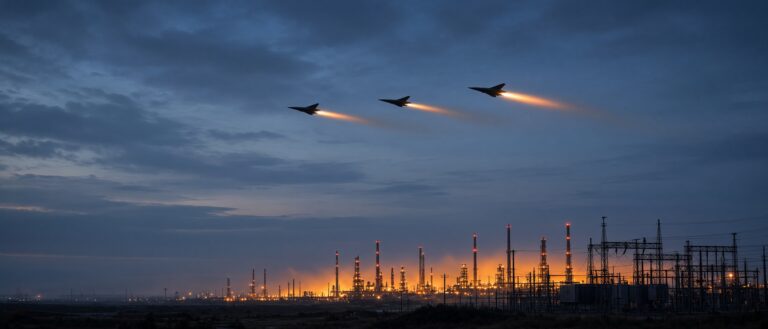
When a neighbor quietly parks more than a hundred vessels around your house without sending a text, you don’t need a megaphone to hear the message. In early November, the Taiwan 100 Chinese ships drill unfolded across the western Pacific with no official name, no prior warning, and a scale larger than Beijing’s named Justice Mission 2025 exercise from last December. In that same stretch, Taiwan’s National Security Council Secretary-General Joseph Wu reported over 100 People’s Liberation Army Navy and China Coast Guard vessels peaking on November 3, forces from three separate PLA theater commands coordinated around the aircraft carrier Liaoning between Taiwan and Guam, and Taiwan’s Defense Ministry confirmed area-denial training aimed at keeping allied rescuers out. Any one of those headlines might pass as routine saber-rattling, yet stacked together in a single week, they deserve a calm, careful look.
I want to do something a little different in this report, friend. I’ll give you the numbers, but I’ll also tell you which ones I could confirm in the original reporting, which ones come with an asterisk, and where the headlines have run ahead of the facts. Some of the claims bouncing around social media are bigger than the primary reporting supports, and you deserve the version you can trust.
Here’s the path we’ll walk: what actually happened at sea between late October and mid-November, what’s confirmed versus what’s unverified, why Beijing left this exercise unnamed, and what Scripture says to do with all of it, which is neither panic nor a shrug. If you’re new here, our guides to the biblical signs of the end times in 2026 and biblical signs of the end times give you the big map. This report is today’s weather.
What Happened: 100+ Ships, Peak November 3
According to Reuters (syndicated via SRN News), China carried out a sweeping, unannounced military exercise across the western Pacific and around Taiwan in early November. Officials in Taipei described the operation as a campaign of “silent intimidation.”
At its peak on November 3, Taiwan’s National Security Council Secretary-General Joseph Wu reported that more than 100 PLA Navy and China Coast Guard ships were operating at sea across the region. That single-day footprint surpassed the scale of Justice Mission 2025, China’s last formally named exercise aimed at Taiwan back in December 2025. Yet this time, Beijing issued no exercise name, no public announcement, and no standard airspace or maritime warning notices ahead of time.
The ships didn’t just pack up and go home after a weekend show of force, either. By Friday, November 13, a senior Taiwan security official told Reuters that roughly 70 Chinese vessels and the aircraft carrier Liaoning remained active inside the first island chain. That kind of staying power tells analysts this wasn’t a quick photo op.
Three Theater Commands and the Liaoning Carrier Group
Zoom out, because the command structure behind these ships matters just as much as the hull count.
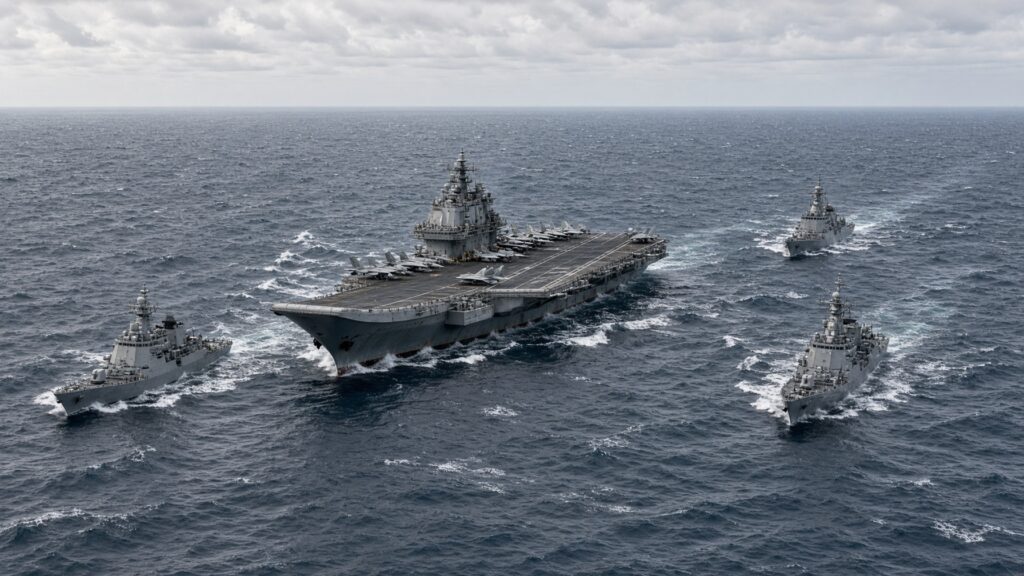
Per Reuters, the drills brought together coordinated naval formations from three separate PLA theater commands: Eastern, Northern, and Southern. In practical terms, that means Beijing wasn’t exercising a single local fleet. It was testing whether three regional commands could synchronize operations across vast stretches of open water at the same time.
According to the Institute for the Study of War (ISW) in its November 6, 2026 China and Taiwan update, the initial concentration featured four task forces operating between Taiwan and Guam, led by the Liaoning carrier strike group. ISW noted that the strike group transited into the Western Pacific through the Basilan Strait in the Philippines between October 23 and October 26. Days later, on November 10, Taiwan’s Ministry of National Defense confirmed in briefings covered by Defense and Tech / Reuters that the Liaoning task group and formations from multiple theater commands had been conducting “area-denial” training in the Western Pacific.
Confirmed vs. Asterisk Audit: Separating Fact From Rumor about the Taiwan 100 Chinese Ships Drill
Before we go any further, let’s separate what primary sources confirm from claims that come with an asterisk:
- Confirmed: Over 100 PLA Navy and China Coast Guard vessels deployed in the region, peaking November 3, with roughly 70 ships and the carrier Liaoning still active on November 13 (Reuters).
- Confirmed: Four task forces drawn from three PLA theater commands operated between Taiwan and Guam after transiting the Basilan Strait in late October (Institute for the Study of War).
- Asterisk (Context Only, Unconfirmed Participant): Commercial satellite tracking during the same window spotted China’s newer carrier, the Fujian, at sea. Neither Reuters nor ISW confirmed that the Fujian participated in the Taiwan exercise. Two Chinese carriers at sea simultaneously changes the math for defense planners, so it’s worth noting, just don’t call it a confirmed two-carrier Taiwan drill.
- Do Not Repeat (Unverified): Secondary social posts have claimed China conducted a submarine-launched ballistic missile test during this drill. That claim doesn’t appear in the primary Reuters or ISW reporting, so we’re leaving it off the ledger.
- Do Not Repeat (False): No blockade occurred, and no shots were fired. Calling this a blockade confuses rehearsing isolation with actually cutting off shipping lanes.
What Were They Rehearsing? Isolation, Area Denial, and Strikes
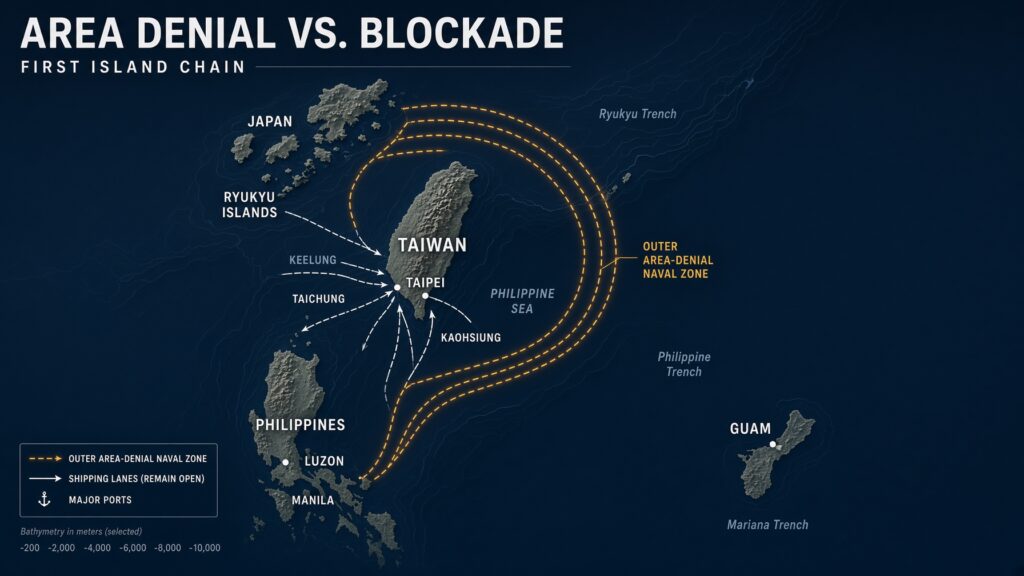
A joint assessment by the American Enterprise Institute and the Institute for the Study of War, summarized by The Maritime Executive, concluded that the PLA appeared to be rehearsing how to surround and isolate Taiwan. According to the senior Taiwan security official who spoke with Reuters, those exercises included simulated strikes against foreign militaries as well as targets inside Taiwan, including major cities.
Taiwan Defense Minister Wellington Koo described Beijing’s ongoing posture in Devdiscourse / Reuters coverage as “area-denial drills” designed to stop the United States or regional allies from reaching Taipei in a crisis.
Let’s put that in plain English, because military acronyms can fog up a simple idea. Area denial, often called A2/AD, isn’t a blockade. It’s the step right before a blockade.
| Concept | What It Means at Sea | Status in November 2026 |
|---|---|---|
| Area Denial (A2/AD) | Positioning carriers, submarines, and missile task forces east of Taiwan and toward Guam to make outside rescue too costly. | Confirmed rehearsal by Liaoning task group and three theater commands. |
| Naval Blockade | Physically stopping commercial ships and aircraft from entering or leaving Taiwan’s ports. | Not occurring. Commercial shipping and air traffic continued operating. |
Table based on defense assessments from Reuters, ISW, and The Maritime Executive.
Think of it like locking the neighborhood gates before trying to corner one house. Carriers east of Taiwan, task forces stretched toward Guam, and ships patrolling the Philippine Sea form an outer fence, not a parade.
Why Having No Name Matters
Named drills are theater. They’re built for cameras, state television graphics, and diplomatic warnings. When Beijing names an exercise, it’s saying, “We’re angry, we’re ready, and we want you watching.”
An unnamed drill sends the opposite message. It tells Taipei, “We can surround your waters without announcing a thing.” It tells Washington, “We can mass over a hundred ships at sea and let you find out through Taiwanese intelligence.” And it tells every neighbor in the Pacific that Beijing doesn’t feel obligated to telegraph its movements anymore.
The silence is the message.
It also fits a broader 2026 pattern we’ve been tracking across multiple fronts. Major flashpoints rarely arrive with formal declarations anymore. They’re rehearsed quietly, denied publicly, and normalized step by step. We’ve watched that same pattern in the global oil crisis across the Strait of Hormuz and Red Sea, in the grinding Russia-Ukraine war, and in ongoing Middle East tensions tied to the 2026 Iran war and Ezekiel 38 Hormuz blockade. While the world’s eyes stay glued to one crisis, pressure quietly builds on another.
Why This Matters Prophetically: Rumors of Wars and Roaring Seas

Let’s open our Bibles carefully here, because careful is what a watchman owes you.
In Matthew 24:6 (KJV), Jesus told His disciples: “And ye shall hear of wars and rumours of wars: see that ye be not troubled: for all these things must come to pass, but the end is not yet.” And in Luke 21:25 (KJV), He described the atmosphere leading up to His return: “And there shall be signs in the sun, and in the moon, and in the stars; and upon the earth distress of nations, with perplexity; the sea and the waves roaring.”
Let’s be crystal clear about what we aren’t saying. We don’t set dates. We don’t claim a naval exercise equals a specific prophecy fulfilled, and we aren’t predicting when or if China will invade Taiwan. Armies rehearse worst-case scenarios all the time. That’s what militaries do, and a drill isn’t a prediction.
At the same time, an honest watchman doesn’t ignore convergence. Throughout the Cold War and across the Taiwan Strait crises of 1995 and 1996, navies flexed muscle and tension eventually cooled. History reminds us not to treat every flare-up as the final buzzer. Yet what stands out in 2026 is how many pressure points are lit at once, and how fragile the world’s supply lines have become. Taiwan isn’t just an island on a map. It produces the bulk of the world’s advanced semiconductors and sits astride vital shipping lanes. A blockade there wouldn’t stay a regional dispute; it would trigger an immediate global shock across chips, freight, insurance, and energy.
I’m not saying this drill fulfills Luke 21. I’m saying the mood on the earth, nations in distress with perplexity while warships crowd the sea lanes, looks more and more like the atmosphere Jesus described. As Paul wrote in Romans 8:22 (KJV), “For we know that the whole creation groaneth and travaileth in pain together until now.” That isn’t a countdown clock. It’s a reason to stay awake and practice biblical discernment.
What To Watch Next
Instead of chasing rumors, keep your eye on five concrete indicators over the coming weeks:
- Liaoning’s staying power: Does the carrier strike group remain deployed east of the Philippines, or head back to port? Duration reveals intent.
- The naming pattern: Does Beijing keep running large exercises without names or warnings, turning silence into standard doctrine?
- Allied maritime transits: Do the United States, Japan, or the Philippines increase naval transits in response to test freedom of navigation?
- Daily ship counts: Do Taiwan’s Ministry of National Defense reports show a return toward 100+ vessels, or a steady drawdown?
- Diplomatic silence or signals: Does high-level U.S.-China diplomacy address these Western Pacific drills publicly, or leave them unspoken?
Calm Hands, a Settled Heart
If reading about warships in the Pacific leaves a knot in your stomach, take a deep breath, grab a sandwich, and remember who sits on the throne. This stuff doesn’t trouble me at all, because I know who my King is.
Scripture gives us both practical wisdom and unshakable hope. Proverbs 22:3 (KJV) reminds us, “A prudent man foreseeth the evil, and hideth himself: but the simple pass on, and are punished.” Prudence isn’t panic. Keeping a few extra weeks of household pantry staples, basic medications, flashlights, and backup batteries on hand isn’t fear; it’s simple stewardship so you aren’t caught flat-footed if supply chains hiccup, and so you have extra to share with a neighbor. Calm hands, a settled heart.
Even more importantly, Jesus told believers how to stand when the world shakes: “And when these things begin to come to pass, then look up, and lift up your heads; for your redemption draweth nigh” (Luke 21:28, KJV). Daniel 2:44 (KJV) promises that the God of heaven will set up an everlasting kingdom that will never be destroyed. For those who belong to Christ, our hope isn’t anchored in naval deterrence or diplomatic summits; we’re looking for the blessed hope of His return, knowing God has not appointed us to wrath, but to obtain salvation by our Lord Jesus Christ (1 Thessalonians 4:16-17; 1 Thessalonians 5:9; Revelation 3:10, KJV).
Don’t take my word for anything, though. Be like the Bereans in Acts 17:11 (KJV) and search the Scriptures daily, rightly dividing the word of truth (2 Timothy 2:15, KJV). If you’ve ever wondered whether you can truly trust what the Bible says about history and the future, take a look at our guides on evidence the Bible is true, fulfilled prophecy and discernment, and every messianic prophecy Jesus fulfilled.
And if you aren’t sure where you stand with God today, don’t put that off. “For God so loved the world, that he gave his only begotten Son, that whosoever believeth in him should not perish, but have everlasting life” (John 3:16, KJV). You can read clearly how to know Jesus personally and find peace with God on our salvation page.
Sources
- Reuters (via SRN News) – China stages unannounced Pacific drills involving over 100 vessels and three theater commands
- Institute for the Study of War (ISW) – China and Taiwan Update, November 6, 2026
- The Maritime Executive – Joint AEI and ISW analysis on PLA drills rehearsing Taiwan isolation
- Devdiscourse / Reuters – Taiwan Defense Minister Wellington Koo on Beijing’s area-denial drills
- Reuters – Senior Taiwan security official briefing on simulated attacks and 70 remaining vessels on November 13
#Taiwan #China #SouthChinaSea