Brent crude oil price moves used to follow a fairly simple rule you could read off a gas station sign: when ships catch fire in the Persian Gulf, oil goes up. Then came Monday morning. After touching $117.64 on Friday, Brent slid roughly 3% toward $110 a barrel while West Texas Intermediate fell to around $101, even as Iran’s Revolutionary Guard claimed two oil tankers exploded after striking naval mines in the Strait of Hormuz and British maritime monitors logged two projectiles hitting the offshore vessel SELAT STORM 72 nautical miles east of Ras Al Khafji, Saudi Arabia. Any one of those headlines would normally send energy traders scrambling for cover. Stacked together alongside a third straight day of quiet mediation talks in Qatar, they deserve a calm, careful look.
I want to do something a little different in this report, friend. I will give you the market numbers and the maritime reports, but I will also tell you which attacks have been logged by official naval monitors, which ones come with an asterisk because they rest on a single unverified military statement, and why oil prices fell on a morning when vessels were burning. Some of the shipping figures bouncing around online need careful sorting, and you deserve the version you can trust.
Here is the path we will walk: what actually happened on the water over the weekend, why traders pushed crude down $3 a barrel while smoke was still rising, what happens next if the talks in Doha stall or Israel’s coalition math forces another turn, and what Scripture says to do with all of it, which is neither panic nor a shrug. If you are new here, our guides to the biblical signs of the end times in 2026 and the 2026 Iran war and the Ezekiel 38 Hormuz blockade give you the big map. This report is today’s weather.
What Happened on the Water: Two Tanker Claims and the SELAT STORM Strike
/img
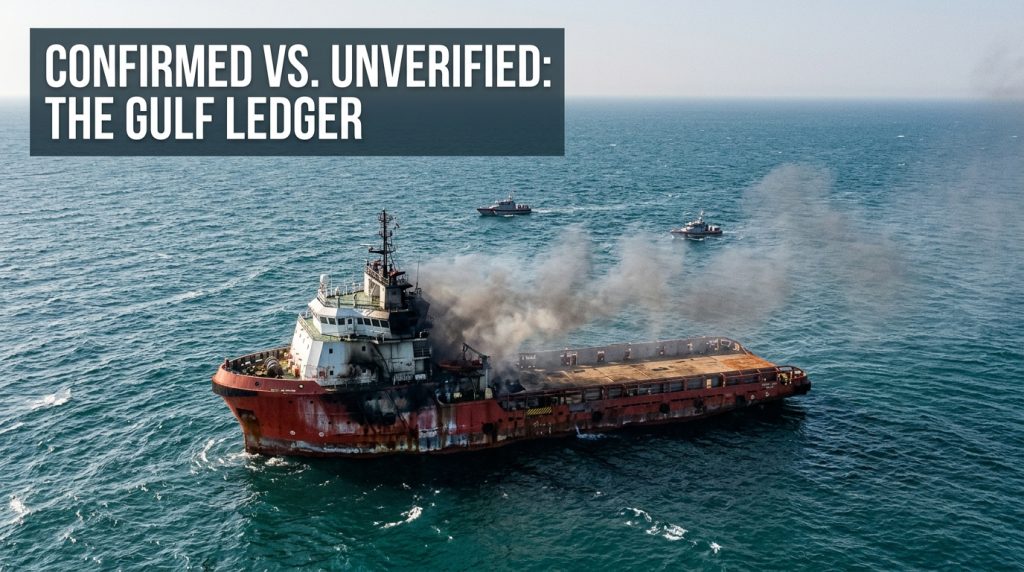
Monday’s market drop looked calm on a trading screen. The water underneath it did not.
Zoom out, because the details matter. Let’s separate what is logged by international maritime monitors from what comes with an asterisk:
- The two-tanker mine claim (comes with an asterisk): According to Reuters and regional reports from Tribune India, the Islamic Revolutionary Guard Corps (IRGC) Navy announced on November 1 that two oil tankers—including one supertanker—exploded after striking naval mines while attempting to navigate an “unauthorized route” through the Strait of Hormuz. Let’s be precise about what we know here. As Political.org noted, that claim has not been independently verified outside the IRGC statement, and it arrived at the exact moment Tehran was trying to show it still enforces Strait restrictions while sitting at the negotiating table in Qatar.
- The SELAT STORM projectile strike (logged by UKMTO): This incident has hard coordinates and independent tracking. United Kingdom Maritime Trade Operations (UKMTO) Warning 192-26 recorded an attack at 23:47 UTC on November 1 roughly 72 nautical miles east of Ras Al Khafji, Saudi Arabia. Maritime security consultancy Vanguard Tech and DeepDraft SITREP identified the vessel hit by two projectiles as the Panama-flagged offshore tug and supply vessel SELAT STORM (IMO 9266657). DevDiscourse reported all crew members were accounted for with no environmental spill logged, while Splash247 noted Vanguard’s report that the vessel was partially sinking.
- The wider Gulf pattern (confirmed vs. estimated): The strike on SELAT STORM was not an isolated stray shot. InvestingLive tallies at least six maritime incidents on October 31, three on November 1, and another on November 2 stretching across the Strait of Hormuz, the Persian Gulf, and the Gulf of Oman—following late-October strikes on the LNG tanker AL MAYEDA 40 nautical miles off Lavan Island and the Omani rescue of 25 crew members from the vessel RITI 1.6 nautical miles off Musandam. UKMTO logged more than 30 confirmed attacks in October, the highest monthly total since the war began on February 28. You may also see claims of “60 to 100 October attacks” online; ScanX Trade notes that higher range is an analyst estimate based on shipowners hiding strikes to avoid insurance spikes, whereas 30+ is the confirmed UKMTO ledger.
To see how the confirmed numbers compare with the unverified claims and analyst estimates, here is the clean breakdown across the corridor right now:
| Maritime / Market Metric | Reported Figure | Verification Status & Primary Source |
|---|---|---|
| Brent Crude Morning Trade (Nov 2) | $109.66 – $111.84 (down ~2.7% to 3.3% from $117.64 Friday high) | Confirmed across trading desks (AP, StockBiz, HDFC Sky, Hindu BusinessLine) |
| WTI Crude Morning Trade (Nov 2) | $100.64 – $102.56 (down ~2.9% to 3.3%) | Confirmed across trading desks (AP, StockBiz, HDFC Sky) |
| SELAT STORM Attack (Nov 1, 23:47 UTC) | Hit by 2 projectiles 72nm east of Ras Al Khafji; crew safe, reported partially sinking | Confirmed via UKMTO Warning 192-26; vessel ID via Vanguard Tech & DeepDraft |
| Two Tankers Explode on Mines (Nov 1) | 2 tankers (including 1 supertanker) hit mines on “unauthorized route” in Hormuz | Asterisk / Unverified — stated by IRGC Navy via Reuters; no independent confirmation |
| October Monthly Maritime Attacks | 30+ official strikes vs. 60–100 total incidents | Split: 30+ logged by UKMTO (JBizNews); 60–100 is an unconfirmed industry estimate (ScanX Trade) |
| Strait of Hormuz Transit Volume | 277 transits in 7 days to Oct 28 (~70% below pre-war baseline) | Confirmed weekly transit count via UKMTO; ~200 stranded tankers estimated by ET VBharat |
Sources: UKMTO Warning 192-26 · Reuters · Associated Press · StockBiz · DeepDraft SITREP · Splash247
Why Oil Fell 3% to $110 While Ships Were Still Burning
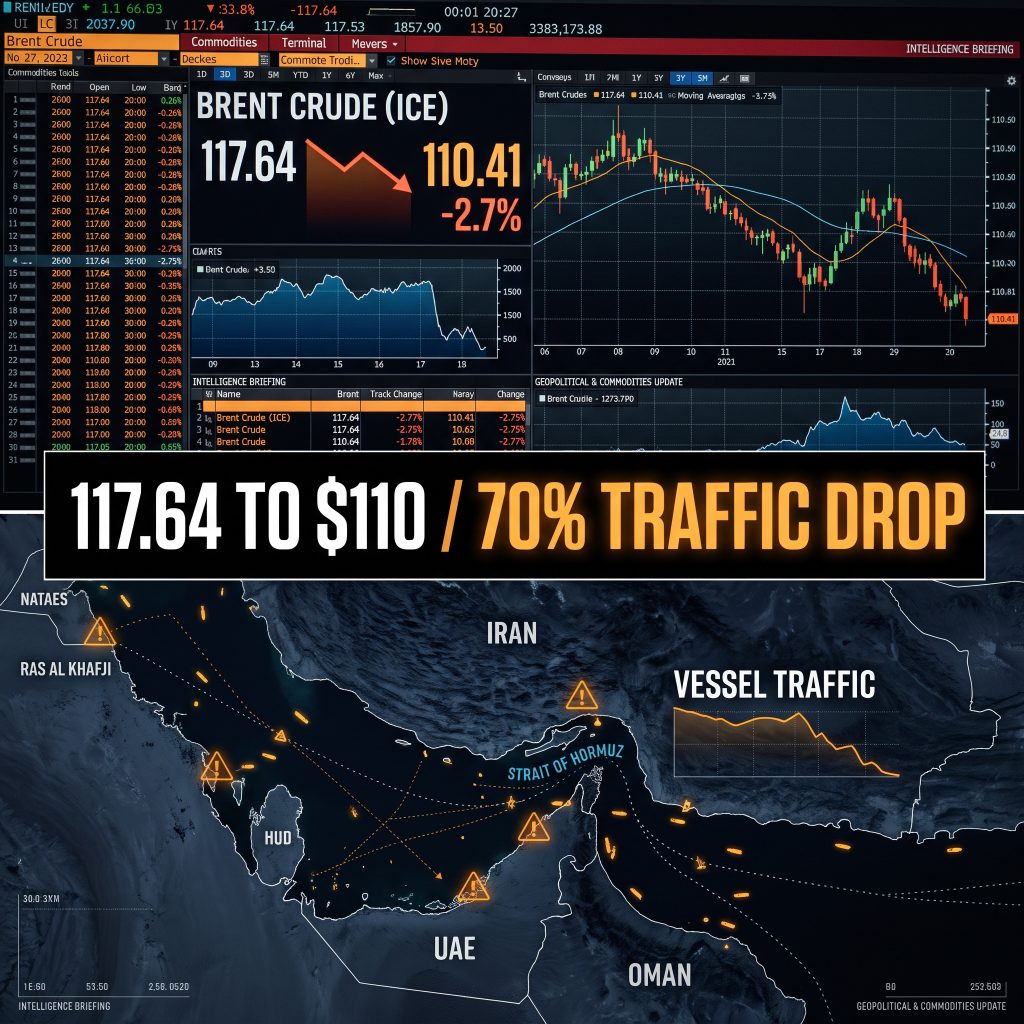
That brings us to the puzzle at the center of Monday’s tape. When missiles and mines are hitting vessels off Saudi Arabia and in the Strait of Hormuz, why did the Brent crude oil price drop more than $3 a barrel from Friday’s $117.64 peak instead of surging past $120?
Traders do not price yesterday’s smoke; they price tomorrow’s barrels. Three specific developments took the air out of Friday’s war premium:
- Day three of Iran–Qatar mediation: According to HDFC Sky, StockBiz, and NewSeisamay, Iranian and Qatari officials entered a third consecutive day of talks aimed at brokering an agreement to end the US–Israeli war with Iran. MettisGlobal noted that Iranian Foreign Minister Abbas Araqchi stated Sunday that consultations with Qatari mediators were progressing. We have tracked how quickly shipping chokepoints react to diplomatic rumors in our pillar guide on the global oil crisis in the Strait of Hormuz and Red Sea.
- Washington signals more time for talks: As Associated Press and Evergreen Edit reported early Monday, President Trump signaled he wants to give diplomacy with Iran additional time to work, pulling Brent down as much as 3.3% to $109.66 in early trading before it settled near $110.24 to $110.41.
- OPEC+ holds December targets steady: Per Reuters on November 1, OPEC+ confirmed on Sunday that it will keep December output targets unchanged and hold off on adjustments until next year as the group wrestles with export disruptions from the conflict. That removed the immediate fear of a surprise supply cut on top of an October rally that had already pushed Brent up 13.6% for the month.
Let me say plainly what I think. Fighting on the water and talking in a hotel room can happen at the exact same hour. In the Middle East, firing across the bow is often how belligerents buy leverage before they sit down at the table, or it is how hardliners spoil a deal they do not want. Both things can be true at once, and nobody outside the room in Doha knows which way it will go.
Prophetic Perspective: Perplexity on the Water and Watchman Restraint
Hold that thought. We will come back to it in Luke 21.
When you watch crude oil climb from roughly $70 a barrel before the war began on February 28 to nearly $118 on Friday, then drop $7 in a weekend while tugboats take projectile fire off Saudi Arabia and diplomats trade drafts in Qatar, the word that comes to mind is whiplash. The King James Bible has an older, better word for it: perplexity.
“And there shall be signs in the sun, and in the moon, and in the stars; and upon the earth distress of nations, with perplexity; the sea and the waves roaring; Men’s hearts failing them for fear, and for looking after those things which are coming on the earth: for the powers of heaven shall be shaken.” (Luke 21:25–26, KJV)
Read verse 25 slowly: “distress of nations, with perplexity.” In the Greek, that word for perplexity carries the sense of having no clear way out—every lever a leader pulls creates a new problem somewhere else. Keep fighting, and 20% of the world’s oil chokepoint stays choked at 70% below normal traffic. Ease up to let oil prices cool, and mines still go off in the channel. I am not claiming a $3 dip in the Brent crude oil price is a fulfillment of Luke 21. I am saying the mood across the markets and shipping lanes is starting to match the mood in the text.
The same care applies when we read Matthew’s record of the Olivet Discourse and Paul’s warning to the church at Thessalonica:
“And ye shall hear of wars and rumours of wars: see that ye be not troubled: for all these things must come to pass, but the end is not yet.” (Matthew 24:6, KJV)
“For when they shall say, Peace and safety; then sudden destruction cometh upon them, as travail upon a woman with child; and they shall not escape.” (1 Thessalonians 5:3, KJV)
I am not claiming the mediation talks in Doha are Paul’s final “peace and safety.” Previous seven-day draft truces have come and gone without ending the war. I am noting that a world which bids down oil prices on peace headlines while tugboats are taking projectiles 72 nautical miles off Ras Al Khafji is the kind of world Paul describes. And when we look at Persia’s prominent place in Ezekiel’s prophecy—
“And I will turn thee back, and put hooks into thy jaws, and I will bring thee forth, and all thine army, horses and horsemen, all of them clothed with all sorts of armour, even a great company with bucklers and shields, all of them handling swords: Persia, Ethiopia, and Libya with them; all of them with shield and helmet:” (Ezekiel 38:4–5, KJV)
—here is where I want to be careful, because careful is what a watchman owes you. Naval mines in the Strait of Hormuz and maritime attrition on Day 244 of this conflict are not the Ezekiel 38 invasion. That chapter describes a massive northern and regional coalition marching against a restored Israel, not a shipping blockade or an offshore tugboat strike in the Arabian Gulf. Persia’s centrality at the world’s energy valve is a hinge to keep watching, not a fulfillment to declare. We apply that same steady standard across our biblical discernment pillar and our fulfilled prophecy library.
Let’s also give the honest historical counterpoint. Older readers remember the Tanker War of the 1980s during the Iran–Iraq conflict, when hundreds of commercial vessels were hit by mines and anti-ship missiles in these exact same waters, and the U.S. Navy eventually reflagged Kuwaiti tankers under Operation Earnest Will. Shipping survived then, and oil markets eventually settled. A burned hull in the Gulf is not new to history. What makes 2026 worth watching is how many pressures are lit at once—from the Russia-Ukraine war and modern missile strikes to a 244-day Hormuz chokepoint and global weather events and birth pangs straining supply chains at the same time. That is not a countdown clock. It is a reason to stay awake, because “the whole creation groaneth and travaileth in pain together until now” (Romans 8:22, KJV).
What Happens Next After Monday’s $110 Drop
A warning light, not a countdown. Still, if you manage a household budget or watch geopolitics, four practical hinges will decide whether oil stays near $110 or snaps right back above $118:
- The Doha diplomacy window: If the third day of Iran–Qatar talks produces a verifiable maritime de-escalation, crude could drift back toward the $100 mark. If these talks collapse like earlier seven-day draft proposals, the $7 discount vanishes on the next verified tanker strike.
- Tactical spread deeper into the Gulf: Watch the map coordinates. Late last week it was limpet mine reports on the Louise 1 (October 29) and strikes near Lavan Island and Musandam (October 30). Sunday night’s strike on SELAT STORM happened 72 nautical miles east of Ras Al Khafji, Saudi Arabia—well inside the Arabian Gulf beyond the narrow Hormuz throat.
- The physical backlog at sea: Even if diplomats shake hands tomorrow, UKMTO logged just 277 transits in the week to October 28—roughly 70% below pre-war levels—with around 200 tankers reported stranded inside the Persian Gulf and commercial crossings down to a trickle. Unwinding that physical logjam and resetting maritime war-risk insurance takes weeks, not hours.
- Israel’s Wednesday political consultations: Keep one eye on Jerusalem. Per the Jerusalem Post, President Isaac Herzog begins formal consultations on Wednesday, November 4, to assign a mandate to form a government, with Gadi Eisenkot projected to hold 67 recommendations (48 opposition plus 19 Arab-led bloc seats) to Benjamin Netanyahu’s 53. Whether those talks produce a unity arrangement or trigger fresh election chatter will heavily influence how energy markets price the next phase of Israeli military operations.
Calm Hands and an Unshakable Kingdom While Oil Swings $8
If reading about exploding tankers, sea mines, and $110 crude oil leaves a knot in your stomach, take a deep breath, grab a sandwich, and remember who sits on the throne. This stuff does not trouble me at all, because I know who my King is.
When energy markets swing $8 in forty-eight hours, the Bible does not tell us to day-trade the panic or hoard jerrycans in fear. It tells us to be steady, practical stewards who love our neighbors:
“A prudent man foreseeth the evil, and hideth himself: but the simple pass on, and are punished.” (Proverbs 22:3, KJV)
Prudence is not prophecy, and stewardship is not fear. Because high crude prices eventually work their way into diesel, heating oil, and grocery freight, a few calm household habits go a long way:
- Top off at the half-tank mark: Instead of waiting for the empty light when a single Gulf headline can jump pump prices overnight, make a quiet habit of filling your vehicle when the gauge hits half.
- Check winter heating and utility buffers: If you heat with oil, propane, or natural gas, review your budget and seasonal service now rather than during a cold snap or a supply spike.
- Keep a modest household margin for a neighbor: Setting aside a little extra room in the grocery and fuel budget means that when shipping spikes squeeze an elderly neighbor or a young family at church, you have calm hands and something to share.
Above all, anchor your hope higher than the commodities board. Jesus told His disciples exactly how to posture their hearts when the nations are in perplexity:
“And when these things begin to come to pass, then look up, and lift up your heads; for your redemption draweth nigh.” (Luke 21:28, KJV)
Notice the posture: heads up, not wringing our hands. Earthly empires, oil cartels, and diplomatic summits rise and fracture, just as Daniel saw when he interpreted the king’s dream:
“And in the days of these kings shall the God of heaven set up a kingdom, which shall never be destroyed: and the kingdom shall not be left to other people, but it shall break in pieces and consume all these kingdoms, and it shall stand for ever.” (Daniel 2:44, KJV)
As watchers who hold to the blessed hope of the pre-tribulation Rapture, we look for the Lord Himself to catch away His church—”For the Lord himself shall descend from heaven with a shout, with the voice of the archangel, and with the trump of God: and the dead in Christ shall rise first: Then we which are alive and remain shall be caught up together with them in the clouds, to meet the Lord in the air: and so shall we ever be with the Lord” (1 Thessalonians 4:16–17, KJV)—remembering that “God hath not appointed us to wrath, but to obtain salvation by our Lord Jesus Christ” (1 Thessalonians 5:9, KJV; compare Revelation 3:10). Yet like the Bereans who “received the word with all readiness of mind, and searched the scriptures daily, whether those things were so” (Acts 17:11, KJV), we study to show ourselves approved unto God (2 Timothy 2:15, KJV) and hold every daily news headline with open, careful hands.
If you are still weighing whether Scripture can be trusted when it speaks about the future, take ten quiet minutes with our guides on the evidence the Bible is true and every messianic prophecy Jesus fulfilled. And if you do not yet know the King whose kingdom cannot be shaken by war or market storms, the promise at the heart of the Bible is still open to you today:
“For God so loved the world, that he gave his only begotten Son, that whosoever believeth in him should not perish, but have everlasting life.” (John 3:16, KJV)
Tankers will rust, treaties will fray, and oil prices will rise and fall. Your soul is worth infinitely more than all of them. You can read how to receive that settled peace and eternal life right now on our page on how to be saved and find hope in Jesus Christ.
Sources
- Associated Press / Evergreen Edit (Nov 2, 2026): Morning crude trading updates ($109.66 early Brent low to $110.24; WTI $100.64) following signals for extended U.S.–Iran diplomatic window.
- StockBiz / HDFC Sky / NewSeisamay / Hindu BusinessLine (Nov 2, 2026): Brent crude drop (~2.7% to 3.0% near 110.20–111.84 from $117.64 Friday peak) on third consecutive day of Iran–Qatar mediation talks; MettisGlobal reporting on Foreign Minister Abbas Araqchi’s remarks.
- UKMTO Warning 192-26 / DeepDraft SITREP / Vanguard Tech / Splash247 / DevDiscourse (Nov 1–2, 2026): Confirmed projectile strike at 23:47 UTC Nov 1 on Panama-flagged offshore tug/supply vessel SELAT STORM (IMO 9266657) 72 nautical miles east of Ras Al Khafji, Saudi Arabia; crew accounted for, reported partially sinking.
- Reuters / Tribune India / Political.org (Nov 1–2, 2026): IRGC Navy statement claiming two oil tankers (including a supertanker) exploded after striking naval mines along an unauthorized route in the Strait of Hormuz, noted as not independently verified.
- JBizNews / InvestingLive / ScanX Trade / ET VBharat (Oct 31–Nov 2, 2026): UKMTO October record of 30+ confirmed maritime attacks vs. 60–100 estimated incidents; 277 weekly transits to Oct 28 (~70% below pre-war average) and ~200 stranded vessels.
- Jerusalem Post (Nov 1–2, 2026): President Isaac Herzog’s November 4 coalition mandate consultations (Eisenkot 67 recommendations vs. Netanyahu 53).