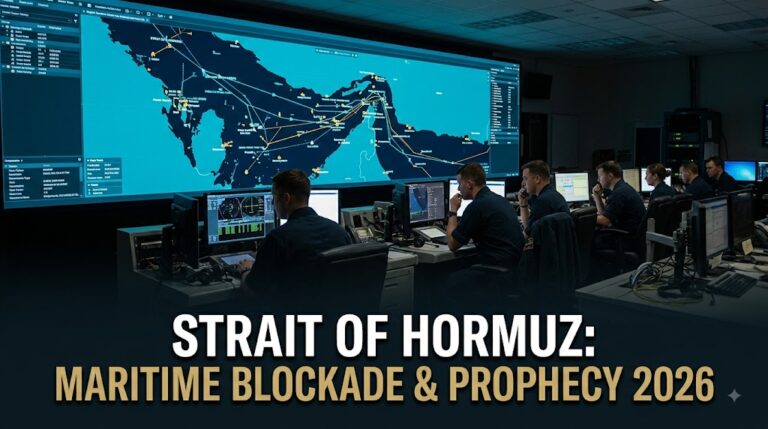
The Iran oil blockade 2026 has produced one of the strangest split-screen moments in modern energy history, the kind of financial paradox where you watch two gauges on the same dashboard move in opposite directions. On one screen, U.S. naval enforcement has choked Iranian crude exports down to near-zero, draining floating storage outside the Persian Gulf from roughly 88.8 million barrels in mid-July to zero by mid-October. On the second screen, global Brent crude has slid for three straight weeks, hovering around $91 to $93 a barrel after peaking above $126 earlier this year. Meanwhile, on the third screen, America’s Strategic Petroleum Reserve sits at 276.4 million barrels, its lowest mark since the early 1980s. Any one of those headlines on its own might look like routine market noise, yet stacked together in the same week, they deserve a calm, careful look.
In this analysis, friend, I aim to take a slightly different approach: I will present the verified data, clarify which figures carry nuances, and highlight where media narratives have outpaced reality. Some of the figures bouncing around social media are bigger than the reporting supports, and you deserve the version you can trust.
Here’s the path we’ll walk: what maritime trackers actually show at Kharg Island and across the Gulf of Oman, why oil prices are softening while missiles still fly near the Strait of Hormuz, what the Strategic Petroleum Reserve numbers really mean, and what Scripture says to do with all of it, which is neither panic nor a shrug. If you’re new here, our guides to the biblical signs of the end times in 2026 and the 2026 Iran war and the Ezekiel 38 Hormuz blockade give you the big map. This report is today’s weather.
What the Blockade Has Done to Iranian Exports
Since the United States reimposed its naval blockade on Iranian ports and vessels in mid-July, commercial satellite and transponder trackers have recorded a dramatic freeze in Tehran’s primary lifeline. Before the war, Iran shipped roughly 2 million barrels of crude and condensates per day, with nearly all of it heading east to China. Today, that flow has been squeezed into a domestic trickle.
Let’s separate what’s confirmed in the maritime data from what’s still political signaling:
- Zero floating storage outside the zone: According to Kpler maritime tracking data, Iranian crude and condensate stored on tankers outside the blockade zone dropped from a peak of 88.8 million barrels on July 14 down to zero by mid-October after the final cargoes discharged in China, leaving roughly 43 million barrels stranded inside the Persian Gulf.
- Kharg Island loadings stalled: Independent tracking from United Against Nuclear Iran (UANI) and OilPrice.com confirms that loadings at Kharg Island, Iran’s main export terminal, have stayed dark or minimal for months, forcing the National Iranian Oil Company to slash production down to roughly 1.8 million barrels a day just to meet internal demand.
- A zero-oil budget in Tehran: Oil normally funds roughly 30 percent of Iran’s government budget, and even more when indirect revenues are counted. Because oil payments typically lag cargo deliveries by about two months, analysts expect Tehran’s incoming crude cash to dry up almost completely by mid-December. In fact, Orepulse reporting confirms that senior Iranian budget officials are already drafting next year’s budget assuming oil income falls to zero.
- The November 17 ship-to-ship transfer (with an asterisk): On November 17, UANI shipping monitors observed a small ship-to-ship transfer of roughly 200,000 barrels of Iranian crude south of Kharg Island, alongside Islamic Revolutionary Guard Corps (IRGC) media chatter about forming tanker “caravans” to break the blockade. That’s a single small cargo, not a restored export pipeline. Even more telling, U.S. Central Command updates confirmed that any vessel receiving Iranian oil via ship-to-ship transfer at sea automatically becomes a blockade target subject to boarding, diversion, or seizure.
Zoom out, because the details matter. Tehran isn’t dealing with a temporary sanctions loophole this time. It deals with physical naval interdiction backed by satellite tracking that spots dark-fleet tankers within hours.
Why Global Oil Prices Are Falling Despite Hormuz Attacks And The Iran oil blockade 2026
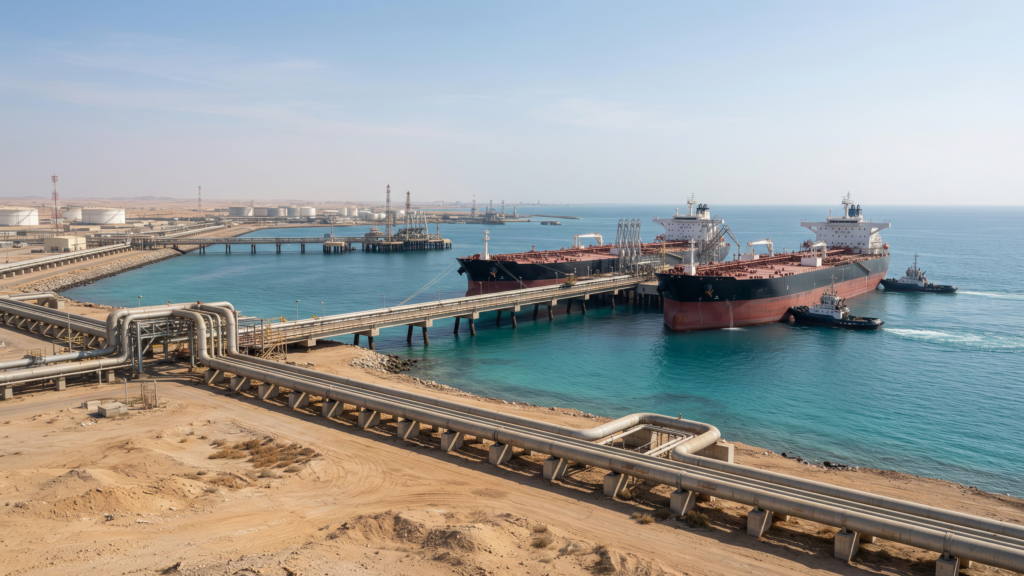
If you only read the war headlines, falling oil prices make zero sense. Over the past 48 hours alone, Iran-aligned Houthi forces launched missiles toward Riyadh, Israeli strikes continued in Lebanon and Gaza, and Iranian naval officials claimed two tankers struck mines near the Strait of Hormuz. Ordinarily, news like that sends crude rocketing past $120.
Yet Fortune’s daily crude benchmark tracking shows Brent trading near $93.41 a barrel on November 19, down from $111.71 a month earlier and heading toward the $91 mark. Why isn’t the market panicking? Three hard supply realities explain it, as we’ve tracked closely in our 2026 global oil crisis and Strait of Hormuz hub:
| Market Driver | Verified Data Point (Nov 2026) | Why It Pressures Crude Prices Downward |
|---|---|---|
| Non-Iranian Gulf Rerouting | Global oil supply rose 2.3 million barrels per day in October to 105.4 mb/d. | Saudi Arabia, the UAE, Iraq, and Kuwait restored heavy export volumes via escorted transits, Fujairah loadings, and the Saudi East-West pipeline to Yanbu on the Red Sea. |
| IEA Quarterly Supply Surplus | Projected surplus of 1.7 million barrels per day in Q4 2026. | High prices earlier in 2026 curbed global demand by 3.7 mb/d between March and October, leaving supply outpacing consumption. |
| U.S. Inventory Builds & Eased Strike Fears | Two consecutive weekly builds in U.S. commercial crude stocks; Brent down ~16% month-over-month. | Washington has signaled no immediate resumption of massive air strikes on Iranian infrastructure, trimming the war risk premium. |
Sources: IEA November 2026 Oil Market Report, The Guardian, and Morningstar / EIA Weekly Data.
In a November 19 interview covered by Middle East Eye and Morningstar, U.S. Energy Secretary Chris Wright put it plainly: far more crude and refined products like diesel and jet fuel are quietly moving out of the Strait of Hormuz than the cable news chyrons suggest. The market has learned to separate two very different things: Iranian barrels being locked inside the Persian Gulf, and the rest of the Gulf’s oil plumbing continuing to pump.
Still, let’s keep a clear head about what “softening” means. At roughly $91 to $93 a barrel, Brent is still about $29 higher than it was a year ago, and European diesel remains roughly 77 percent above pre-war levels. Relief isn’t the same thing as normal.
America’s Strategic Petroleum Reserve at Multi-Decade Lows
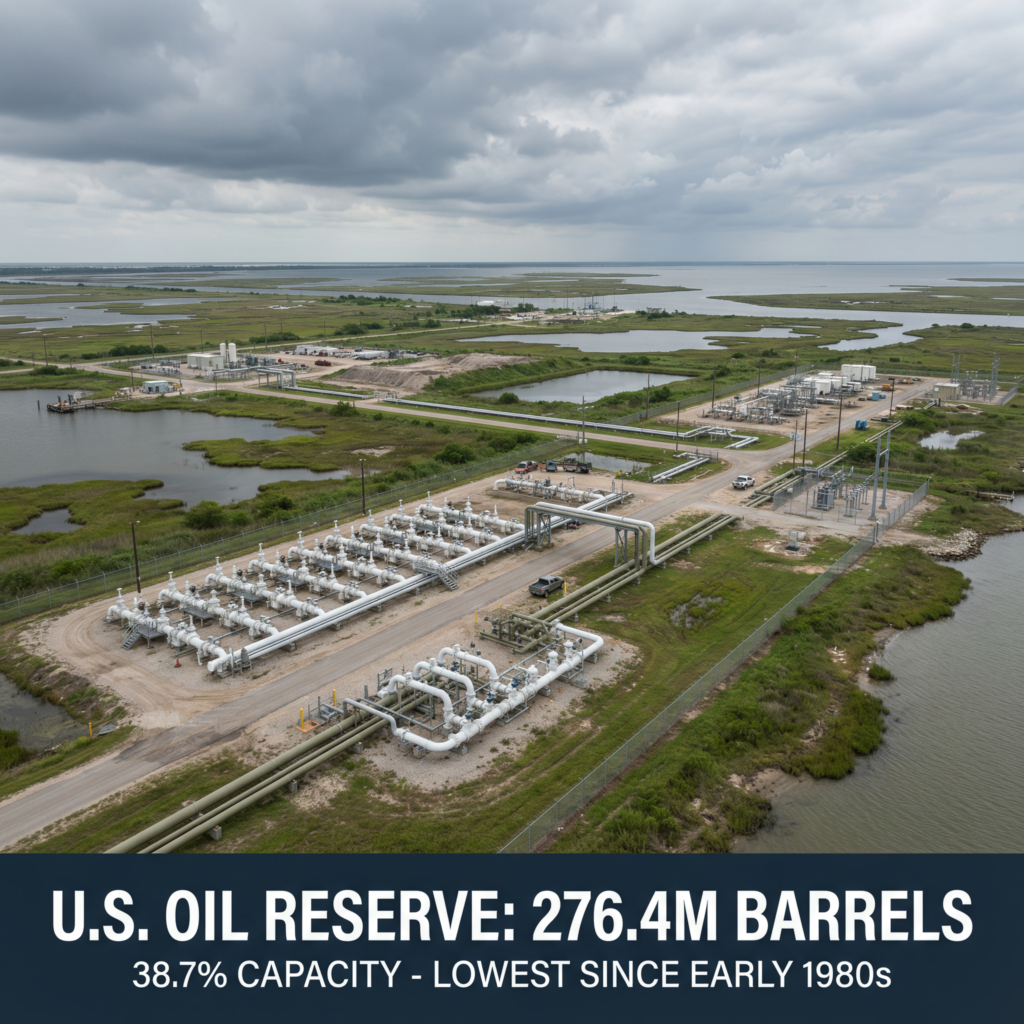
That brings us to the third gauge on the dashboard, and it’s the one that deserves the closest scrutiny. Following the March 2026 closure and mining crisis in Hormuz, the U.S. Department of Energy authorized a 172-million-barrel release from the Strategic Petroleum Reserve (SPR) as America’s share of a coordinated 400-million-barrel International Energy Agency emergency response.
Here is where the exact numbers stand, with a quick audit of the rounding you’ll see online:
- Current SPR inventory: According to the U.S. Energy Information Administration (EIA) reading for the week ending November 13, 2026, the SPR holds 276.4 million barrels (276.361 million barrels exact), down 3.2 million barrels from the prior week.
- Capacity percentage (with an asterisk): You’ll see commentators round that figure to 39 percent of capacity. Against the SPR’s 714-million-barrel authorized capacity, 276.4 million barrels works out to 38.7 percent, the lowest reserve level since the early 1980s.
- Net drawdown since February: Back in late February 2026, the reserve stood at 415.4 million barrels. That means the net drop is 139 million barrels, leaving America’s emergency cushion thinner than it’s been in more than four decades.
Most of these releases were structured as time exchanges, meaning oil companies borrowed the crude and must return it later with premium barrels added on top. Officials indicate the major drawdown phase is winding down, with refills slated to begin early next year. The SPR did what an emergency shock absorber is supposed to do, yet a shock absorber can’t replace the suspension forever. With reserves at 38.7 percent capacity, Washington has far less room to absorb a second major supply shock if a tanker convoy clash erupts in the Gulf.
Iran’s Narrowing Trilemma and the Prophetic Hinge
Analysts at Kpler describe Tehran’s predicament right now as a sharpening trilemma: endure the economic strangulation, negotiate terms that reopen exports, or escalate militarily to raise the cost of the blockade. Both things can be true at once: a desperate government can rattle sabers with tanker caravans while quietly testing backchannel talks, and nobody outside the room knows which way it’ll go.
Hold that thought, because this is where a careful watchman looks at Scripture without losing his balance. When you read about maritime choke points, blockaded cargoes, and nations groaning under economic pressure, two passages come into focus:
- Global distress and maritime perplexity (Luke 21:25-26, KJV): Jesus warned of a coming season marked by “distress of nations, with perplexity; the sea and the waves roaring; Men’s hearts failing them for fear, and for looking after those things which are coming on the earth.” Read verse 26 slowly. It describes a world watching the horizon with a knot in its stomach, wondering what breaks next. I’m not saying today’s tanker tracking map is the final Tribulation fulfillment of Luke 21. I’m saying the mood across global trade routes is starting to match the mood in the text.
- Persia’s alignment on the prophetic stage (Ezekiel 38:5, KJV): Ezekiel places Persia (modern-day Iran) alongside Magog, Rosh, Meshech, and Tubal in a future coalition that moves against Israel in the latter years. Here’s where I want to be careful, because careful is what a watchman owes you. A naval blockade on Iranian oil isn’t the Ezekiel 38 invasion. That prophecy describes a northern-led coalition marching into the mountains of Israel, not Iranian tankers stalled at Kharg Island. Persia’s isolation, desperation, and deepening reliance on Russia and China are a hinge to keep watching, not a fulfillment to declare.
Let’s also give the honest historical counterpoint, because good biblical discernment requires memory. The world has survived severe oil shocks before. In 1973 and 1979, Middle East embargoes and the Iranian Revolution rattled global markets, triggered gas lines, and prompted the creation of the very Strategic Petroleum Reserve we’re watching today. History tells us energy markets adapt, routes shift, and panic fades.
So why pay close attention in late 2026? Not because one oil chart proves tomorrow’s date on a prophetic calendar, but because of simultaneous convergence. An active naval blockade in the Persian Gulf, Houthi missiles flying at Riyadh, depleted strategic reserves, and nations restructuring entire budgets around zero oil revenue are all happening at the exact same time. That isn’t a prediction. It’s a reason to stay awake, because “the whole creation groaneth and travaileth in pain together until now” (Romans 8:22, KJV). If you want to see how past prophecies played out down to the smallest historical detail, spend a few minutes in our fulfilled prophecy library.
Steady Minds, Grounded Faith: Responding to Geopolitical News

If reading about naval blockades, shrinking oil reserves, and Middle East shipping lanes leaves you feeling anxious or unsettled, take a deep breath, pause, and remember who remains in control. This stuff doesn’t trouble me at all, because I know who my King is. Governments rise, embargoes tighten, and barrel prices swing up and down, yet none of it catches the Lord of heaven by surprise.
Scripture never calls believers to hoard fuel cans in a panic, nor does it tell us to stick our heads in the sand. Solomon gave us the balanced rule in Proverbs 22:3 (KJV): “A prudent man foreseeth the evil, and hideth himself: but the simple pass on, and are punished.” Here is what simple, steady stewardship looks like while energy markets remain choppy:
- Keep your household fuel and pantry buffers topped off: Don’t wait until a weekend headline spikes local gas prices to fill your tank, and keep a sensible two-to-four-week buffer of shelf-stable groceries and essentials at home.
- Hold margin in your monthly budget: Even when crude dips toward $91, diesel and shipping costs take months to cool down at the grocery store. Keeping a little breathing room in your cash flow protects your family from surprise price bumps.
- Build extra to bless someone else: Do it calmly, over a few weeks, and do it so you can help your neighbors if prices jump again. Extra to share: that’s stewardship, not fear. That’s preparedness done the Bible’s way: calm hands, a settled heart.
Above all, keep your eyes lifted where Jesus told us to look. In Luke 21:28 (KJV), right after describing distressed nations and roaring seas, He said, “And when these things begin to come to pass, then look up, and lift up your heads; for your redemption draweth nigh.” We know from Daniel 2:44 (KJV) that every earthly kingdom is temporary, and the God of heaven is setting up a kingdom that shall never be destroyed.
As watchmen who search the Scriptures daily (Acts 17:11; 2 Timothy 2:15, KJV), we hold fast to the blessed hope that God has not appointed His church to wrath, but to obtain salvation by our Lord Jesus Christ (1 Thessalonians 4:16-17; 1 Thessalonians 5:9; Revelation 3:10, KJV). If you’re still sorting out whether Scripture really holds up under hard questions, take a look at the evidence the Bible is true and every messianic prophecy Jesus fulfilled.
And if you don’t yet have peace with God through Jesus Christ, friend, don’t wait for the next headline to settle your eternity. John 3:16 (KJV) makes the offer crystal clear: “For God so loved the world, that he gave his only begotten Son, that whosoever believeth in him should not perish, but have everlasting life.” You can read plainly how to place your trust in Him right now on our salvation page.
#IranBlockade #OilPrices #BibleProphecy
Sources
- Kpler Maritime Intelligence: Iran’s Oil on Water Outside the Blockade Zone Hits Zero as Tehran’s Trilemma Sharpens
- United Against Nuclear Iran (UANI): Iran Shipping Update, November 19, 2026
- OilPrice.com: Iran Moves to Restart Oil Exports Despite U.S. Naval Blockade
- Orepulse: Iran Drafts 2027 Budget Assuming Oil Revenue Could Fall to Zero
- Fortune: Current Price of Oil as of November 19, 2026
- International Energy Agency (IEA): Oil Market Report, November 2026
- The Guardian: Global Oil Supply Returns to Surplus for First Time Since Start of Iran War, Says IEA
- Middle East Eye: U.S. Energy Chief Says Things Have Changed With Hormuz, But Not Visibly
- U.S. Energy Information Administration (EIA) / Oil Price API: Strategic Petroleum Reserve Level Today (276.4M Barrels)
- U.S. Department of Energy: United States to Release 172 Million Barrels of Oil From the Strategic Petroleum Reserve