4 Days of Outages, Then an When an emergency alert test November 17 rolls across American radios and television screens at 2:20 p.m. ET today, it won’t land in a vacuum. Over the last 96 hours, a global Microsoft 365 outage locked workers out of email for nearly a day, an FAA nationwide ground stop stranded more than two million airline passengers, a Workday payroll glitch hit 11,500 organizations, and a JPMorgan Chase hardware bug triggered payment delays across major U.S. banks on the exact same afternoon United Airlines grounded departures. Any single one of those headlines would be easy to shrug off as routine digital friction, yet stacked together inside four days, they’ve left millions of people wondering what’s really going on behind the curtain.
I want to do something very intentional in this report, friend. I’m going to separate the verified facts from my personal opinion on purpose, so you can see clearly where the reporting stops and where a watchman’s pattern recognition begins. I’ll give you the confirmed timeline, point out where viral social media rumors have run miles ahead of the evidence, and tell you plainly what I think this rapid frequency means in light of Scripture.
Here’s the path we’ll walk: first, the verified facts about today’s nationwide alert test and the viral 90-day blackout rumor; second, the confirmed breakdown of the last four days of outages alongside every official explanation; third, my clearly labeled Opinion Box on frequency, deception, and digital financial rails; and finally, what Scripture says to do with all of it, which is neither panic nor a shrug. If you’re new here, our guides to the biblical signs of the end times and war and rumors of war in November 2026 give you the big map. This report is today’s weather.
What Happened Today (November 17): Verified Facts vs. Viral Rumors
If you opened X this morning, you probably saw wall-to-wall chatter about an imminent power grid shutdown, bank runs, and a supposed 90-day blackout starting today. Before we look at why people are so jumpy, let’s nail down the two hard facts on the ground today, Tuesday, November 17, 2026.
- Today’s FEMA and FCC Emergency Alert System Test Is Real: According to reporting from the Democrat & Chronicle and Pirates & Princesses, FEMA and the FCC are conducting a scheduled nationwide test of the Emergency Alert System (EAS) today at approximately 2:20 p.m. ET. The test will interrupt radio and television broadcasts across the country for roughly one minute. It will not ping your mobile phone, and no action is required from the public (if postponed, the backup date is December 3).
- No 90-Day Blackout Is Scheduled: As fact-checkers documented in PhillyBurbs, there has been zero federal announcement of a 90-day power outage or any plan to take down the U.S. electric grid today. Fact-checkers traced the panic to manipulated clips circulating online, including an altered November 9 video falsely showing President Trump announcing a nationwide blackout.
Write both of those truths down side by side, because both are real at the same time. As a matter of verified fact, today’s 2:20 p.m. ET broadcast interruption is a routine one-minute test, not a blackout. As a matter of public sentiment on X this morning, millions of Americans don’t trust the word “test” right now because of what they just watched happen over the previous four days.
What Happened in the Last 96 Hours: The Verified Outage Timeline
Frequency breeds fear, and fear breeds questions about who’s telling the truth. Look at the sequence of major infrastructure failures between Thursday, November 12, and Monday, November 16, 2026, along with where the official numbers come with an asterisk.
| Date & Time | System Affected | Verified Impact & Numbers | Official Explanation |
|---|---|---|---|
| Thu, Nov. 12 (16:20 UTC) to Fri, Nov. 13 (16:10 UTC) | Microsoft 365 | Exchange Online mailboxes cut off globally for nearly 24 hours; Outlook, Teams, SharePoint, and Copilot disrupted. | Windows gateway server bug hidden since July, triggered by Teams failover while ~14% capacity was offline. Not cyber. |
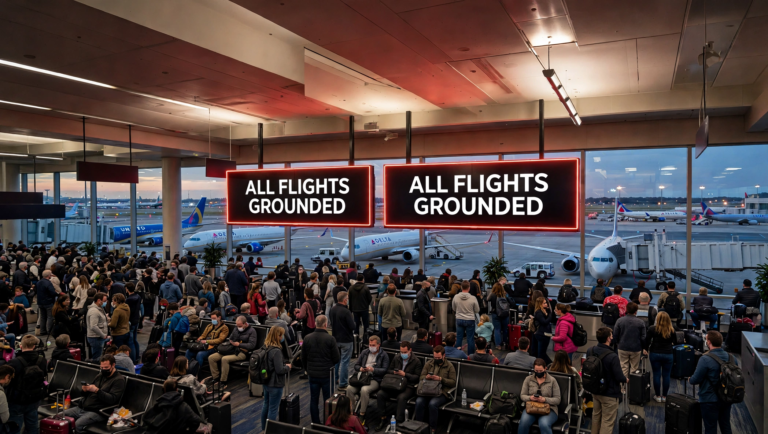
| Fri, Nov. 13 (3:45 p.m. to 8:15 p.m. ET) | FAA Nationwide Ground Stop | At least 10,000 flights impacted Friday and 2M+ passengers disrupted; 18,000+ cancellations and 27,000+ delays through the weekend. | Routine L3Harris copper-to-fiber maintenance in El Dorado, Arkansas overloaded a legacy router. Zero cyber or AI link. |
| Fri, Nov. 13 to Sat, Nov. 14 (11:00 a.m. ET) | Workday Payroll | Payroll, timekeeping, and benefits disrupted across more than 11,500 organizations. | Disaster-recovery test accidentally linked test services to live production databases. Not a cyberattack. |
| Mon, Nov. 16 (Resolved ~6:30 p.m. ET) | JPMorgan Chase & Major U.S. Banks | Chase peaked near 4,800 Downdetector reports; spikes logged at Bank of America (~2,097), Wells Fargo (~1,058), U.S. Bank, TD Bank (~96), and Zelle. | Internal Chase software bug in on-premises hardware systems delayed rival bank payments. No cyber cause found. |
| Mon, Nov. 16 (Resolved ~6:00 p.m. ET) | United Airlines | Departing flights grounded nationwide for roughly an hour; FlightAware logged 645 delays and 25 cancellations by 6:50 p.m. ET. | Technology issue resolved; United stated flights in progress and United Express were unaffected. Not linked to FAA. |
Sources: Channel Dive, USA Today, CNN, CyberSec Guru, FinanceX, Jagran Josh, and Parade.
Let’s zoom in on two important asterisks in that table so you aren’t misled by inflated numbers floating around social media:
- The Bank Count Clarification (8 Banks vs. Rumored 15 to 20): According to a Channel Dive breakdown of the Microsoft outage, USA Today and CNN reporting on the FAA ground stop, and CyberSec Guru coverage of Workday, each failure had a single vendor root cause. On Monday, November 16, FinanceX and USA Today reported that JPMorgan Chase’s on-premises hardware bug delayed payments across rival institutions, while a Downdetector tally cited by Jagran Josh listed 8 major U.S. banks with elevated customer complaint spikes (including Chase, Bank of America, Wells Fargo, U.S. Bank, and TD Bank, alongside Zelle). You may have heard online chatter claiming 15 or 20 U.S. banks went down. I haven’t verified 15 or 20 banks, so don’t repeat that figure as fact. Chase is the only bank with a confirmed internal root cause in the reporting, while the others reflect customer complaint spikes rather than confirmed independent failures.
- The United Airlines Flight Count Discrepancy: When United Airlines suffered its system outage Monday afternoon, Parade and USA Today noted a sharp gap between the airline’s public statement and flight-tracking telemetry. United stated that fewer than 150 flights were impacted for around 30 minutes, yet FlightAware recorded 554 delays and 22 cancellations at 6:10 p.m. ET, climbing to 645 delays and 25 cancellations by 6:50 p.m. ET.
Notice the unbroken chorus across every single official press release over the past four days. Microsoft says its final report drops November 20, yet already insists it was a July Windows bug and not a cyberattack. Transportation Secretary Sean Duffy and the FAA point to an overloaded router in El Dorado, Arkansas, and insist there’s zero evidence of AI or hackers. Workday blames a backup-system drill. Chase blames on-premises hardware. United blames a generic technology glitch. FEMA says today is just a test. Every official explanation sings the exact same note: not an attack, just a bug, just a router, just a test.
Watchman Opinion Box: Frequency, Deception, and Testing the Rails
Editor’s Note on Separation of Reporting and Opinion: Everything above this heading is verified news reporting and official statements. Everything inside this section is my personal opinion and biblical perspective as a watchman, not a claim of inside intelligence or verified cyber attribution.
What jumped out at me most about this four-day sequence isn’t any single outage. It’s the frequency, paired with the immediate, reflexive dismissal of any bad-actor involvement.
Within hours of every single breakdown, before forensic logs could even be finished, officials rushed to the microphones with the exact same script: “This has nothing to do with AI. Nothing to do with hackers. Nothing to do with bad actors.” Honestly, friend, I just don’t buy it. I don’t buy that Microsoft 365, the entire U.S. airspace system, payroll for 11,500 employers, major U.S. banks, and a flagship airline all stumble inside 96 hours and it’s purely an unrelated coincidence.
I’m not saying I can prove a specific hack on a specific server on a specific day. Inside this Opinion Box, I’m telling you what I believe: bad actors or cyber probing could very well be involved, and governments aren’t going to admit it because of the fear factor. Think about basic human nature. If federal officials announced on Monday afternoon that hackers had breached JPMorgan Chase and disrupted interbank payments, millions of Americans would sprint to their local branches and empty their accounts before sunset. If the FAA announced on Friday afternoon that cyber attackers had knocked out air traffic control routers, nobody would get on an airplane for Thanksgiving. Governments of the world notoriously withhold the truth when the truth would trigger instant panic.
And what did Jesus say would be the very first sign on the board before His return? Deception.”And Jesus answered and said unto them, Take heed that no man deceive you.”Matthew 24:4 (KJV)
Let me make a quick correction for the record so we handle God’s Word with precision. In an earlier discussion, I referenced Matthew 24:3 for that line. Verse 3 is actually the disciples asking Jesus, “what shall be the sign of thy coming, and of the end of the world?” Jesus’s answer begins in verse 4 with that unmistakable warning against deception. Getting the verse right matters, because deception is the thread running through this entire story. If institutions aren’t telling the public the whole truth to keep people calm, that’s still deception, and it sits right at the top of Christ’s prophetic checklist.
Looking at Monday’s banking disruption from an opinion standpoint, I also believe we’re watching a live stress test of public reaction. You can’t easily rip out a legacy financial system and replace it with a programmable, 24/7 digital architecture while the old system is humming along smoothly. People won’t trade freedom for a new grid if the old one works fine. But if the old system keeps stuttering in public, if banking apps freeze, if Zelle transfers stall, and if people get locked out of their money on a random Monday, then when officials eventually unveil a “new, resilient, 24/7 digital settlement system,” exhausted citizens will say, “Yes, please, anything is better than this.” Even if Chase’s hardware bug was truly the sole trigger on Monday, the fact that one bank’s internal glitch rippled across Bank of America, Wells Fargo, U.S. Bank, TD Bank, and Zelle proves how centralized and fragile the plumbing already is.
That brings us to the word that defines the last four days: birth pangs.”For nation shall rise against nation, and kingdom against kingdom: and there shall be famines, and pestilences, and earthquakes, in divers places. All these are the beginning of sorrows.”Matthew 24:7-8 (KJV)
Birth pangs aren’t a single contraction followed by months of quiet. They’re defined by frequency, intensity, and shrinking intervals between shocks. That’s what the last 96 hours felt like, and that’s why X lit up with blackout rumors this morning. People aren’t panicking because a one-minute radio test is a blackout. They’re on edge because after four straight days of critical systems failing, they don’t trust the word “test” anymore. I’m not date-setting, and I’m not predicting a blackout today. I’m saying watch the frequency, watch the deception, and watch how public trust is being conditioned.
Why It Matters: New Digital Plumbing Being Tested While Legacy Rails Stutter
Stepping back out of the Opinion Box into verified financial reporting, there’s a striking calendar coincidence from Monday, November 16, that adds real context to why readers are paying close attention to banking infrastructure right now.
On the exact same day JPMorgan Chase’s hardware bug delayed U.S. interbank payments, the Monetary Authority of Singapore (MAS) and Germany’s Bundesbank announced the completion of Project Simbolon, a cross-border wholesale central bank digital currency (CBDC) settlement test for the euro and Singapore dollar conducted alongside DBS and Deutsche Bank, as reported by CoinDesk.
Let’s be crystal clear about what Project Simbolon is and what it isn’t. Wholesale CBDC isn’t a retail consumer wallet; it’s back-end interbank plumbing and tokenized deposit settlement designed to move money across borders 24/7 without legacy bottlenecks. Nobody is claiming a Frankfurt-Singapore settlement test caused a hardware glitch in New York. Still, watching central banks successfully test next-generation 24/7 digital rails on the very afternoon legacy American bank plumbing sputters in public shows you the exact direction global finance is moving, which is why practicing biblical discernment matters more than chasing viral rumors.
Five Concrete Markers to Watch Next
Instead of getting whipped around by manipulated social media clips, keep your eyes on five verifiable developments over the coming days:
- Microsoft’s November 20 Post-Incident Report: Watch whether Microsoft’s full technical review stands by the July Windows gateway bug narrative or quietly revises its security findings.
- The FAA and L3Harris Router Investigation: Watch what federal engineers release regarding the El Dorado, Arkansas copper-to-fiber cutover and whether twenty-year-old air traffic bottlenecks expose deeper vulnerabilities.
- The Thanksgiving Travel Surge: Next week brings one of the heaviest aviation loads of the year. We’ll see quickly whether Friday’s FAA ground stop and Monday’s United outage were isolated hiccups or warning lights for peak holiday volume.
- Today’s 2:20 p.m. ET EAS Broadcast Test: Watch whether the one-minute radio and television test runs cleanly or triggers secondary confusion online.
- Verified Power Grid Telemetry: Watch official regional grid operators and verified utility outage maps rather than recycled videos on social media. If a real, verified grid event happens, we’ll report it as verified fact, never as rumor.
An Honest Counterpoint, and How to Keep Calm Hands and a Settled Heart

Before we close, let’s give the skeptic’s counterpoint its fair due, because a faithful watchman never exaggerates the evidence. Nationwide EAS tests have been conducted periodically for years. Legacy enterprise IT systems fail every week, fiber cutovers go sideways, and human engineers make mistakes during disaster-recovery drills. Looking back at Cold War civil defense drills or the Y2K remediation scramble of 1999, history reminds us that not every infrastructure scare signals an immediate collapse.
Yet what sets this week apart isn’t one isolated glitch. It’s the simultaneous convergence of pressures across cloud computing, national airspace, corporate payroll, major banks, and global settlement rails all at once, alongside a broader world already groaning under geopolitical strain as we track in our fulfilled prophecy and discernment library. As Paul wrote, “the whole creation groaneth and travaileth in pain together until now” (Romans 8:22, KJV). Watching those tremors doesn’t mean panicking. It means staying awake.
If reading about rolling outages and blackout rumors leaves a knot in your stomach, take a deep breath, grab a sandwich, and remember who sits on the throne. This stuff doesn’t trouble me at all, because I know who my King is.
Scripture gives us a balanced, steady posture for days when systems wobble: “A prudent man foreseeth the evil, and hideth himself: but the simple pass on, and are punished” (Proverbs 22:3, KJV). Prudence isn’t panic, and preparation isn’t prophecy. Take a few calm, practical steps this week so a temporary outage never catches your household off guard:
- Keep a modest cash buffer at home: Enough small bills to buy groceries, fuel, or pharmacy essentials if card readers or banking apps go offline for 24 to 48 hours.
- Save offline copies of vital details: Keep a printed folder with key account numbers, utility contacts, prescriptions, and downloaded airline boarding passes before you head to the airport.
- Maintain basic household readiness with extra to share: Keep flashlights, batteries, bottled water, and shelf-stable food stocked so if the power ever does blink out on your block, you have plenty to share with an elderly neighbor. Extra to share is stewardship, not fear. That’s readiness done the Bible’s way: calm hands, a settled heart.
Above all, anchor your hope where no power grid or banking server can ever touch it. Jesus told His disciples, “And when these things begin to come to pass, then look up, and lift up your heads; for your redemption draweth nigh” (Luke 21:28, KJV), reminding us that earthly kingdoms are temporary while “the God of heaven set up a kingdom, which shall never be destroyed” (Daniel 2:44, KJV). Like the Bereans who searched the Scriptures daily to verify what they heard (Acts 17:11, KJV) and studied to rightly divide the word of truth (2 Timothy 2:15, KJV), believers don’t live in dread of wrath, because “God hath not appointed us to wrath, but to obtain salvation by our Lord Jesus Christ” (1 Thessalonians 5:9, KJV), who promised to keep His own from the hour of temptation (Revelation 3:10, KJV) and gather us together at His coming (1 Thessalonians 4:16-17, KJV).
If you aren’t sure where you stand with God today, you don’t have to carry that uncertainty another hour. You can look at the historical evidence the Bible is true and examine every Messianic prophecy Jesus fulfilled, because God’s Word has never missed a single detail. “For God so loved the world, that he gave his only begotten Son, that whosoever believeth in him should not perish, but have everlasting life” (John 3:16, KJV). If you’re ready to place your trust in Jesus Christ and find real refuge today, visit our guide to salvation and eternal peace.
Sources
CoinDesk (Reporting on the November 16 completion of Project Simbolon cross-border wholesale CBDC testing by Germany’s Bundesbank and Singapore’s MAS).
Democrat & Chronicle (Reporting on the scheduled Tuesday, November 17, 2026 FEMA and FCC nationwide Emergency Alert System broadcast test at 2:20 p.m. ET).
Pirates & Princesses (Clarification separating the one-minute radio and television EAS test from viral blackout rumors).
PhillyBurbs (Fact-check debunking the viral 90-day power blackout rumor and altered November 9 video clip).
Channel Dive (Technical reporting on the November 12-13 Microsoft 365 Exchange Online outage and July Windows gateway server defect).
USA Today (Coverage of the November 13 FAA nationwide ground stop, the November 16 JPMorgan Chase banking disruption, and the United Airlines departure delay outage).
CNN (Reporting on the FAA ground stop timeline, L3Harris El Dorado fiber cutover, and legacy air traffic control infrastructure).
CyberSec Guru (Analysis of the November 13 Workday disaster-recovery test incident impacting more than 11,500 organizations).
FinanceX (Reporting on how JPMorgan Chase’s on-premises hardware bug delayed interbank payments across rival U.S. banks).
Jagran Josh (Breakdown of the 8 major U.S. banks showing elevated Downdetector customer outage reports on November 16).
Parade (Comparison of United Airlines’ outage statement against FlightAware cancellation and delay figures).
Just As Predicted! Stay Ready and Keep Looking Up!
#EmergencyAlertTest #BankOutage #FAAGroundStop