November 10, 2026 — 7 AM Prophecy News Watch
While diplomats sat down in Abu Dhabi on Tuesday morning, Russia was already sending its message overnight.
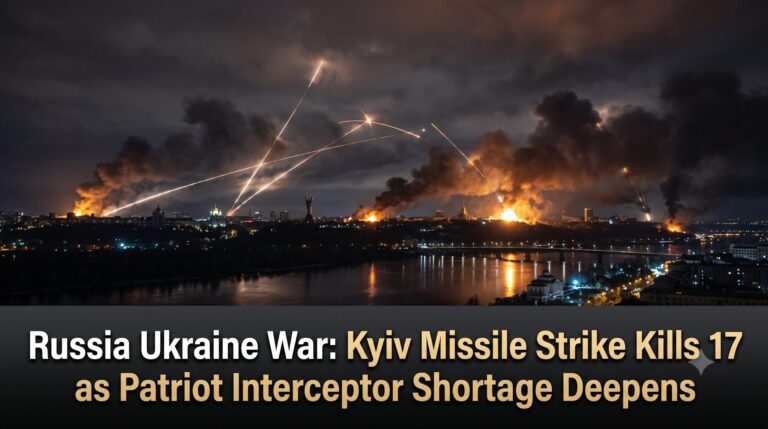
From 18:00 on Monday, November 9, Russian forces attacked Ukraine with one Iskander-M ballistic missile and 162 drones — including 96 jet-powered Shahed-type drones, plus Gerbera and Parodiya decoy drones.
Ukrainian air defence said that by 07:30 Tuesday it had destroyed or jammed 135 of those drones, including 70 jet-powered ones. Strikes still got through at 19 locations.
That is the pattern now: talk by day, bombardment by night.
What Happened in the Ukraine Drone Attack November 10 2026
According to the Ukrainian Air Force via Ukrinform, the attack began at 18:00 on November 9 and continued overnight. The Iskander-M was launched from the Millerovo area in Russia. Drones were launched from Bryansk, Oryol, Shatalovo and Millerovo in Russia, and Hvardiiske in temporarily occupied Crimea.
The air attack was repelled by aircraft, anti-aircraft missile units, electronic warfare and unmanned systems units, and mobile fire groups.
As of 07:30 Tuesday, 135 drones had been shot down or suppressed. Hits were recorded at 19 locations, while debris from downed targets fell at nine locations.
Energy Hit in 8 Regions, Power Out in 6
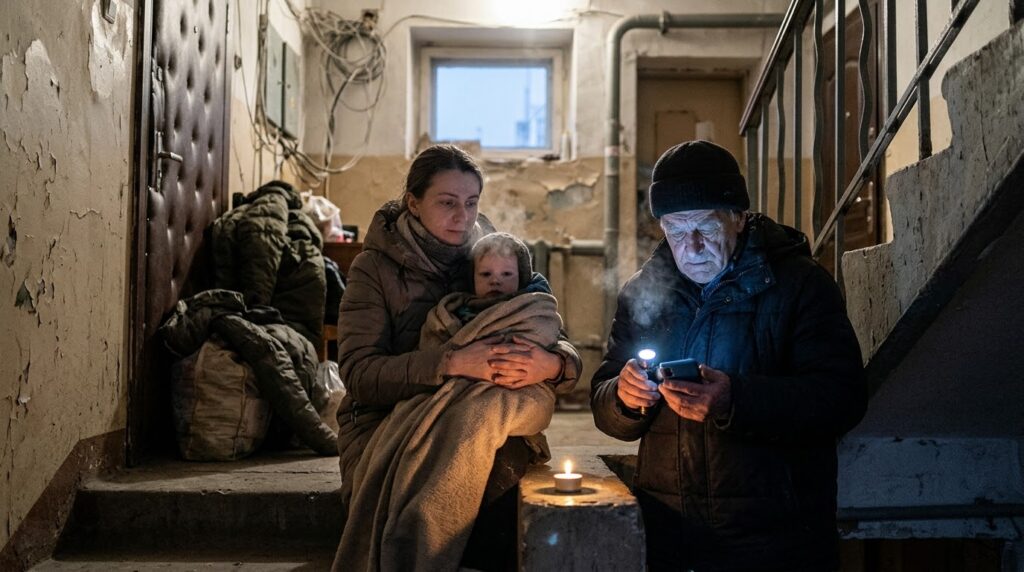
Ukrenergo, Ukraine’s state grid operator, told Reuters that Russian forces struck energy infrastructure in eight regions overnight and into Tuesday morning: Kyiv, Kharkiv, Sumy, Poltava, Dnipropetrovsk, Vinnytsia, Cherkasy, and Kirovohrad.
As of Tuesday morning, consumers were without power in six regions: Dnipropetrovsk, Donetsk, Kyiv, Sumy, Kharkiv, and Chernihiv.
Emergency power cuts were introduced in Kyiv city and Kharkiv, Poltava and Sumy oblasts due to damaged equipment and voltage drops in the high-voltage grid. Hourly outage schedules are in effect in most regions.
This is not a one-night campaign. It is a winter strategy: hit generation, substations, and distribution until the grid cannot hold, then hit it again the next night.
In Kirovohrad alone, a strike on critical infrastructure in the Holovanivsk district set a facility on fire and left almost 10,500 customers without power.
The Human Cost: Read The Numbers Carefully
Two different casualty windows are circulating this morning. Do not confuse them:
Overnight Nov 9-10: at least 14 people injured, including two men injured in a morning strike on Kropyvnytskyi, capital of Kirovohrad Oblast.
Past 24 hours (all attacks): 9 killed and 39 injured, including a 1-year-old child, according to the Kyiv Independent’s regional tally.
That 24-hour total includes:
- Donetsk Oblast: 3 killed, 1 injured
- Vinnytsia Oblast: 2 killed in a strike on a civilian company in Ladyzhyn
- Kirovohrad Oblast: 2 injured in Kropyvnytskyi, one in intensive care
- Kharkiv Oblast: 8 injured, including children aged 1, 5, and 11, after attacks on Kharkiv and 10 settlements
- Kyiv Oblast: 1 killed, 9 injured including a child, after an energy facility in Boryspil district was damaged
Behind every number is a home, a workplace, a family that went to sleep under sirens and woke to no power.
Frontline: 156 Clashes, Heaviest in Pokrovsk
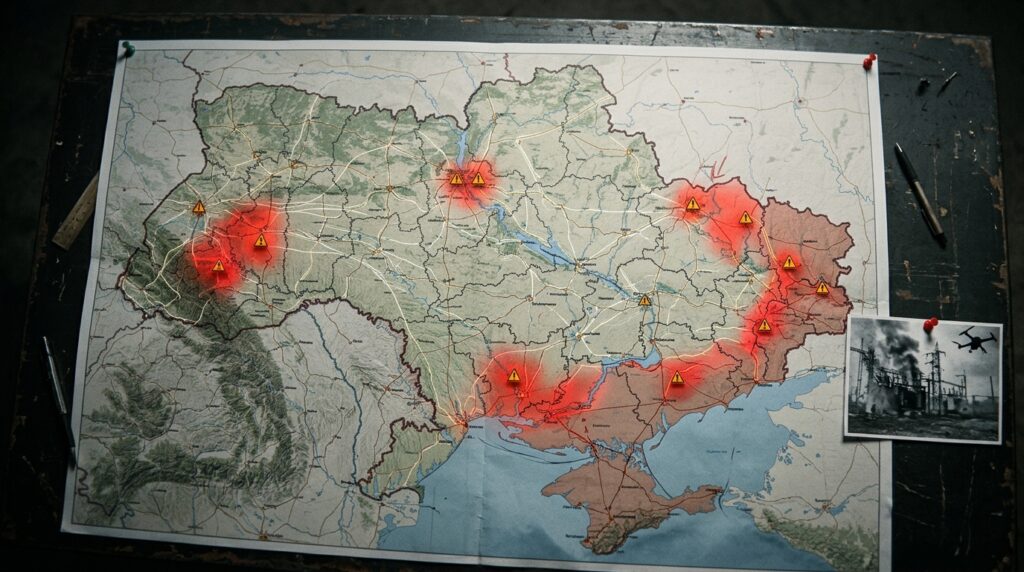
The General Staff of the Armed Forces of Ukraine reported 156 combat engagements in the past day, as of 08:00 Tuesday. Ukrainska Pravda’s summary of the General Staff report confirms the heaviest fighting was in Pokrovsk and Kostiantynivka, with 22 attacks across those two fronts combined.
The heaviest fighting was in:
Pokrovsk front — 13 attacks: Russian forces tried to advance near Vilne, Svitle, and Molodetske, and toward Myrne, Serhiivka, and Novopavlivka.
Kostiantynivka front — 9 attacks: Russian forces conducted offensive operations near Kostiantynivka, Dovha Balka, and Rusyn Yar, and toward Mykolaipillia.
Pokrovsk remains the hinge of the eastern front. If it falls, the road west opens. If it holds, Russia’s grinding advance stalls again — at terrible cost to both sides.
Zelenskyy: Russia Wants to Split Ukraine Along the Dnipro
On Monday evening, President Volodymyr Zelenskyy said Russia is using strikes on bridges and energy infrastructure to divide Ukraine along the Dnipro River.
The aim, he said, is to wear Ukrainians down until Kyiv accepts Moscow’s terms — terms now being pressed at the US-mediated talks in Abu Dhabi.
That framing matters. This is not just about territory. It is about splitting a country’s power, transport, and morale in two: east bank under constant pressure, west bank cut off from the east’s energy and logistics.
And it is happening while talks are underway.
Abu Dhabi: Talks Open, But The Bombs Did Not Stop
The three-way talks between Russia, Ukraine, and the United States opened Tuesday in the United Arab Emirates, the head of Kyiv’s delegation confirmed. It is a two-day session, the first such meeting since February, focused on security guarantees.
Kyiv is seeking a ceasefire on current frontlines. Moscow is maintaining its demand for the surrender of the rest of Donetsk — plus its claims on Luhansk, Zaporizhzhia, and Kherson, regions it illegally annexed in September 2022 but never fully captured.
European partners are also in Abu Dhabi, holding separate meetings with the Ukrainian delegation.
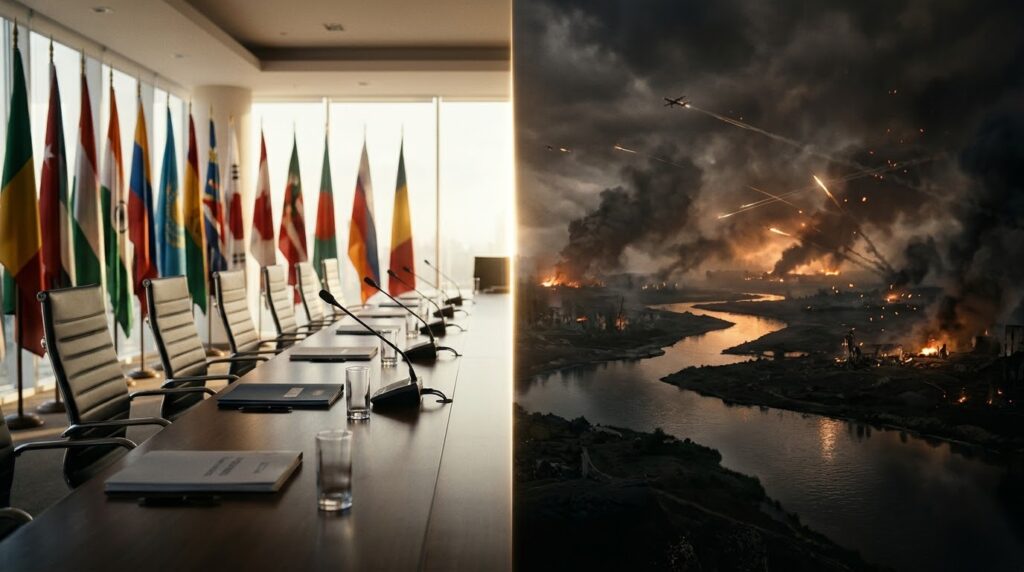
That is the diplomatic reality: the table is set, and the missiles are still flying.
Prophetic Lens: “Peace and Safety” While The Grid Burns
We do not date-set. We do not claim a negotiation equals prophecy fulfilled.
But Scripture gives us a lens for this exact tension:
“For when they shall say, Peace and safety; then sudden destruction cometh upon them, as travail upon a woman with child; and they shall not escape.” — 1 Thessalonians 5:3 (KJV)
That is the Abu Dhabi moment: talk of peace and security guarantees, while 162 drones are in the air and the lights go out in six regions.
And Ezekiel 38 gives us the northern-coalition lens: a great power from the north, allied powers, coming against Israel’s region in the latter days. Ukraine is not Ezekiel 38 itself — but the same great-power logic, the same winter war on energy, the same attempt to redraw borders by force, is shaping the world that Ezekiel describes. For the deeper Ezekiel 38 framework, see 2026 Iran War: Ezekiel 38, Prophecy Blockades, and Jeremiah 49.
Winter is now a weapon. Energy is now a frontline. And “peace talks” no longer mean the war has paused.
For how to read these converging signs without fear or hype, see Bible Prophecy 2026: What the Bible Says About Israel Today and Biblical Signs of the End Times.
Watch, pray, and stay grounded in the Word — not in the headlines alone.
What To Watch Next
- Abu Dhabi Day 2 (Nov 11): Does Moscow soften on Donetsk, or does Kyiv walk away?
- Next overnight wave: Does Russia repeat a 160+ drone wave, or shift to ballistic missiles on bridges?
- Grid restoration: How fast can Ukrenergo restore the six regions — and will the next strike undo it?
- Pokrovsk: Can Ukraine hold the hinge, or does the front bend further west?
We will update this story as the Abu Dhabi talks conclude and the next overnight tally comes in.
Sources: Ukraine Air Force via Ukrinform; Ukrenergo via Reuters; Kyiv Independent; General Staff of the Armed Forces of Ukraine (08:00 Nov 10) via Ukrainska Pravda; Zelenskyy evening address Nov 9; The Hindu on Abu Dhabi talks opening.
#AbuDhabiTalks #UkraineDroneAttack #StandWithUkraine