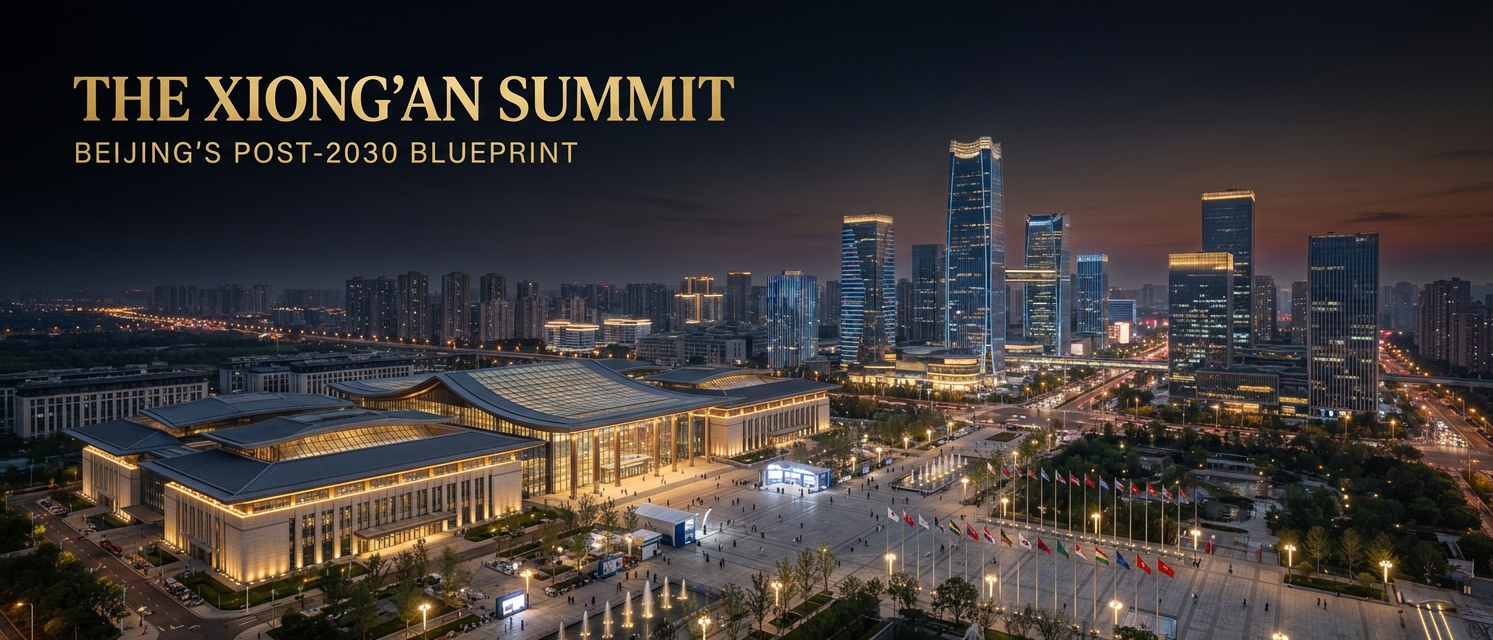
If you spent late October watching U.S. midterm polls, grocery receipts, and the usual cable news shouting matches, you probably missed a remarkably quiet gathering on the other side of the planet. From October 23 to October 25, 2026, Beijing hosted the inaugural China Global Governance Forum inside Xiong’an New Area, a futuristic smart city rising south of the capital. Around 300 to 400 delegates from 97 countries and international organizations walked through glass command centers, sat through 22 panels on artificial intelligence and United Nations reform, and signed off on more than 450 governance proposals. Former World Economic Forum chairman Klaus Schwab took the stage, former German Chancellor Gerhard Schroder sat in the front row, and United Nations Under-Secretary-General for Policy Guy Ryder praised the city’s long-term planning. Yet if you blinked in the Western press, you’d have missed the whole thing.
Friend, I want to make you the same promise I make every time a headline starts making the rounds on social media. We aren’t going to chase panic, and we aren’t going to swallow viral claims whole without checking the receipts. Every number in this report comes straight from primary diplomatic releases, official statistical bureaus, eyewitness dispatches, and live financial records. Where a viral commentary gets the big picture right, I’ll show you the proof. Where it overstates secrecy, misses a date, or declares a powerful institution “dissolved” when it’s actually still hosting meetings in New York, I’ll put an honest Watchman’s Asterisk right next to it so you can stand on solid ground.
Think of this article like checking today’s weather while keeping the big map open on your kitchen table. Today’s weather is a diplomatic summit in Hebei Province, a set of trade deals between Beijing and Ottawa, and a new artificial intelligence governance push. The big map is what Scripture has laid out for centuries on SamuelClark.com regarding global systems, centralized control, and the ultimate return of Jesus Christ. We’ll walk through four verified fronts from the Xiong’an summit, lay them side by side in a clean audit table, step into a clearly labeled Watchman’s Opinion on how Xiong’an’s digital-twin surveillance grid echoes Revelation 13, and close with steady, practical steps for your home and your faith, including the most important turn on the road at SamuelClark.com/salvation.
Front 1: Inside the China Global Governance Forum in Xiong’an
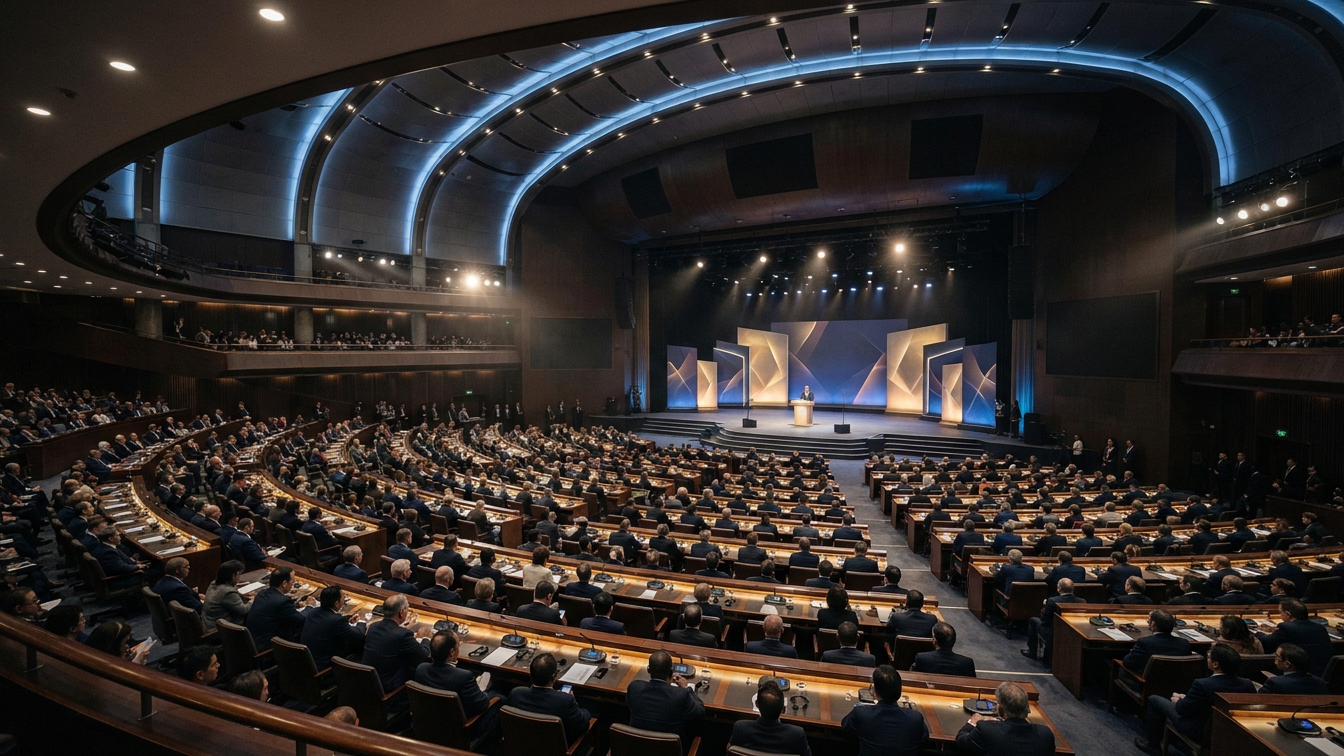
The inaugural 2026 Global Governance Forum took place from October 23 to October 25, 2026, in Xiong’an New Area, Hebei Province. It was the first summit of its kind China has ever hosted. According to People’s Daily and Xinhua, the event was organized by the Chinese People’s Institute of Foreign Affairs (CPIFA), a Party-aligned diplomatic body, under the theme “Rebuilding Confidence and Cooperation: Reforming and Improving Global Governance in a Transforming World.”
President Xi Jinping didn’t attend in person. Instead, he sent a written message read aloud at the opening ceremony by Foreign Minister Wang Yi. As published by the Permanent Mission of the People’s Republic of China to the UN and the Chinese People’s Political Consultative Conference, Xi stated that the world is undergoing accelerated transformation unseen in a century, with growing deficits in peace, development, security, and governance. He called on delegates to implement his Global Governance Initiative (GGI), which he first unveiled at the Shanghai Cooperation Organization summit in Tianjin in September 2025.
Wang Yi then delivered the keynote address, published by the China International Development Cooperation Agency, laying out concrete institutional steps rather than just speeches. Beijing announced the launch of a new Global Governance Research Center tasked with publishing an annual Global Governance Index and policy reports. The forum also unveiled an International Advisory Committee, a Global South Joint Research Network on Economic and Trade Governance, and an International Media Dialogue Mechanism. Over two days of 22 panels and roundtables, participants examined artificial intelligence governance, cyberspace, outer space, the deep sea, polar regions, World Trade Organization reform, and United Nations streamlining.
At the close of the summit on October 25, organizers released the official closing document, “Global Governance: Xiong’an Vision”, along with reporting in Global Times. That date was no accident. October 25, 2026, marked the 55th anniversary of UN General Assembly Resolution 2758 in 1971, which seated Beijing at the United Nations. The Xiong’an Vision declares multilateralism “the only viable way to effectively address the global governance deficit,” urges accelerating the UN 2030 Agenda while drafting a post-2030 global development agenda, and positions the United Nations as the central platform for global AI governance. CPIFA leadership reported that delegates submitted more than 450 governance reform proposals during the three-day event.
Watchman’s Asterisk on “Secrecy”: Viral commentary, including the widely shared Activist Post essay by Brandon Smith, framed Xiong’an as a “secretive summit” hidden from Western eyes. Here is the honest check. The forum wasn’t literally secret. China’s Foreign Ministry and People’s Daily announced it publicly on September 23, 2026, a full month in advance. Chinese state broadcaster CGTN ran a dedicated multimedia special hub. Even Reuters ran two short wire dispatches, an October 16 preview reported via The Standard confirming roughly 180 foreign guests, and an October 23 report carried by Investing.com covering Wang Yi’s deep-sea and outer-space push. A more accurate phrase than “secretive” is asymmetric transparency: loud state-media pageantry paired with unrecorded closed-door roundtables and near-total indifference from major Western broadcast networks distracted by the U.S. midterms.
Front 2: Who Showed Up, Who Stayed Home, and a Major Fact-Check
If you want to know what a conference actually represents, look at the seating chart. Confirmed attendees in Xiong’an included Klaus Schwab (who gave a keynote setting out eight principles for future global governance), former German Chancellor Gerhard Schroder in the front row, New York Times columnist Thomas L. Friedman, Asia Society co-chair John L. Thornton, UN Under-Secretary-General for Policy Guy Ryder, former UNEP head Erik Solheim, and UN High Commissioner for Refugees Barham Salih, who expressed interest in building a close partnership with China under the GGI framework.
Still, an eyewitness on the ground tells a much more sobering story than the hype. Andrea Renda, Director of Research at the Centre for European Policy Studies (CEPS), attended the forum in person and published a candid firsthand account on his Substack on November 8, 2026. Renda noted that roughly 300 participants attended, and he wrote that the plenary lineup “fell short of expectations.” Aside from Wang Yi and Guy Ryder, the room was filled mostly with former UN officials, former presidents and ministers from Global South nations, friendship-association figures, and Schwab. No sitting Western heads of state attended. As Renda put it, it felt like “an international conference where leading Western thinkers and institutions were virtually absent, and perhaps unwanted.”
Watchman’s Asterisk on Klaus Schwab and the Council for Inclusive Capitalism: Two factual corrections matter here if we want to keep our credibility airtight. First, Klaus Schwab isn’t the sitting head of the World Economic Forum; he resigned as WEF chairman in April 2025, so he spoke in Xiong’an as the forum’s founder and former leader. Second, the Activist Post article claimed that Lynn Forester de Rothschild’s Council for Inclusive Capitalism “essentially dissolved.” That claim is false.
Live records from the Council for Inclusive Capitalism show that on November 18, 2026, just eight days ago, the Council announced the next phase of its global initiative on artificial intelligence and the workforce, representing a leadership network spanning 200 million workers across 163 countries. In September 2025, de Rothschild co-hosted a major UN General Assembly and Climate Week roundtable on AI alongside World Bank President Ajay Banga and Bank of America CEO Brian Moynihan, and continued that push in September 2026. The Council didn’t disappear. It lowered its loud pandemic-era branding and pivoted straight into AI governance, which actually makes the convergence around global AI rules more significant, not less.
Front 3: The “Eye of Xiong’an” and China’s Plug-and-Play Smart City

Why did Beijing bypass Shanghai and Beijing’s own diplomatic quarter to bus 300 international delegates out to Xiong’an? Because Xiong’an isn’t just a venue. It’s a physical sales pitch.
In his November 8 Substack dispatch, Andrea Renda described Xiong’an as “three cities in one: underground, street level and the cloud.” Running underneath it all is a live digital twin powered by the city’s supercomputing center, locally known as the “Eye of Xiong’an” or the city’s “brain.” According to Renda’s account of the official tour, the system captures thousands of images per second to monitor emergencies, optimize traffic and logistics, track people’s movements, and intervene when needed. Renda described the atmosphere as “a bit like a golden prison, with Big Brother always watching.” When he tried to ask how data privacy is protected or whether a social credit system runs on top of the grid, the official tour left no room for questions.
Earlier state-media profiles confirm the granularity of that grid. In Xiong’an’s Nanwenying neighborhood, inspected by Xi Jinping in 2023, each of the more than 3,700 households maintains an individual government file dynamically updated every two months. Before delegates ever sat down for panels, organizers toured them through AI smart-city hubs, robot-dog demonstrations, and green-tech zones, then asked them to sign the Xiong’an Vision affirming that Xiong’an’s planning principles hold “important reference value for reforming and improving global governance.”
Even more telling is what Renda learned about Beijing’s next export model for the Global South, a region representing roughly 85% of the world’s population and around 60% of global economic output at purchasing power parity. China is packaging logistics, water, energy, telecoms, data centers, artificial intelligence, and workforce training into a single integrated “plug-and-play” system as a sequel to the Belt and Road Initiative and Digital Silk Road. Once a developing country buys and trains its staff on that integrated Chinese stack, switching to any Western provider becomes nearly impossible.
Watchman’s Asterisk on the “Potemkin City” Reality: Before anyone thinks Xiong’an is a flawless sci-fi empire, look at the occupancy numbers. Official figures cite 1.4 million residents, yet that counts the three existing rural counties absorbed into the administrative zone. According to Renda’s on-the-ground reporting, only about 170,000 residents have actually relocated into the new city against a long-term target of 5.2 million. Most state firms and workers who moved there were pushed by government directives. Critics and urban scholars point out that the city sits on a low-lying floodplain, required demolishing tens of thousands of villagers’ homes, and still struggles with low organic demand. Beijing is pitching a glossy prototype to the world while its own citizens remain reluctant to move in.
Front 4: Trade Realignment, Reserve Currencies, and the Consumer Math
The Xiong’an summit also sits inside a real tug-of-war over trade, tariffs, and the U.S. dollar. In January 2026, Canadian Prime Minister Mark Carney visited Beijing, the first trip by a Canadian leader in nearly a decade, and signed a “cars-for-canola” strategic partnership. As reported by CBC News, Ottawa lowered tariffs on up to 49,000 Chinese electric vehicles to 6.1% in exchange for Beijing slashing duties on Canadian canola, lobster, crab, and peas. Then in November 2026 at APEC in Shenzhen, Ottawa and Beijing extended and expanded the pact to cover $280 million in Canadian pork and seafood plus an AI partnership.
Yet the raw trade math shows how hard it is to walk away from America. Canada-China two-way trade sits near $98 billion, while Canada-U.S. trade stands near $872 billion, with roughly 70% of Canadian exports still heading south. Europe faces an even sharper bind. With the EU’s trade deficit with China hovering near $400 billion and European green-energy supply chains heavily dependent on Chinese solar panels and batteries, analysts at Natixis CIB have warned Europe that copying Canada’s commodity-for-tech deal risks hollowing out European industry.
The same gap shows up in global currency ambitions. China didn’t suddenly start eyeing an alternative to the U.S. dollar in 2016 when the International Monetary Fund added the renminbi to its Special Drawing Rights (SDR) basket. As documented by the Peterson Institute for International Economics, People’s Bank of China governor Zhou Xiaochuan published his landmark essay “Reform the International Monetary System” back in March 2009, explicitly calling for an international reserve currency “disconnected from individual nations” built around IMF SDRs. Seventeen years later, SDRs still represent only about 4% of global reserves, and replacing the dollar would require trillions in new issuance plus turning the IMF into a world central bank.
Finally, check the consumer spending and wage math. Can China and Europe simply replace the American consumer? World Bank nominal household consumption data confirms that the United States accounts for 29.39% of global final household consumption (roughly 67.9% of U.S. GDP), compared to China’s 19.74% (just 40.0% of China’s GDP). Meanwhile, World Data Lab reported in November 2026 that America’s share peaked at 31.8% in 2024 and is forecast to ease gently toward 29.0% by 2036. Why can’t Chinese households absorb all of the world’s exports yet? Look at the National Bureau of Statistics of China wage release from May 2026 (covering full-year 2025): average urban private-sector wages sit at 71,590 RMB (about $9,961 per year), while urban non-private (state and large corporate) wages range from 125,819 to 129,447 RMB (about $18,000 to $19,300 per year), and rural workers earn far less.
Watchman’s Asterisk on the Economic Math: The viral claim that U.S. shoppers make up roughly 30% of global consumer spending is verified, and the $10,000 private-sector wage figure in China matches official Beijing statistics closely (though the state-sector figure is actually a bit higher than the $16,000 cited in commentary). The takeaway is plain: Beijing is building the political and digital scaffolding for a post-dollar, post-Western order, even though the underlying consumer math still leans heavily on the United States.
Summary Audit Table: Four Fronts from the Xiong’an Summit
| Front | Verified Primary Figures | Risk / Timeline Window | Watchman’s Asterisk & Primary Source |
|---|---|---|---|
| 1. Xiong’an Global Governance Forum | Oct 23-25, 2026; ~300-400 delegates from 97 countries; 22 panels; 450+ proposals; new Global Governance Research Center & annual Index | Accelerating UN 2030 Agenda + drafting post-2030 global agenda | Not literally secret (announced Sept 23), but asymmetric transparency with unrecorded roundtables (CPIFA, Xinhua, Reuters via Investing.com) |
| 2. Attendees & Institutional Pivot | Klaus Schwab, Gerhard Schroder, Guy Ryder (UN), Thomas Friedman, Barham Salih; Council for Inclusive Capitalism still active (200M workers across 163 countries) | Active 2025-2026 pivot into UN and corporate AI governance | No sitting Western heads of state attended; Schwab resigned as WEF chair in April 2025; Council for Inclusive Capitalism did NOT dissolve (Andrea Renda Substack, Council for Inclusive Capitalism) |
| 3. “Eye of Xiong’an” Surveillance Grid | Live digital twin capturing thousands of images/sec; 3,700+ Nanwenying households with bi-monthly updated files; “plug-and-play” Global South tech stack | Ongoing 2026-2035 Belt & Road / Digital Silk Road export phase | Only ~170,000 relocated residents out of 5.2 million target; built on a floodplain with low organic demand (Andrea Renda Substack) |
| 4. Trade, SDRs & Consumer Math | U.S. 29.39% vs. China 19.74% global household consumption; Canada EV tariff cut to 6.1% (49,000 quota); China urban private wages ~$9,961/yr | 2026-2036 gradual trade realignment and AI/currency bloc building | Canada-U.S. trade ($872B) dwarfs Canada-China ($98B); SDRs remain ~4% of reserves since China’s 2009 push (PM of Canada, China NBS, IMF) |

Watchman’s Opinion: Xiong’an, Revelation 13, and the Architecture of Control
Editor’s Disclosure: The section below reflects Samuel Clark’s personal commentary and biblical perspective as a watchman, separate from the verified hard-news reporting above.
When I first read the eyewitness description of Xiong’an’s supercomputing “Eye” running a live digital twin of an entire city, capturing thousands of images every second and updating household dossiers every two months, I stopped and just said, “Wow.”
I want to be very careful here, because sensationalism ruins biblical credibility. Xiong’an is not the Mark of the Beast. A diplomatic conference in Hebei Province isn’t the Antichrist taking his throne tomorrow morning. History is full of empires and committees that dreamed of centralized control and tripped over their own clay feet. Look at Xiong’an itself: a showcase city built on a floodplain where 170,000 people live in a grid designed for 5.2 million. Geopolitics is messy, nations compete for self-interest, and Washington, Brussels, and Beijing aren’t one big happy club.
Still, you don’t have to stretch Scripture an inch to see the direction of travel. For nearly two thousand years, skeptics laughed at Revelation 13:16-17 (KJV):”And he causeth all, both small and great, rich and poor, free and bond, to receive a mark in their right hand, or in their foreheads: And that no man might buy or sell, save he that had the mark, or the name of the beast, or the number of his name.”
The Apostle Paul wrote in Romans 8:22 (KJV), “For we know that the whole creation groaneth and travaileth in pain together until now.” Jesus described this exact convergence of global anxiety and systemic shaking in Matthew 24:7-8 (KJV) (“For nation shall rise against nation, and kingdom against kingdom: and there shall be famines, and pestilences, and earthquakes, in divers places. All these are the beginning of sorrows”) and Luke 21:25-26 (KJV) (“upon the earth distress of nations, with perplexity; the sea and the waves roaring; Men’s hearts failing them for fear, and for looking after those things which are coming on the earth”). When leaders openly talk about a “global governance deficit,” push global AI oversight through the United Nations, and market turnkey surveillance infrastructure to 85% of the world’s population, they aren’t inventing the Bible’s timeline. They’re proving how soberly accurate the Bible has always been.
Calm Hands, a Settled Heart

Whenever we look at surveillance grids, shifting trade blocs, and post-2030 blueprints, the enemy would love nothing more than to push you into fear, anger, or doomscrolling. Don’t take the bait. Remember who sits on the throne. Beijing doesn’t hold the calendar. Geneva doesn’t hold the keys. The Lord God Almighty does.
Scripture never tells believers to panic, and it never tells us to stick our heads in the sand either. Proverbs 22:3 (KJV) gives us the steady middle lane: “A prudent man foreseeth the evil, and hideth himself: but the simple pass on, and are punished.” That looks like calm, ordinary household stewardship:
- Keep a sensible buffer of pantry staples, clean water, and basic household supplies on hand, plus a little extra set aside so you can bless a neighbor if supply chains hiccup.
- Hold some physical cash alongside your digital accounts so an outage or payment freeze doesn’t catch your family flat-footed.
- Reduce unnecessary debt and keep your monthly expenses lean so economic shifts or tariff battles don’t own your peace of mind.
- Guard your digital habits and keep your discernment sharp by checking primary sources instead of letting algorithms wind up your blood pressure.
Above every practical step stands our true anchor in Matthew 6:33 (KJV): “But seek ye first the kingdom of God, and his righteousness; and all these things shall be added unto you.” As a Berean who holds to the pre-tribulation Rapture, I don’t watch these warning lights waiting for the Antichrist; I watch them waiting for Jesus Christ, remembering Luke 21:28 (KJV): “And when these things begin to come to pass, then look up, and lift up your heads; for your redemption draweth nigh.” Every human governance scheme has an expiration date, because Daniel 2:44 (KJV) promises, “And in the days of these kings shall the God of heaven set up a kingdom, which shall never be destroyed: and the kingdom shall not be left to other people, but it shall break in pieces and consume all these kingdoms, and it shall stand for ever.”
If you’ve never looked closely at the mathematical track record of fulfilled Bible prophecy, I invite you to lay the evidence on the workbench over at SamuelClark.com. And if all of this shaking makes you wonder where you truly stand with God, please don’t put that off for another week. John 3:16 (KJV) still holds: “For God so loved the world, that he gave his only begotten Son, that whosoever believeth in him should not perish, but have everlasting life.” You can read the plain, clear Gospel and settle your eternity today at SamuelClark.com/salvation.
Sources
- Activist Post / Alt-Market (Brandon Smith, Nov 25, 2026): The Globalists Just Came Out Of Hiding For A Secretive Summit In China
- Chinese People’s Institute of Foreign Affairs (CPIFA, Oct 25, 2026): Global Governance: Xiong’an Vision (Full Text)
- China International Development Cooperation Agency / MFA (Oct 23, 2026): Wang Yi Keynote at the 2026 Global Governance Forum
- Permanent Mission of the PRC to the UN (Oct 25, 2026): Xi Jinping Sends Message to 2026 Global Governance Forum (Xiong’an)
- Chinese People’s Political Consultative Conference (Oct 23, 2026): Xi sends message to 2026 Global Governance Forum (Xiong’an)
- Xinhua News Agency (Oct 24, 2026): China hosts global governance forum to pool wisdom and efforts
- Global Times (Oct 25, 2026): Global Governance Forum concludes in Xiong’an New Area
- People’s Daily (Sept 24, 2026): 2026 Global Governance Forum (Xiong’an) to be held in late October
- CGTN (Oct 2026): 2026 Global Governance Forum (Xiong’an) Special Hub
- Reuters via The Standard HK (Oct 16, 2026): China targets practical action from global governance forum next week
- Reuters via Investing.com (Oct 23, 2026): China’s foreign minister urges stronger governance of deep sea and outer space
- Andrea Renda, Director of Research at CEPS (Substack, Nov 8, 2026): A trip to Xiong’an and China’s grip on the Global South
- Council for Inclusive Capitalism (Nov 18, 2026): The Council for Inclusive Capitalism Convenes Leaders to Put Workers at the Center of the AI Transition
- Council for Inclusive Capitalism (Sept 10, 2026): AI and the Workforce: An Inclusive Capitalism Perspective
- Council for Inclusive Capitalism (Oct 24, 2025): Why AI is the biggest test yet for Inclusive Capitalism
- Prime Minister of Canada (Jan 16, 2026): Prime Minister Carney forges new strategic partnership with the People’s Republic of China
- CBC News (Jan 16, 2026): Here’s what you need to know about the Canada-China deal on EVs and canola
- CBC News (Nov 17, 2026): Canada has extended and expanded its deal with China
- Natixis CIB (Nov 12, 2026): Infrastructure: Bigger Deals, Higher Stakes
- International Monetary Fund (Sept 30, 2016): IMF Launches New SDR Basket Including Chinese Renminbi
- Peterson Institute for International Economics (Aug 5, 2011): A Currency System for a Multi-Polar World (Zhou Xiaochuan 2009 SDR Essay)
- World Data Lab (Nov 19, 2026): World Consumer Outlook
- National Bureau of Statistics of China (May 16, 2026): Average Annual Wages of Employees in Urban Units in 2025
Editor’s note, KJV final read: All Scripture quotations in this report have been verified verbatim against the King James Version (KJV): Revelation 13:16-17, Romans 8:22, Matthew 24:7-8, Luke 21:25-26, Proverbs 22:3, Matthew 6:33, Luke 21:28, Daniel 2:44, and John 3:16.