The Fingerprint in the Dirt: 5 Reasons the World’s Most Scrutinized Book Still Stands
A watchman doesn’t ask you to believe on a feeling. He points at the evidence and lets you look for yourself.
The modern objection is always the same: “Who says this is true?” It’s a fair question, and I’ve stopped being surprised when skeptics ask it — most of them have never actually been handed the data, only the dismissal. So let’s hand them the data.
I’ve spent time in the archaeology, the manuscript history, and the math behind fulfilled prophecy — much of it cross-referenced against Mike Winger’s excellent “Evidence for the Bible” video series and a 2024 academic paper out of Taylor University’s mathematics conference. None of this is my original research. It’s a synthesis, and I’ll cite it plainly as we go, because a watchman who hides his sources is not worth listening to.
Here are five lines of evidence — statistical, archaeological, engineering, medical, and manuscript — that push the Bible’s claim to divine inspiration past “interesting” and into “hard to explain away.”
1. The Silver Dollar Problem: When Chance Runs Out of Room
Mathematicians have tried for seventy years to put a number on the odds of one man fulfilling the messianic prophecies by accident. The most rigorous recent attempt comes from a 2024 conference paper, “Examining the Probability of Christ Fulfilling Prophecies”, published through Taylor University’s Association of Christians in the Mathematical Sciences (ACMS) and authored by Will Best and Robin Lovgren of Belmont University.
Best and Lovgren didn’t take the lazy route of treating each prophecy as independent. They used conditional probability — accounting for the fact that a man who is “marred” is already more likely to be “from a poor background,” and adjusting the math downward to be fair to the skeptic. Even after stacking the deck against themselves, they calculated the odds of one person fulfilling eight specific markers from Isaiah 53 — high and lifted up, marred beyond recognition, from a poor background, despised and rejected, crucified, silent at trial, buried in a rich man’s tomb, and innocent yet put to death — at 1 in 2.94 × 10¹⁴.
I’ve already walked through the wider Stoner tradition and the full 300+ prophecy case on the site — see Every Messianic Prophecy Jesus Fulfilled if you want the complete tour with the honest objections named and answered. This paper narrows the lens to just eight and still lands in the same absurd territory: to visualize it, cover the entire state of California — 163,695 square miles — in a single layer of Oreo cookies, then add enough for a second layer over 7% of the state. Mark the underside of exactly one cookie. A blindfolded man picking that cookie on his first try has the same odds as one man accidentally fulfilling those eight prophecies.
I’ll say what I said last time: treat this as the feel of the size of the claim, not a courtroom-grade proof. Best and Lovgren say the same thing in their own conclusion — the estimate is conservative and the assumptions are debatable. The honest point still stands: chance doesn’t produce numbers like this.
2. Broken Knuckles in Babylon: The King Critics Said Never Existed
For over a century, skeptics used the Book of Daniel as Exhibit A against biblical reliability. Daniel 5 names Belshazzar as the last king of Babylon — but ancient king lists and the Greek historian Herodotus named Nabonidus as the last king. Belshazzar’s name appeared nowhere in the historical record. Critics called it a second-century forgery with bad history baked in, and for a long time that looked like a fair hit.
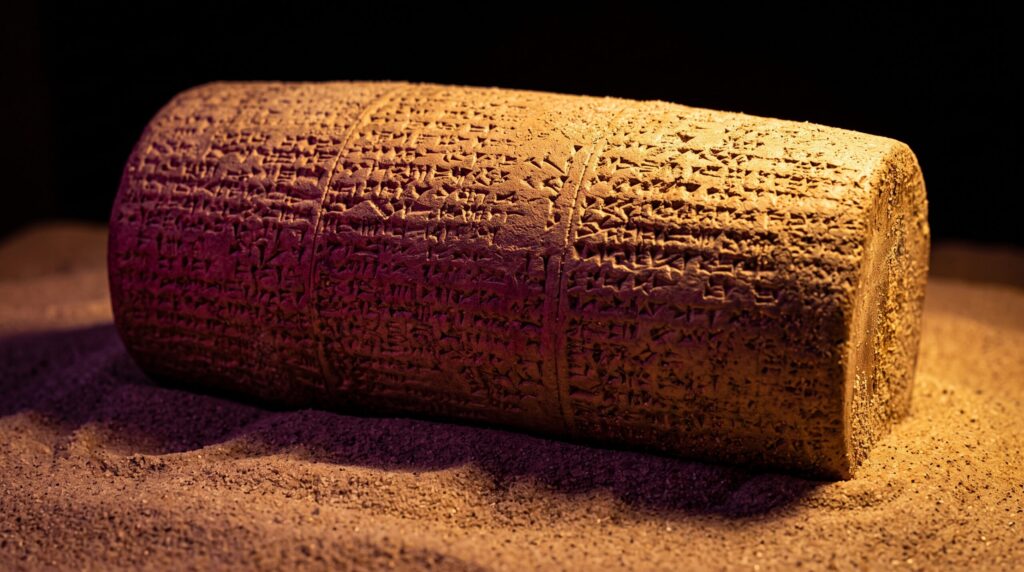
Then in 1854, British consul John Taylor uncovered the Nabonidus Cylinder — a clay inscription contemporary with the fall of Babylon. It contains Nabonidus’s own prayer: “May it be that I, Nabonidus, king of Babylon, never fail you; and may my firstborn, Belshazzar, worship you with all his heart.” Further study showed Nabonidus spent years away from the capital, leaving Belshazzar as co-regent in his place — which is exactly why Belshazzar, in Daniel 5, could only offer to make Daniel “third ruler” in the kingdom. Nabonidus held first place. Belshazzar held second. Third was the highest office Belshazzar had the authority to give. That’s not a detail a second-century forger invents by accident — it’s the kind of insider knowledge only a contemporary of the events would know.
Mike Winger covers this case in detail in Defending Daniel — Evidence for the Bible pt. 4, and it’s worth the watch if you want the full chain of custody on this one. The critics walked away with broken knuckles. The text was vindicated by the dirt.
3. Scraped to the Rock: The Impossible Engineering of Tyre
In Ezekiel 26, the prophet made a specific, almost absurd prediction against Tyre, the wealthiest trade city of its age: the stones, timbers, and even the dust of the city would be thrown into the sea, and the site would become bare rock — good for nothing but drying fishing nets.
At the time it was written, this made no sense. Tyre’s mainland was formidable. But in 332 BC, Alexander the Great arrived to find the population had retreated to an island fortress half a mile offshore. Alexander had no navy. So his engineers did something no one predicted a conqueror would ever need to do: they scraped the ruins of mainland Tyre — literally its stones, its timber, its dust — into the Mediterranean, building a causeway to the island out of the wreckage of the city itself.

Ezekiel’s prophecy anticipated a specific engineering solution roughly 250 years before Alexander stumbled into a naval problem that forced him to invent it. Today the mainland site is still bare rock, and fishermen still dry their nets there — you can see the full breakdown in The Destruction of Tyre — Evidence for the Bible pt. 2.
4. The Weight of the Cross: What the Prophets Couldn’t Have Guessed
Psalm 22 and Isaiah 53 describe an execution matching Roman crucifixion — a method the Persians hadn’t invented yet and the Romans wouldn’t adopt for centuries after these texts were written. I want to be careful here, more careful than the popular version of this argument usually is: the text doesn’t describe crucifixion’s respiratory mechanics in clinical terms. Isaiah 53:5 says the Messiah was “crushed for our iniquities” — and it’s a legitimate, and striking, inference that this language lines up with what we now understand about how crucifixion actually kills a person: the body’s weight pulls the diaphragm down, the victim must push against the nailed feet just to exhale, and death eventually comes by asphyxiation as the lungs are quite literally crushed under the body’s own weight. That’s my read on the connection, not a claim the text spells out for you — and I’d rather tell you that plainly than dress it up as more precise than it is.
What’s harder to wave away is Isaiah 53:9 — the prediction that the Messiah would be buried “with the rich in his death.” Roman practice for crucified criminals was decay on the cross or disposal in a common pit. It took a wealthy man, Joseph of Arimathea, choosing personal risk to claim the body, to fulfill a detail written roughly 700 years earlier.
“But he was pierced for our transgressions; he was crushed for our iniquities; upon him was the chastisement that brought us peace, and with his wounds we are healed.” — Isaiah 53:5
5. The Hundred-Year Buffer: What the Dead Sea Scrolls Prove
The most common rebuttal to fulfilled prophecy is the “written after the fact” charge — that these texts were composed once the events had already happened. The 1947 discovery of the Dead Sea Scrolls closed that door.
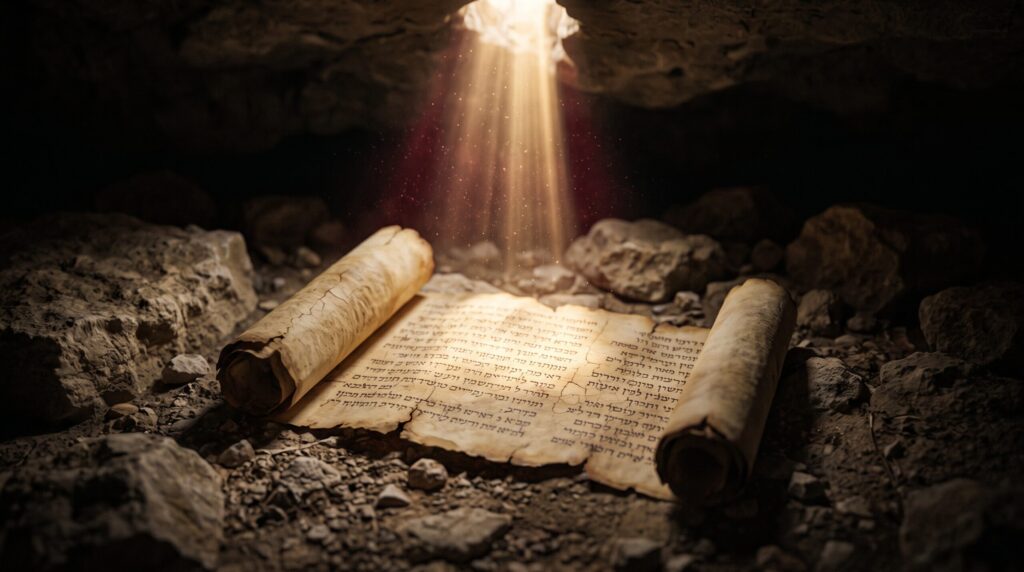
The Great Isaiah Scroll (1QIsaᵃ), dated to roughly 125 BC, is a physical time capsule proving the messianic language of Isaiah 53 existed in writing more than a century before Christ was born. When scholars compared 1QIsaᵃ to the Masoretic Text used in modern Bibles — copied roughly a thousand years later — they found something remarkable: roughly 95% textual agreement, with the variants overwhelmingly limited to spelling and minor scribal style rather than substance. That’s not “identical in every letter” — there are a few thousand small variants across the whole scroll — but it is a level of transmission fidelity that has no real parallel in ancient literature.
What This Adds Up To
None of this is a stack of coincidences. It’s a probability that beggars belief, an archaeological record that vindicated a text critics had already buried, an engineering feat predicted before it was needed, a medical reality embedded in poetic language centuries early, and a manuscript trail that closes off the easiest objection entirely. Taken together, this isn’t evidence you weigh once and set down. It’s evidence that keeps asking you a question.
If what God said about the past checked out with this much precision — the King, the co-regent, the causeway, the cross, the century-old scroll — the honest next question isn’t “was the Bible right about the past?” It’s “what did He say about what’s still coming, and about you?”
If you want the fuller case for the Messiah specifically, start with Every Messianic Prophecy Jesus Fulfilled, and for the wider case that fulfilled prophecy is the foundation for everything we watch in current events, see the [LINK TO: Prophecy Evidence Hub — once published].
And if the evidence has done its work and you’re ready to settle the only question that actually matters, that page is here: [LINK TO: The Free Gift of Salvation].
Related reading: Biblical Signs of the End Times.
Subscribe to Converging Times
Stay alert. Keep watch. Receive prophetic updates and world event analysis delivered directly to your inbox.
Keep Watch
— Samuel Clark
Sources
- Will Best and Robin Lovgren, “Examining the Probability of Christ Fulfilling Prophecies,” ACMS Conference Proceedings, Taylor University, 2024. (Authors affiliated with Belmont University.)
- Peter W. Stoner, Science Speaks (Moody Press). Free online edition.
- Mike Winger, “Defending Daniel — Evidence for the Bible pt. 4.”
- Mike Winger, “The Destruction of Tyre — Evidence for the Bible pt. 2.”
- “Cylinders of Nabonidus.” Wikipedia; Armstrong Institute, “Biblical Belshazzar Revealed.”
- Dead Sea Scrolls, 1QIsaᵃ (Great Isaiah Scroll). Leon Levy Dead Sea Scrolls Digital Library.
- The Holy Bible, King James Version — all Scripture quotations. Read KJV online.

